An AI data strategy is a plan for collecting, organizing, governing, and delivering the data that AI workloads need. It aligns data availability, quality, governance, and discoverability so models and applications can operate reliably at scale while preserving the documentation, controls, and auditability required in enterprise environments.
Models, compute, and use cases are often available before the underlying data is ready. A coherent strategy prevents fragmented data work from becoming the constraint on production AI. The video above walks through the core ideas.
What is an AI data strategy?
An AI data strategy defines how an organization structures and manages data assets for model development and production AI systems. It connects technical data architecture with operational, security, and governance requirements.
A complete strategy addresses four interdependent foundations:
- Availability: The right data must reach training pipelines and running AI applications when they need it.
- Quality: Data must be monitored for missing, inconsistent, inaccurate, or biased content.
- Governance: Teams must document, version, control, and audit the data behind AI decisions.
- Discoverability: Builders must be able to find datasets, understand their provenance, and judge whether they fit a use case.
These foundations cannot be managed in isolation. Discoverable but low-quality data remains unsafe to use, while governed data that cannot be accessed with the required freshness cannot support the workload.
How should data support training and inference?
Training and inference require different access patterns, interfaces, and freshness levels. Infrastructure designed for one does not automatically serve the other well.
Model development, training, and evaluation may process large historical datasets repeatedly. Teams need reproducible snapshots, documented transformations, and enough context to understand exactly which data produced a model version.
Inference systems consume data while applications are running. Depending on the use case, they may need recent transactions, documents, vector search results, operational state, or streaming events. This path must balance freshness and latency with identity, policy, and security boundaries.
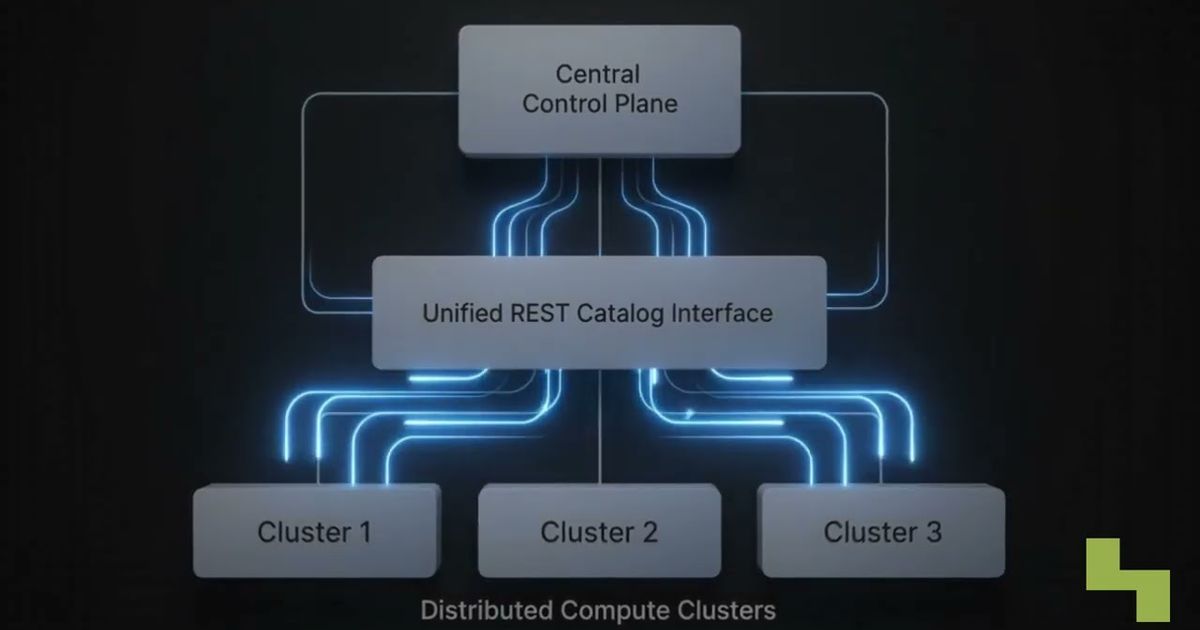
A practical architecture therefore separates concerns while preserving traceability between them. It should identify which data is required, how current it must be, which interface serves it, and who or what may access it.

How do quality and governance make AI reliable?
Data quality reduces preventable model errors, while governance makes AI behavior explainable and correctable. Both must begin before deployment rather than being added after a problem appears.
Incomplete, inconsistent, or biased training data can encode those problems into model outputs. Correcting the source only after training may require rebuilding datasets, repeating evaluations, and retraining the model. Systematic monitoring at ingestion and transformation points helps teams identify issues closer to their origin; these AI data quality practices should include clear ownership and validation rules.
Governance establishes the evidence needed to investigate an AI result. Teams should know which dataset and version were used, where the data came from, how it changed, and which policies applied. This is especially important when AI affects people through credit, health care, hiring, or operational decisions.
Governance is therefore more than a compliance checkpoint. Effective AI data governance combines documentation, versioning, access controls, lineage, and audit records so organizations can explain decisions and correct their underlying data or processes.
How can teams make AI data discoverable?
Data discoverability helps AI teams find relevant assets and determine whether they are suitable for a specific workload. It requires more than a searchable list of dataset names.
Useful discovery information includes provenance, ownership, definitions, update frequency, quality status, access conditions, and intended uses. Feature definitions and transformations should also be visible so separate teams do not create conflicting versions of the same concept.
A discoverability process should help teams:
- Search shared data assets before creating new ones.
- Trace data back to its source and transformations.
- Assess quality, freshness, scope, and permitted use.
- Identify duplicate datasets or inconsistent feature definitions.
Without this context, teams can train models on the wrong data even when technically valid datasets are available. Discoverability connects availability to responsible selection, making it a core part of the wider strategy.

Key takeaways
- An AI data strategy coordinates availability, quality, governance, and discoverability as one system.
- Training and inference need different data access patterns and freshness levels.
- Quality monitoring should begin at the source to prevent problems from propagating into models.
- Governance makes the data behind AI decisions documented, auditable, explainable, and correctable.
- Discoverability helps teams avoid duplicate assets, conflicting definitions, and unsuitable training data.
How Hyperlake helps
Hyperlake lets teams assemble data and knowledge services, model services, applications, policies, and monitoring in infrastructure they or their clients control. Its modular architecture can combine workload-appropriate data engines with authenticated services, scoped identity, OPA policy decisions, enforcement, logging, lineage, and lifecycle controls; specific engines and procedures depend on the deployment. To discuss an AI data foundation for your environment, talk to our team.
Frequently asked questions
What data should an organization prioritize first for AI?
Start with data tied to a defined AI workload rather than attempting to prepare every enterprise dataset. Identify the inputs needed for training, evaluation, grounding, and inference, then assess their ownership, quality, freshness, provenance, access requirements, and permitted uses. This creates a manageable foundation that can expand as additional workloads become concrete.
Can the same data platform serve both model training and inference?
A shared platform can support both, but the serving paths may need different storage engines, interfaces, scaling behavior, and controls. Training often emphasizes large, reproducible historical datasets, while inference may require low-latency access to current operational context. The strategy should preserve common governance and lineage without forcing every workload through one technical pattern.
Why does data provenance matter when an AI output is wrong?
Provenance shows where the data originated, how it was transformed, and which version reached the model or application. When an output is questioned, that record helps teams determine whether the issue came from the source, a transformation, an outdated snapshot, or inappropriate use. It makes investigation and correction practical rather than speculative.