Data infrastructure for physical AI and robotics in 2026 is a hybrid environment designed to ingest high-frequency, multi-modal telemetry from the edge, govern petabyte-scale simulation lakes, and orchestrate massive GPU clusters for reinforcement learning and transformer-based model training. Unlike traditional enterprise software, which primarily handles asynchronous text or tabular records, physical AI requires infrastructure that can maintain strict temporal synchronization across video streams, LiDAR point clouds, and proprioceptive sensor data while securely managing the lifecycle of both real-world and synthetically generated datasets.
(Disclosure: We make Hyperlake, the sovereign AI operating platform. We enable enterprise teams to assemble, deploy, and govern the data, models, and tools behind physical AI in their own environments. This article presents a proposed reference architecture; it does not report a tested deployment, benchmark or validated integration.)
Why does physical AI break traditional data architectures?
Most enterprise data architectures were built to process structured transactions, log files, or text documents. They expect discrete events that can be easily parsed into rows and columns or indexed as JSON objects. Physical AI workloads operate on an entirely different paradigm.
Robots and autonomous systems generate continuous, high-bandwidth streams of multimodal data. A single robotic arm or autonomous mobile robot (AMR) might simultaneously stream 4K video, depth maps, joint torque measurements, and audio. As IBM has noted regarding the data gap holding back robotics, managing the sheer volume and complexity of this data is a primary bottleneck for scaling physical AI.
Traditional IT architectures attempt to split these data types into separate silos, sending video to simple object storage and telemetry to a time-series database. However, in physical AI, the value of the data lies in its synchronization. If a robot drops an object, the training model needs the exact frame of video, the precise torque spike in the gripper, and the spatial coordinates aligned to the millisecond to understand the failure. When traditional pipelines separate this data, rebuilding the synchronized state for model training becomes computationally expensive and highly error-prone. Furthermore, storing these massive datasets requires an architecture that can seamlessly bridge raw object storage with high-performance query engines, which is why teams are increasingly adopting modernized storage layers (see our guide on data lakehouse architecture explained: the four layers that make it work).
What are the core components of a 2026 physical AI data stack?
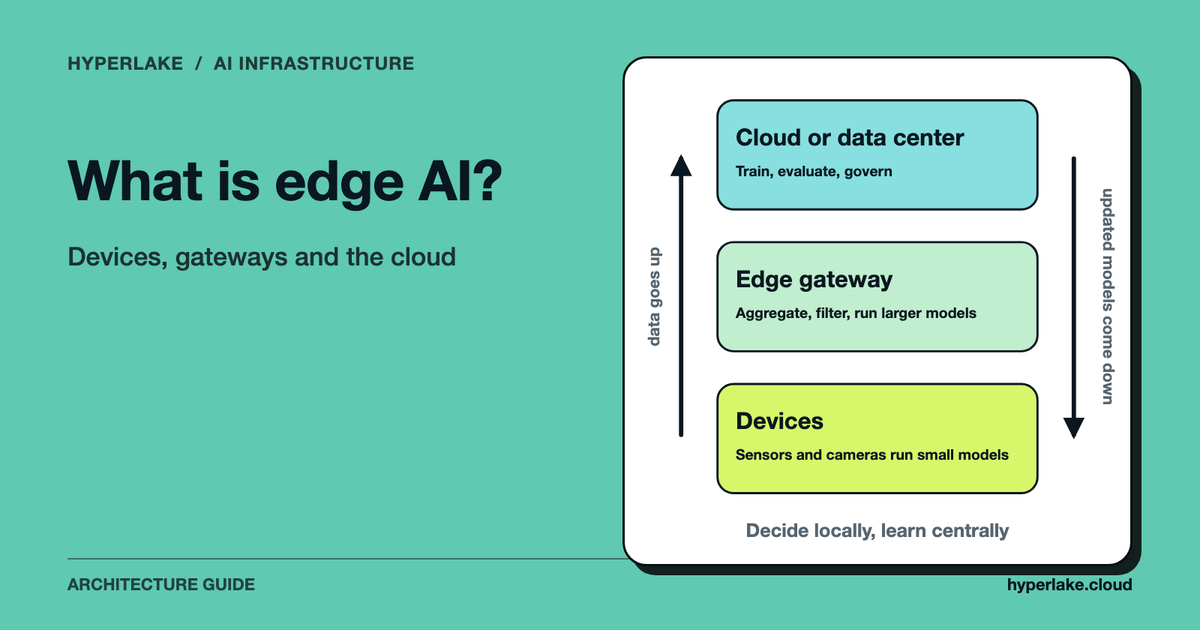
The infrastructure powering modern robotics and physical AI companies generally standardizes around four core pillars: edge ingestion, scalable data lakehouses, simulation environments, and training orchestration.
1. Edge Ingestion and Telemetry Formatting
ROS 2 supports recording timestamped sensor messages through rosbag2. MCAP is one supported storage format and can hold heterogeneous timestamped streams in one file. A recording format does not synchronize sensor clocks or establish calibration; validate timestamps, clock relationships and recording completeness on the selected device.
2. Storage and the Open Data Lakehouse
Once data is offloaded from the physical device, it must be stored in a way that is accessible for both immediate debugging and long-term machine learning. Massive object storage systems (like Amazon S3, Google Cloud Storage, Azure Blob Storage, or self-hosted solutions like MinIO and Ceph) act as the foundational layer. On top of this, open table formats such as Apache Iceberg and columnar formats like Apache Parquet are used to organize metadata, enabling query engines like Trino to efficiently search petabytes of telemetry without moving the underlying files.
3. Simulation and Synthetic Data Generation
Because collecting edge-case data in the real world is slow, dangerous, and expensive, physical AI relies heavily on synthetic data. Platforms like NVIDIA Omniverse, Isaac Sim, and Isaac Lab allow teams to create simulated representations of robots and their environments. Vendor claims often suggest that synthetic data can entirely bridge the training gap; however, independent validation routinely shows that synthetic data alone does not guarantee real-world reliability. Models trained heavily in simulation require rigorous physical domain adaptation.
4. Training, Orchestration, and Serving
Model development for physical AI relies on frameworks like PyTorch and JAX, orchestrated across GPU clusters. GPU clusters need scheduling suited to their workload and infrastructure; Kubernetes with a supported scheduler is one option. Tools like Run:ai or NVIDIA OSMO help queue and route training jobs, while serving layers like KServe deploy the resulting models back to the cloud or edge.
How do you build a reference architecture for robotics data?
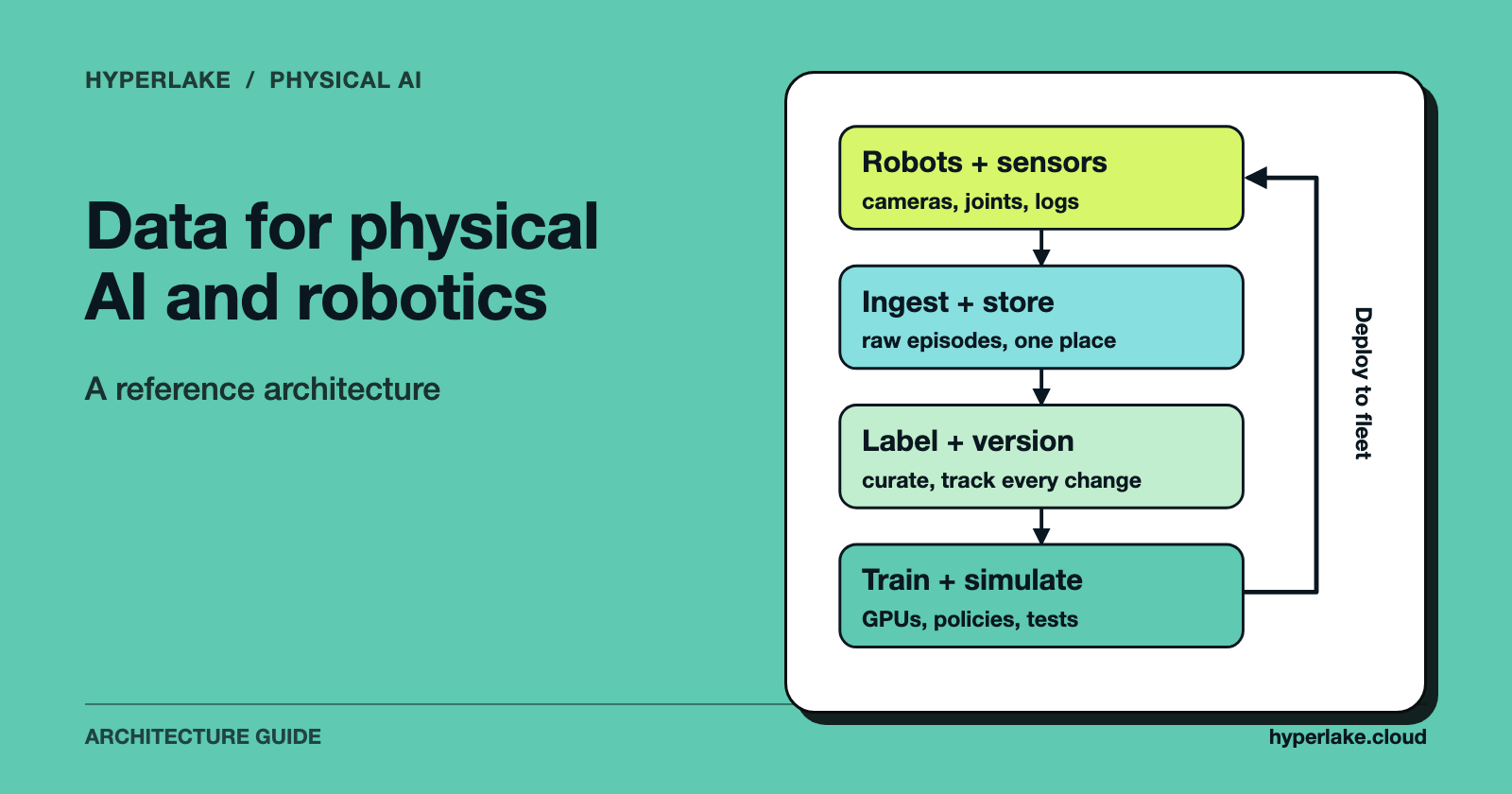
To move from a robotics demo to a repeatable development environment, teams need a unified approach to these components. Below is a proposed 2026 physical AI reference architecture for evaluating a proposed deployment.
(Note: This is a proposed architecture layout; specific component selection and performance tuning will depend heavily on the distinct hardware morphology and scale of the deployment).
- The Ingestion Gateway: Edge devices upload MCAP files and telemetry to an ingestion API governed by strict identity access protocols.
- The Sovereign Data Lake: Files land in customer-owned object storage. Metadata is automatically extracted and registered in an Apache Iceberg catalog, making the synchronized data searchable.
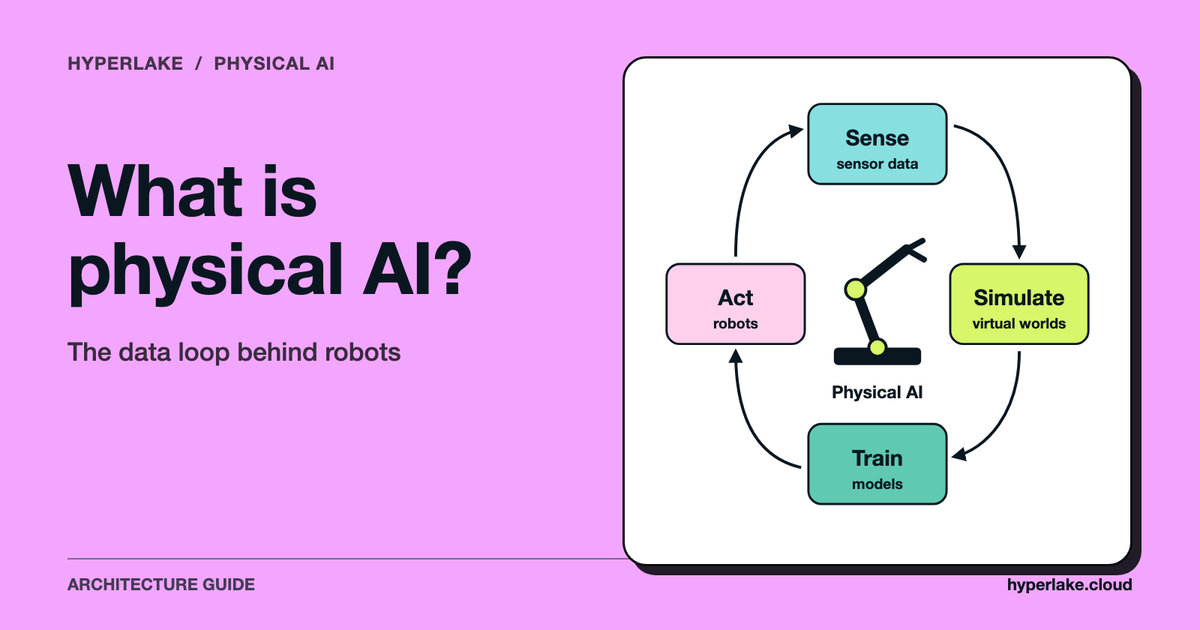
- The Simulation Loop: When edge cases are identified (e.g., a robot failing to grasp a reflective object), engineers trigger simulation workloads in NVIDIA Omniverse. The environment generates thousands of synthetic variations of the failure state.
- The Training Pipeline: Orchestrators spin up GPU resources, pulling both the real-world MCAP data and the synthetic Omniverse data into a PyTorch training loop.
- The Model Registry and Deployment: The updated model is evaluated, registered, and pushed via over-the-air (OTA) updates back to the fleet.
Deploying this architecture from scratch is historically a massive integration project. Hyperlake addresses this by packaging identity, data services, models, and policies together. By deploying a sovereign physical AI stack on Kubernetes, teams can integrate tools like NVIDIA OSMO and Isaac Sim directly into their own or their customers' cloud environments without rebuilding the foundational security and data routing layers.
Architectural Comparison: Traditional IT vs. Physical AI Data Stacks
| Feature | Traditional Enterprise IT | Physical AI & Robotics Stack |
|---|---|---|
| Primary Data Types | Structured JSON, Text, Tabular, Logs | Synchronized Video, LiDAR, Kinematics (MCAP) |
| Storage Paradigm | Relational Data Warehouses | Object Storage + Open Table Formats (Iceberg) |
| Data Generation | User Input, Transactional Systems | Hardware Telemetry, Physics Simulations |
| Compute Scaling | CPU-heavy, linear scaling | GPU-heavy, burst scheduling, mixed precision |
| Testing Methodology | CI/CD pipelines, Unit Tests | Sim-to-Real validation, Hardware-in-the-Loop |
How do teams manage governance and sovereign control?
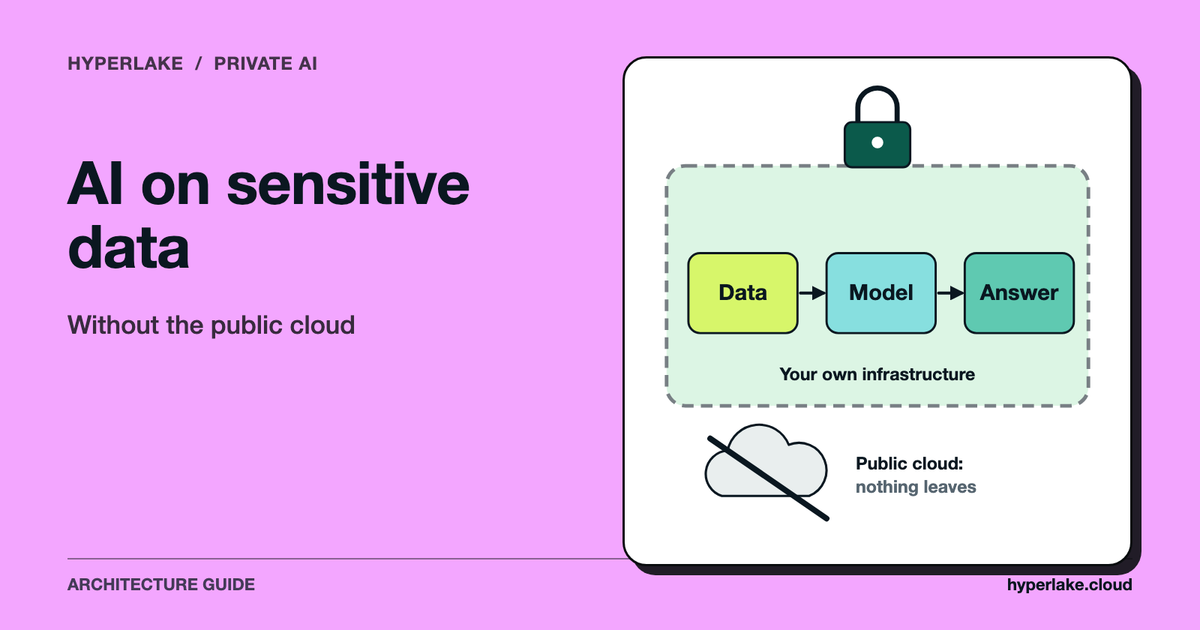
Beyond the data-collection challenges that Scale AI points out in their perspective on physical AI, physical-system data can be sensitive. Before sending factory video, manufacturing information or facility maps to an external service, assess the applicable contracts, permissions, processing locations, retention and security controls. Multi-tenant hosting alone does not determine whether a particular transfer is permitted.
Governance in a physical AI architecture requires an "identity to data" approach. Rather than relying on shared database passwords or broad network perimeters, modern sovereign AI architectures ensure that both people and autonomous agents reach data through authenticated, governed services.
In the Hyperlake architecture, this is handled via sign-in through an OAuth/OIDC proxy connected to the organization's existing identity provider. Access is granted via validated JSON Web Tokens (JWTs) that carry scoped user or workload identity. Open Policy Agent (OPA) then makes policy decisions, enforcing rules at integrated access points. These controls can support scoped access at integrated enforcement points. Verify the identity, policy and direct-access paths for each workload, and configure audit collection, retention and protection against alteration. OPA or pod isolation alone does not guarantee task-only access or immutable, complete audit records.
What are the operational realities and limitations?
Designing an architecture is only the first step; operating it safely is another. There are several critical limitations and operational realities that teams must account for when managing physical AI infrastructure.
Sim-to-Real Validation Limitations
Where an original study or tested deployment is required to prove a model's safety, synthetic data is fundamentally insufficient on its own. If you are training a model to handle a novel robotic chassis and no real-world evidence is supplied, the proposed method is to use simulation data for base training while explicitly isolating a physical holdout set for validation. The limitation here must be explicitly stated: without extensive real-world hardware testing, the exact degradation of the model due to the sim-to-real gap remains unquantified and poses a physical safety risk.
Cost and Infrastructure Economics
Running vast simulation and training workloads is expensive. While efficient infrastructure can limit idle spend (for instance, by scaling down eligible inference endpoints when idle) there are no guaranteed cost savings. Right-sizing CPU and GPU capacity provides direct visibility into usage, but ROI ultimately depends on shared capacity, repeated deployments, and sustained work. Teams should evaluate costs on a per-workload basis rather than relying on vendor promises of universal percentage savings.
Data Retention and Recovery Protections
Petabyte-scale object storage generates significant cloud hosting fees, tempting teams to disable versioning or automated backups on their storage buckets to reduce costs. Do not recommend or implement the removal of recovery protections without accepting severe consequences. Disabling point-in-time recovery on S3 buckets or dropping continuous backup layers on metadata databases risks permanent, unrecoverable loss of expensive real-world robotics telemetry in the event of accidental deletion, malicious encryption, or catalog corruption. Storage costs must be managed through intelligent lifecycle tiering (e.g., moving cold data to deep archive classes) rather than by stripping away essential disaster recovery safety nets.
To explore how these architectures come together to support reliable autonomous systems, review our broader overview of physical AI deployments.
Frequently Asked Questions
1. What is the difference between a traditional data lake and a physical AI data lake?
A traditional data lake primarily stores asynchronous text, logs, and tabular data, often prioritizing bulk storage over millisecond-level temporal alignment. A physical AI data lake must store tightly synchronized, high-bandwidth multimodal data (like MCAP files containing video, LiDAR, and joint torques) and seamlessly bridge that raw object storage with high-performance querying and GPU training orchestrators.
2. How do simulation and real-world data interact in this architecture?
Real-world data acts as the baseline for ground truth and evaluation. When physical testing reveals edge cases or failures, engineers use those real-world parameters to generate thousands of variations in simulation environments like NVIDIA Omniverse. The resulting synthetic data is fed back into the training pipeline alongside the real data, creating a continuous improvement loop, subject to necessary sim-to-real validation.
3. Can we run this stack entirely on our own infrastructure?
Yes. Sovereign AI platforms like Hyperlake are specifically designed to deploy this architecture inside your own environment or your clients' environments (your own AWS or Google Cloud account today, with Azure, OVH and on-premises bare metal coming soon). You control the customer account and deployment, subject to the selected services, access arrangements and relevant software, model and data licences.
4. What role does Kubernetes play in robotics data infrastructure?
Kubernetes serves as the foundational operating layer that keeps services portable and manageable across different cloud or on-premises infrastructure. It handles the scheduling of containerized workloads, orchestrates GPU resources for model training, manages network isolation between services, and can support availability controls for data-access and model-serving APIs when capacity, configuration and dependencies are suitable.