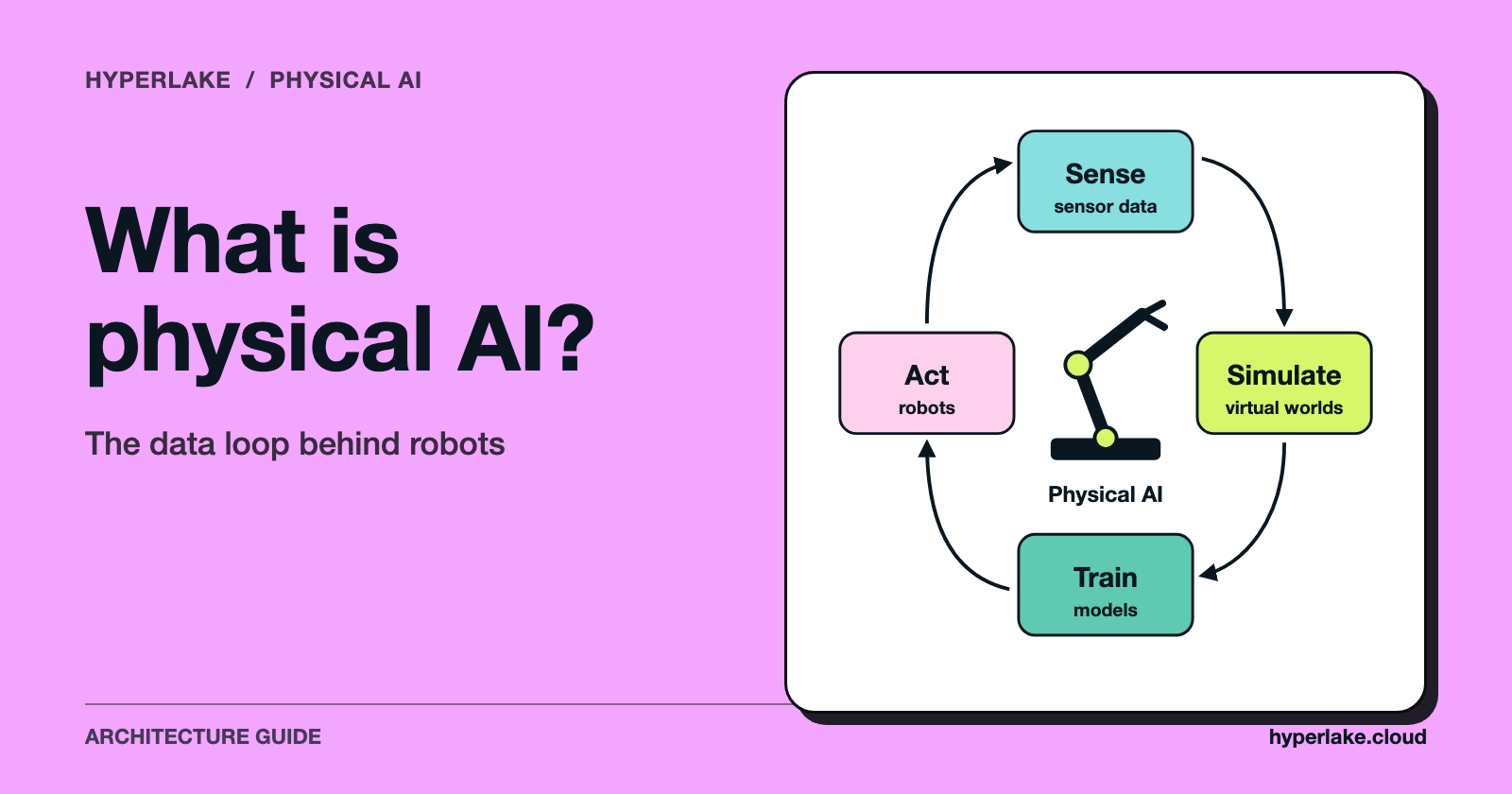
When a chatbot gets something wrong, someone reads a bad answer. When a robot gets something wrong, it can hit something. Physical AI means AI systems that perceive and act in the physical world, such as robots and other embodied machines, and their infrastructure has to connect sensor data, development, simulation, evaluation and deployment. A failure can affect equipment, people or the surroundings.
That makes the data path part of the engineering problem. Suppose you can't say which sensor calibration, timing, environment and software version sat behind a model result. The result is then very hard to interpret.

What makes physical AI different from a chatbot?
Consequences, mostly. A chatbot produces information for a person to interpret. A physical system may feed model output into a chain that moves an actuator or changes how a machine behaves, so both the stakes and the timing requirements change.
The world also reaches these systems through imperfect sensors. Cameras, depth sensors, joint states and other signals arrive at different rates, and sometimes with gaps. The data pipeline has to keep enough context to explain what the system could actually observe at the time.
A language model can be part of a physical AI application, but only as one component. Perception, planning, control and safety mechanisms each need their own design and their own evaluation.
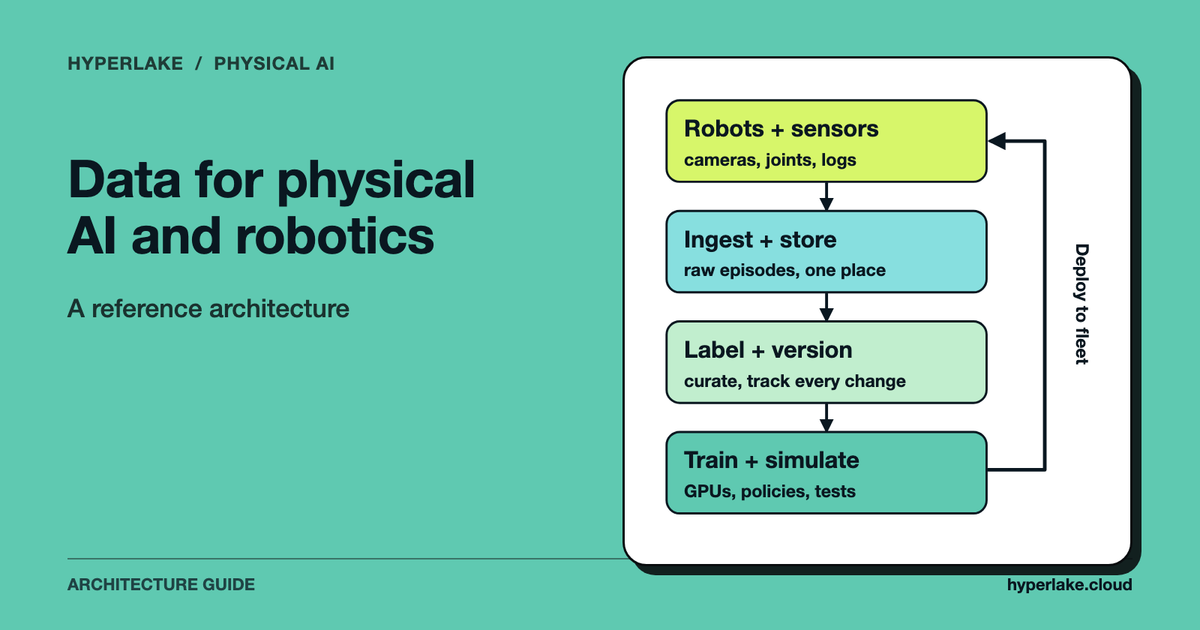
What does the physical AI infrastructure loop look like?

Each step in the loop should leave a record of what changed. Then you can trace a deployed model back to the data and evaluation that justified releasing it.
One caution: the diagram shows a development loop, not a safety architecture. Independent safety controls and the right engineering assurance process have to be designed for the actual machine and its environment.
What physical AI data needs to be preserved?
The raw observation, along with the metadata that lets you make sense of it. Depending on the system, that could mean timestamps, sensor identity, calibration, coordinate frames, device state and software versions.
Keep the link between recordings and the datasets derived from them. A labelled image, a selected trajectory and a simulation asset should each point back to where they came from. Otherwise teams spend days chasing a "model failure" that turns out to be a data-preparation error.
Record permissions and retention requirements too. Physical-world recordings can include people, locations or commercially sensitive operations, so even a technically excellent dataset needs an approved purpose and access model.
How should storage be organised?
Split the large, immutable recordings from the metadata used to find and interpret them. Researchers should be able to pull data by task, device, time and relevant conditions instead of clicking through opaque folders.
Dataset versions need to be explicit. A training run should name the records and transformations it used, not point vaguely at "the latest data." Record exclusions as well, so the team can explain later why a hard scenario was left out.
Retention and retrieval costs need planning. Physical data piles up fast, and shuttling it between environments can turn into an operational bottleneck. Measure your real workload before choosing a storage or network design.
Where do simulation tools fit?
Simulation lets you explore scenarios and test behaviour under controlled conditions. It's handy for development, for regression checks and for generating some kinds of training material.
NVIDIA's robotics platform includes technologies relevant here, Isaac-related tools among them. The right combination depends on the robot, the task, the assets and what you need to integrate with.
A simulation result is evidence about simulated conditions, and nothing more. Differences in sensors, contact, lighting, latency or environment can all affect how well it transfers to the real world. Keep those assumptions in plain view when you read the results.
What role do data and labelling providers play?
Scale AI's physical AI offering shows the kind of role data services play in this category. A provider can help with parts of collection or preparation. As system owner, you still have to understand provenance, quality and permitted use.
Define the labelling task precisely. Labels that work for object detection may fall short for planning or manipulation. Review the ambiguous cases, and decide how corrections flow through to derived datasets.
Labels deserve a quality process just as model outputs do. A big dataset can hide systematic mistakes that a random glance won't catch.
How do compute and orchestration change?
Expect the platform to run data preparation, training, simulation and inference evaluation, each with a different resource pattern. Some of it's batch work, some needs interactive access, and some needs specialised acceleration.
Schedule those classes on purpose, so a long simulation job doesn't quietly eat the resources set aside for a release evaluation. Record resource requirements and failure behaviour too; that way jobs can be retried without losing their provenance.
A framework such as PyTorch may handle model development while orchestration and serving tools take care of other jobs. A machine-learning framework is not the whole operating platform.
What should evaluation include?
The task, the environment and the failure modes that matter. Average performance can hide a rare but serious failure, so choose scenarios that reflect the intended operating conditions and probe the system's limits.
Where the comparison depends on it, keep evaluation data separate from development data. Keep tuning against the same scenarios and you'll need more evidence before you can claim the system generalises.
Record the full configuration every time: model, software, sensor assumptions, simulation assets and evaluation criteria. Without those details, a result is hard to reproduce or compare after an update.
Physical deployment also needs the appropriate safety and engineering review. A good model benchmark or a recorded demo doesn't establish functional safety. We think this is the line teams are most tempted to blur.
What should a first project look like?
Choose a bounded task with data you already have and a clear evaluation environment. Get ingestion, provenance and a reproducible evaluation working before you grow the model or the hardware scope.
A team might start, for instance, by organising recorded sensor data and reproducing an existing evaluation. That tends to surface timestamp, calibration and dataset-version problems early, before they get baked into a larger programme.
End the project with a concrete handoff: a documented dataset, an evaluated artifact and an operating process someone else on the team can repeat. It's a far stronger foundation than a demo whose conditions nobody can reconstruct.
Where does HyperLake fit?
HyperLake's physical AI direction connects customer-controlled data infrastructure with simulation, orchestration and model workflows. Components such as NVIDIA OSMO, Omniverse, Isaac Sim and Isaac Lab may be relevant, subject to licensing and validated integration.
The data foundation can include modular storage, query and governance components in the customer's environment, which today means your own AWS or Google Cloud account (private cloud and on-premises are coming soon). The design question worth asking: how does a recording become a governed dataset, and then an evaluated release?
HyperLake's public demonstration context includes recorded robot feeds and safety review. Please don't read that as proof that any autonomous physical deployment is certified, or safe for unrestricted operation.
Frequently asked questions
Is physical AI the same as robotics?
Not quite. Robotics is a major application area, but physical AI is the broader idea of AI that perceives and acts in the physical world, and the specific system and operating environment set the engineering requirements.
Does simulation replace real-world evaluation?
No. Simulation gives you evidence under modelled conditions, and real-world behaviour plus the appropriate safety process still have to be assessed for the intended deployment.
What is the most important data requirement?
Keeping the context needed to interpret observations: provenance, timing, calibration, relevant state and software versions. Lose that and model results can mislead you.
Should teams buy GPUs first?
Usually not. Start with the workload, the data and the evaluation requirements, because those set your compute, storage and network needs. Hardware on its own won't give you a repeatable development process.