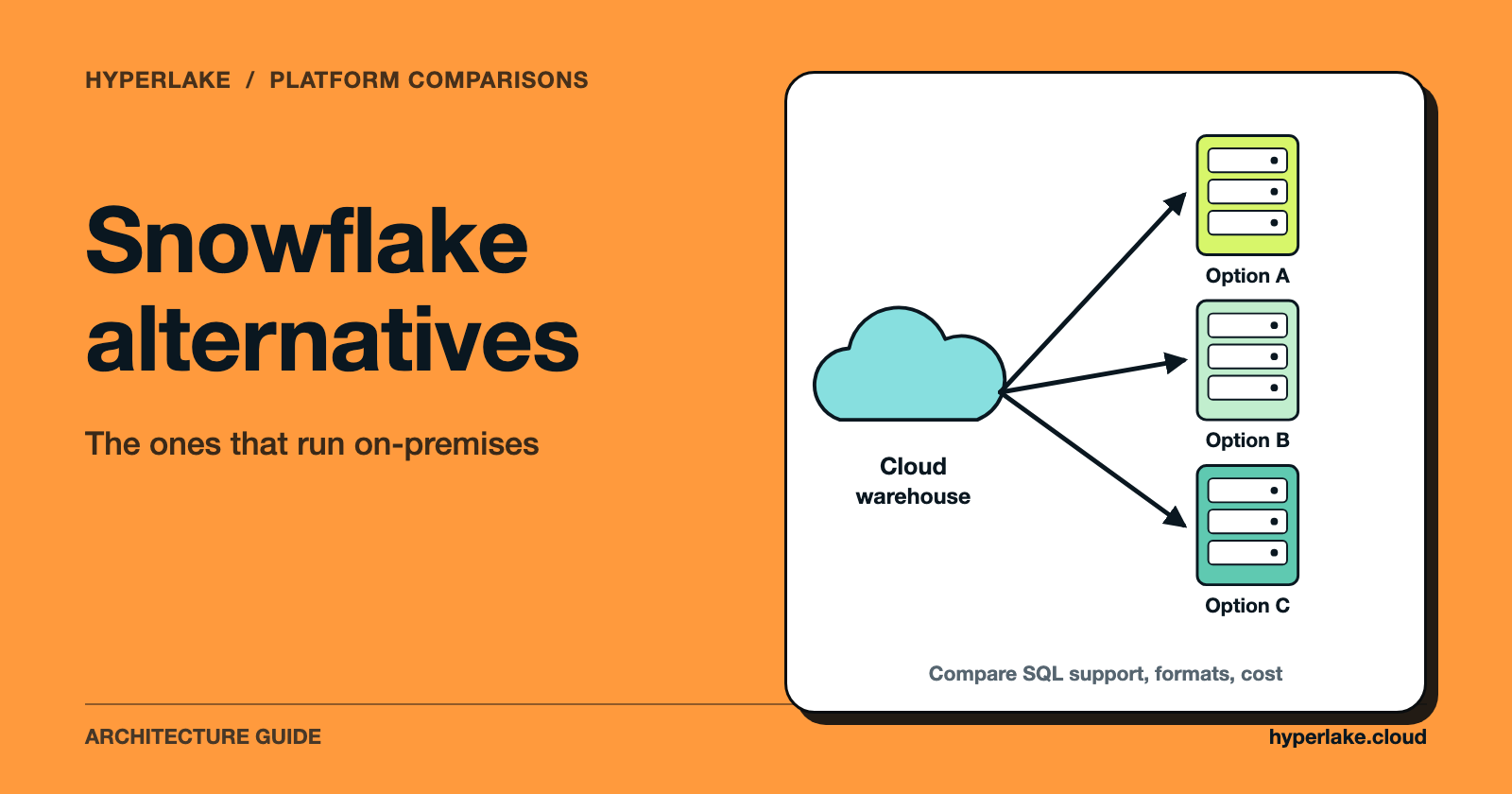
If the database has to run in your own data centre, Snowflake is off the table. Its documentation describes a managed cloud service, not something you install. So the real question is which Snowflake alternatives run on-premises: the usual shortlist is ClickHouse, Trino-based lakehouses, Greenplum, Vertica, Teradata and Cloudera, plus the operating platform you'll need around whichever you pick.
They don't do the same job. Before comparing them, work out which part of your Snowflake workload you actually need to reproduce. Analytical SQL? Shared datasets, scheduled transformations, interactive dashboards, or a whole data platform?

Why can't you just install Snowflake locally?
Snowflake says you can't. Its architecture documentation states that it cannot be installed on premises or in a private cloud. Pointing it at external storage or open table formats changes nothing, since the execution environment is still theirs.
That's your first filter. When local operation is mandatory, settle it before anyone burns weeks comparing SQL dialects or dashboard connectors. Check what the requirement really is, too: "on-premises" sometimes turns out to mean regional hosting or a private network path, which is a different problem with a different shortlist.
Write down why local operation matters. Data policy, existing infrastructure, disconnected operation and commercial control each produce different acceptance criteria, and a system can pass one while failing another.
Which Snowflake alternatives deserve a shortlist?
| Option | Best initial fit to investigate | Main evaluation issue |
|---|---|---|
| ClickHouse | Analytical workloads over large event-style datasets | Data modelling, updates and query compatibility |
| Trino with a lakehouse | SQL across governed data sources and open tables | Storage, catalog and operational integration |
| Greenplum | Distributed warehouse workloads with PostgreSQL roots | Current distribution, support and migration compatibility |
| Vertica | Dedicated analytical warehouse evaluation | Supported deployment, licensing and workload behaviour |
| Teradata | Enterprise warehouse programmes needing an on-premises offering | Commercial scope and migration effort |
| Cloudera | Broader private data-platform requirements | Components required and operating complexity |
| HyperLake | Customer-controlled integration of modular data and AI components | Selected engines, controls and support responsibilities |
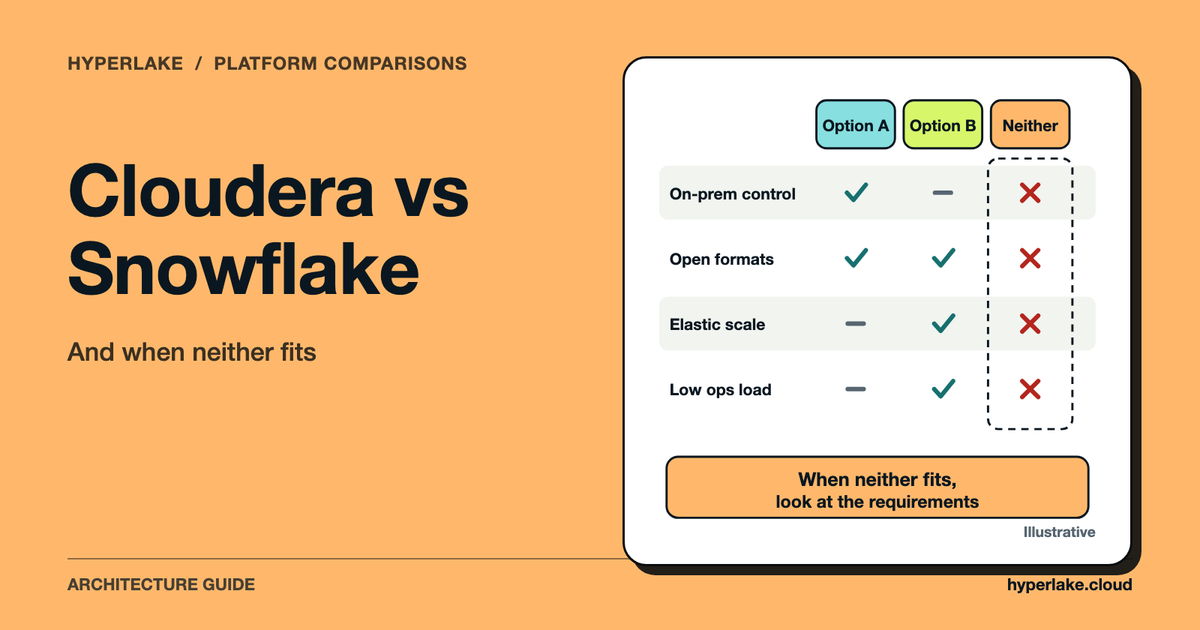
It's a fit-based shortlist, not a benchmark ranking. Nobody should pick from it without a migration proof run on their own queries, concurrency and data lifecycle.
When should you evaluate ClickHouse?
When fast analytical queries over event-like data sit at the heart of the requirement. ClickHouse publishes self-managed installation guidance, so running it yourself is a documented path.
Test it with the queries that hurt: high-cardinality grouping, joins, access to recent data and whatever update patterns your application depends on. Look hard at the data model and the ingestion design as well. A Snowflake schema rarely moves across unchanged and works well.
Then the boring questions. Who handles upgrades? Replication, backup, recovery? A fast demo is one small piece of replacing a managed service, and the operating work needs a named owner.
When does a Trino lakehouse make sense?
Trino is a distributed SQL query engine, and it can sit at the centre of an on-premises lakehouse. Installing one process doesn't give you a complete warehouse, though.
Around it you'll still need storage, a catalog, ingestion and table maintenance, followed by access controls and observability. Open tables let several engines use the same data, which is great; each engine's supported operations and permissions still need reviewing.
We like this path for organisations that want to pick their own components and keep control of where the data sits. It's a poor fit for a team expecting the managed-service experience without paying for the platform work that creates it.
How should Greenplum and Vertica be assessed?
Greenplum earns a place in any distributed warehouse evaluation, especially if your team's skills or existing workloads make its PostgreSQL heritage useful. Confirm the current commercial distribution and support terms with Broadcom's Tanzu documentation, and don't assume the packaging or licence terms you remember still hold.
Vertica is presented by Rocket Software. Add it to the list if you're evaluating a dedicated analytical database, and ask for the supported deployment design for your infrastructure.
Test both with representative SQL and data-maintenance operations. Stored procedures, functions, semi-structured data and downstream tools usually cause more migration work than the first table copy suggests. Before anyone commits to a cutover date, log every incompatibility as a backlog item with an owner.
When do Teradata and Cloudera fit?
Teradata offers an on-premises deployment option. Consider it when the requirement is an enterprise warehouse programme with a defined support and commercial model.
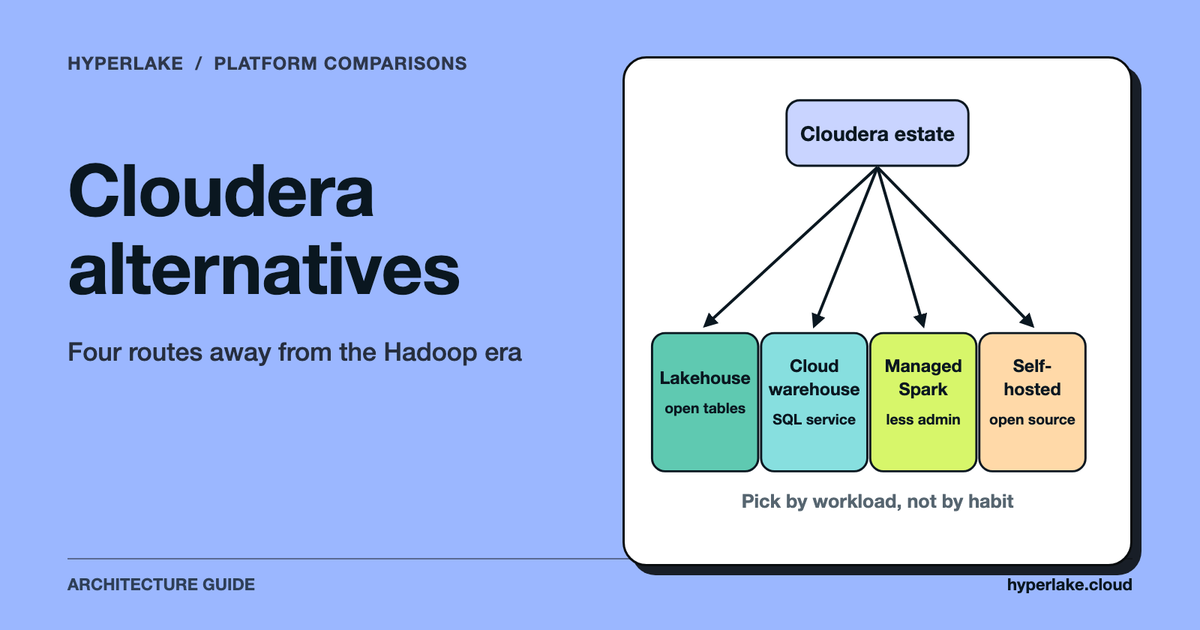
Cloudera is a wider data-platform comparison. Work out which private deployment components your workloads actually need, because treating the whole platform as a like-for-like swap for one database muddles the comparison.
With either one, make suppliers split out included functionality, optional components, implementation services and ongoing support. A proposal that blurs those lines can't be fairly compared with a modular design.
What should the migration proof include?
One bounded data product with real consumers. Rebuild its ingestion, transformations, permissions and reports, compare results on agreed datasets, and write down any semantic differences you chose on purpose.
Then break it: rehearse a failed load, a restore and a rollback to the old system. Keep the source system running until the new path meets the acceptance criteria you agreed. Users care about data arrival, dashboard refresh and access behaviour as much as query speed.
Use what you learn to size the next wave. Migrations get more predictable when each wave leaves reusable mappings and operating knowledge behind, and not just one more copied table.
How should you compare total cost?
Choose one time horizon and put everything inside it: migration, licences, support, infrastructure, facilities and people. Keep one-time transition costs apart from recurring ones, and remember the stretch when both systems run side by side.
Here is a deliberately hypothetical budgeting example, not a vendor quote. Say annual infrastructure allocation is $60,000, software and support $30,000, and operating effort $90,000. That's $180,000 a year before migration and contingency, and half of it is people. Change the operating-effort guess and the answer moves, even if server prices don't.
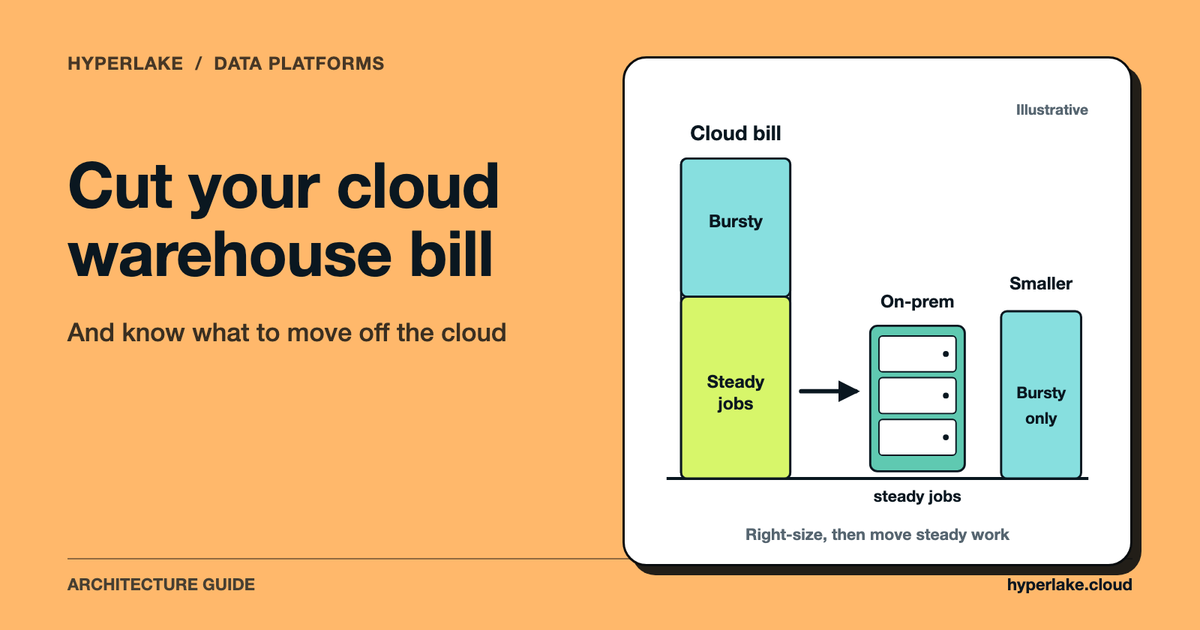
Set that against your actual cloud bill for the same workload, on the same basis, including storage, compute, data transfer and support where they apply. Putting a self-hosted hardware invoice beside a fully managed bill and calling the gap "savings" is an easy mistake to make.
Aim for a range, not a number. Show what happens if utilisation drops, data grows or you need another operator. Those scenarios tell you quickly whether the case rests on optimistic assumptions.
Where does HyperLake fit?
HyperLake supports customer-environment deployments using modular components such as Iceberg, Trino, PostgreSQL and ClickHouse alongside data and AI services. It's relevant when the decision includes how the chosen engines get deployed, governed and run together. One honest caveat for this article: today HyperLake runs in your own AWS or Google Cloud account, and private cloud and on-premises deployment are coming soon.
Engine choice still depends on the workload. A HyperLake proposal should say which component runs each job, where the data lives and which operating responsibilities stay with you. No compute markup is part of how we position it, but infrastructure and operations don't become free.
Use the same acceptance workload for every candidate, us included. A platform wrapper shouldn't excuse an engine from the query, permission or recovery checks.
Frequently asked questions
Can Snowflake run in my own data centre?
No. Snowflake documents a managed cloud architecture and doesn't offer a local installation. If on-premises execution is mandatory, you'll need a different engine or platform.
Is Trino a complete Snowflake replacement?
Not on its own. Trino is a query engine, so a replacement design also needs the storage, catalog, ingestion, governance and operations that suit the workload.
Which option is cheapest?
It depends on utilisation, licences, support, migration and operating effort. Build a complete cost model with your own workload; public headline prices won't tell you much.
Should we move every workload at once?
Usually not. A bounded migration is easier to judge and easier to reverse. Start with one data product, prove correctness and operations, then plan later waves from what you learned.