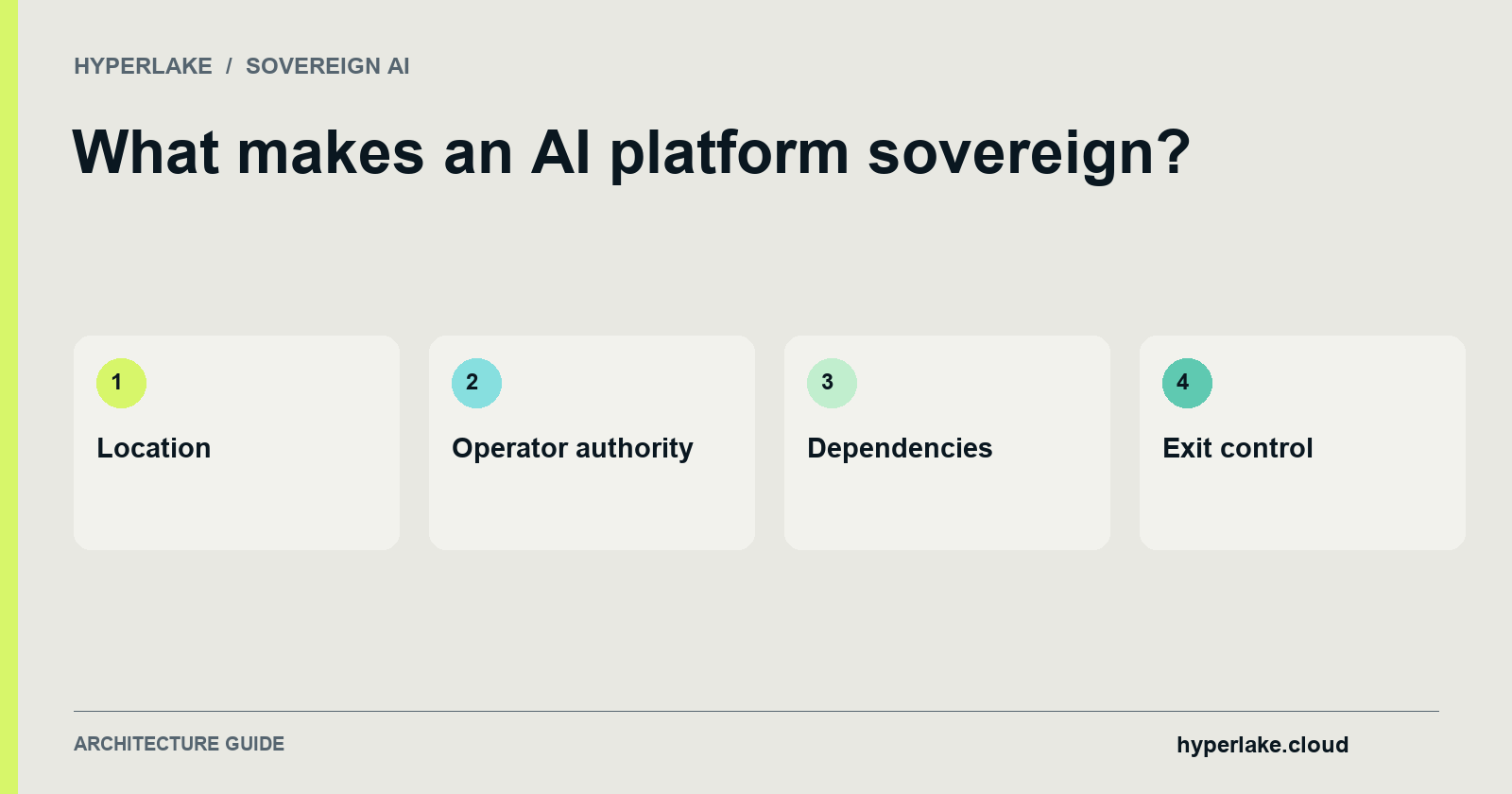
A sovereign AI data platform should provide an evidenced arrangement for data location, administrative authority, operational control and legal responsibilities. The word “sovereign” alone does not establish those controls. Compare a named deployment and operating model against your requirements, including support access, external dependencies and the ability to leave the service.
The market includes sovereign cloud offerings, customer-controlled platforms and managed data services with relevant controls. These are different approaches, so the first buying decision is which model the organisation can accept and operate.

What should count as sovereignty evidence?
Start with requirements that can be inspected. Specify where processing may occur, which parties may administer the service, who controls keys and what must continue working during a supplier outage or contract exit.
Then ask for evidence behind each answer: architecture, configuration, contract terms, operating procedures and a demonstration of the difficult cases. A regional hosting claim does not explain remote support access, and a customer-managed key claim does not explain every path to plaintext.
Keep legal assessment distinct from engineering evidence. The architecture can show how data moves; qualified reviewers must assess the laws and contractual obligations that apply to the parties and use case.
Which providers and approaches belong in the discussion?
This table is a set of evaluation paths. It does not certify that every option meets a particular sovereignty requirement.
What does Oracle offer?
Oracle's sovereignty portfolio includes several deployment models. Its Dedicated Region description places data and control planes in a customer-defined data centre, while other options address different regional or isolation needs.
The practical question is which option is being quoted. Ask about operator access, service availability, connectivity, updates and the responsibilities that remain with the customer.
Do not transfer a claim from one option to another. A capability described for an isolated deployment does not automatically apply to a standard public-cloud service.
How should AWS, Google and Microsoft be assessed?
AWS's Digital Sovereignty Lens, Google Cloud's sovereign offerings and Microsoft Sovereign Cloud provide starting points for those discussions.
Ask each provider to map the proposed service configuration to your requirements. A cloud portfolio can contain services with different locations, access models and dependencies. The answer needs to cover the actual model endpoint, data stores and monitoring components.
Pay particular attention to recovery and support. Where does a workload fail over? Which team can inspect a trace? What changes when a managed AI feature is enabled? These questions make the control arrangement concrete.
Where does IBM Sovereign Core fit?
IBM Sovereign Core is another offering to examine where sovereignty and operational control are central requirements. Request the supported architecture, service scope and responsibility model for the intended environment.
A useful demonstration should include administration and change control, not only an application query. Ask who approves updates, how access is recorded and what happens if an external dependency is unavailable.
Compare the resulting arrangement with the organisation's operating capacity. A design can provide useful control while still requiring skills and support the customer must plan to obtain.
Can Databricks or Snowflake meet sovereign requirements?
Databricks and Snowflake belong in the evaluation when their deployment and service controls are compatible with the requirements. They should not be labelled universally sovereign or universally unsuitable without examining the use case.
Snowflake documents a managed cloud architecture rather than software installed in a customer's private data centre. If local installation is mandatory, that is a decisive boundary. If the requirement is a specific cloud location and control arrangement, assess the exact service instead.
For either platform, inspect the data and control planes, administrative access, model integrations and export path. Familiarity with the analytics product does not automatically settle the AI workload's data flows.
How does HyperLake approach the problem?
HyperLake supports modular data and AI components deployed in customer environments, including private and on-premises infrastructure. Its architecture can combine engines such as Iceberg, Trino, PostgreSQL and ClickHouse with model-serving and access-policy components.
That approach is relevant when the organisation wants direct choices over placement and component operation. The design still needs an explicit account of where policy is enforced, which services can be reached directly and who handles upgrades and incidents.
HyperLake's natural-language control experience is a direction being built toward, with integration and automation dependent on the deployment. Evaluate demonstrated capabilities in the proposed environment rather than assuming every component can already be managed conversationally.
What questions expose weak sovereignty claims?
Ask for a normal request path, a support path and a recovery path. Include document fragments, prompts, outputs, metadata and logs. A diagram that shows only the primary database leaves too much unanswered.
Ask whether the customer can revoke administrative access and what effect that has on support. Ask whether keys, policies and model artifacts can be exported in usable form. Ask who can authorise a new outbound destination.
Then request evidence for the answers. Contractual commitments, configuration records and operating procedures serve different purposes; a mature proposal explains how they work together.
How should the organisation choose?
Separate mandatory requirements from preferences. A requirement to operate without external connectivity creates a different shortlist from a preference for local storage. Avoid scoring a candidate highly on convenience if it fails a mandatory control.
Use one representative workload for the evaluation. Include data intake, an inference request, an administrative change and a restore. Review the resulting records with the teams who will operate and govern the system.
Compare complete cost and responsibility. More direct control can create additional operating work. A managed arrangement can reduce some work while leaving dependencies that must be accepted explicitly.
The decision should end with a control matrix and a named owner for each unresolved item. That is a more durable outcome than a general statement that the selected vendor is sovereign.
Frequently asked questions
Is there one universal definition of a sovereign AI platform?
No single label resolves every legal and operational requirement. Define the required location, access, control and dependency arrangements for the workload and assess evidence against them.
Does a local region guarantee sovereignty?
No. A region establishes part of the location story. Operator access, legal relationships, external dependencies and recovery arrangements also matter.
Must sovereign AI run on premises?
Not always. Some requirements can be met through a suitable cloud arrangement. Others may require local or disconnected operation. The requirements should determine the deployment choice.
What should a supplier provide before purchase?
A service-specific architecture, responsibility matrix, relevant contract terms and evidence covering normal operation, support, recovery and exit. Marketing terminology alone is insufficient.