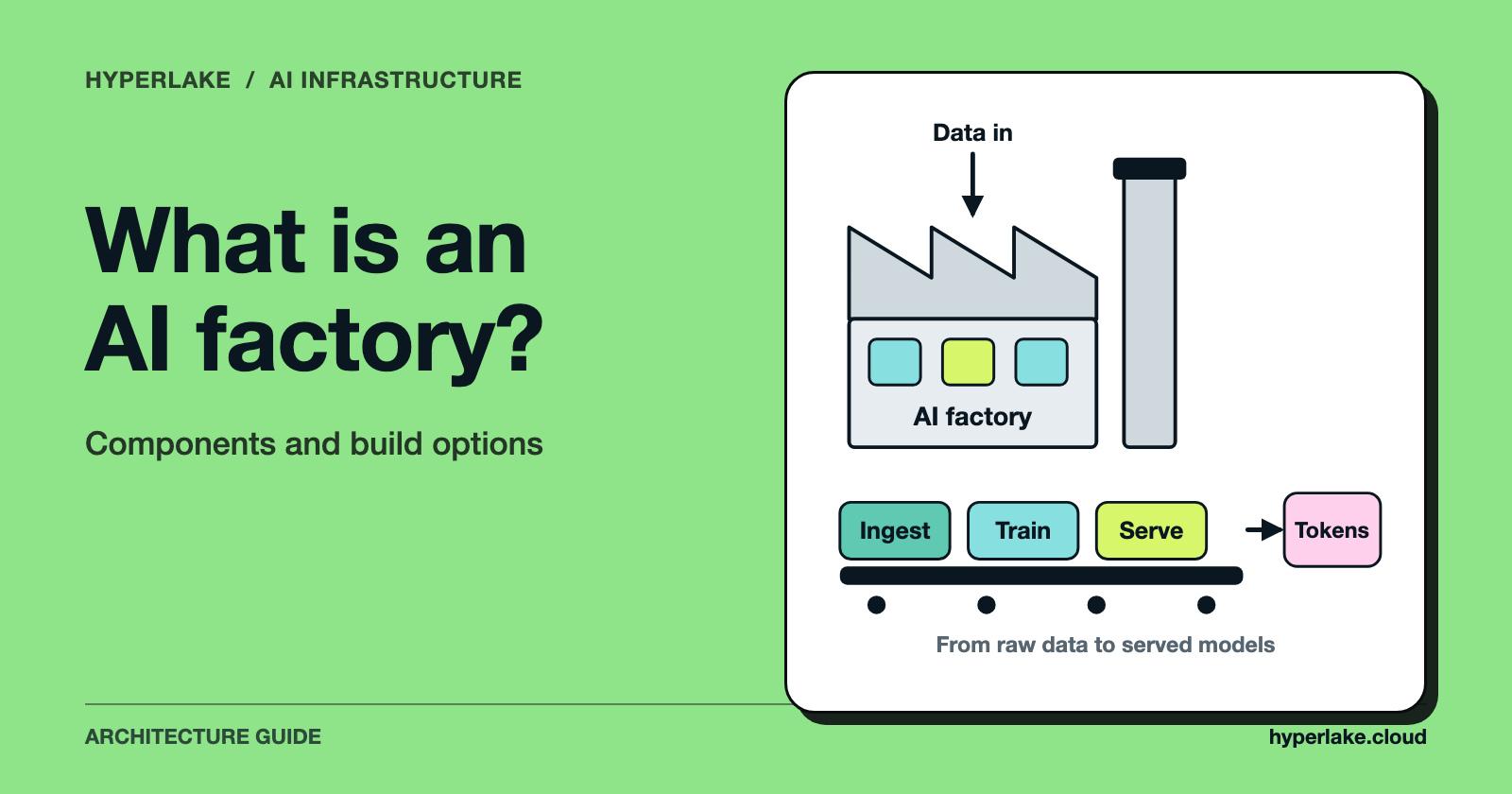
A room full of GPUs is not an AI factory. An AI factory is the set of processes and infrastructure that turns data into evaluated, deployable AI services, covering data preparation, compute, model management, evaluation, serving and ongoing monitoring. The term earns its keep when it describes a repeatable production process.
The metaphor helps, up to a point. It also hides the dull part, because somebody still has to decide which data is usable, what counts as good enough and who gets to release a model into a real workflow.

Does an AI factory need to train its own models?
No. Plenty of useful systems start from an existing model and spend their effort on retrieval, evaluation and serving. Training or fine-tuning is one possible workload, and you don't need it to use the term.
Adapt a model only when you have a clear reason and evidence to back it up. If the real trouble is poor source documents or wrong permissions, training won't necessarily fix anything.
The choice reaches the hardware, too. Training, batch processing and interactive inference want different resources and different scheduling. So we'd size for the work the system will actually do, not for a training programme that might show up one day.
What comes into an AI factory, and what comes out?
Going in: documents, images, sensor recordings, structured records and existing model artifacts. Coming out: an inference service, an evaluated model version or a repeatable processing workflow.
You should be able to trace a line between the two. If a later version behaves differently, the team has to know which data, model and configuration produced each output.
Take a fictional document assistant. A running language model isn't the useful bit. What you want is a service that pulls up only the material it's permitted to use, answers a defined set of questions and responds sensibly when the evidence isn't there. The factory has to support that whole path, end to end.
Which AI factory components are required?
| Component | Job | Question for the owner |
|---|---|---|
| Data intake | Receive and validate source material | Is this data permitted and suitable for the workload? |
| Storage and catalog | Preserve data and its meaning | Can a release be tied to a known source version? |
| Compute and scheduling | Run processing, evaluation and serving | Can important work obtain resources when needed? |
| Model and artifact management | Track approved versions | Can the previous release be restored? |
| Evaluation | Assess usefulness and failure modes | What evidence is required before release? |
| Serving | Expose the approved capability | Who may call it, and what happens on failure? |
| Monitoring and operations | Keep the service usable | Who responds when quality or availability changes? |
| Governance | Define permissions and accountability | Who can approve data, model and configuration changes? |
A small deployment might get one service to play several of these parts. Larger workloads split them across services and teams. Either way, every role exists, even if the implementation is only a script and a spreadsheet.
How does the production loop work?
It starts with a defined use case and approved data. From there the team prepares the data, picks or adapts a model, evaluates it and approves a release. Then production itself feeds the next round.

The release decision deserves the most attention. Doing well on one evaluation doesn't earn a model a place in every application. The approval should say what the model is for, what's known to be wrong with it and what would trigger a review.
Monitoring needs a purpose as well. Collect what you need to understand quality, reliability and resource use, and keep to the application's data-handling rules while you do.
Where do Kubernetes and NVIDIA components fit?
Kubernetes orchestrates services and jobs. Model quality and application safety are outside its remit. If several teams share the infrastructure, its multi-tenancy guidance is worth a read for the isolation questions.
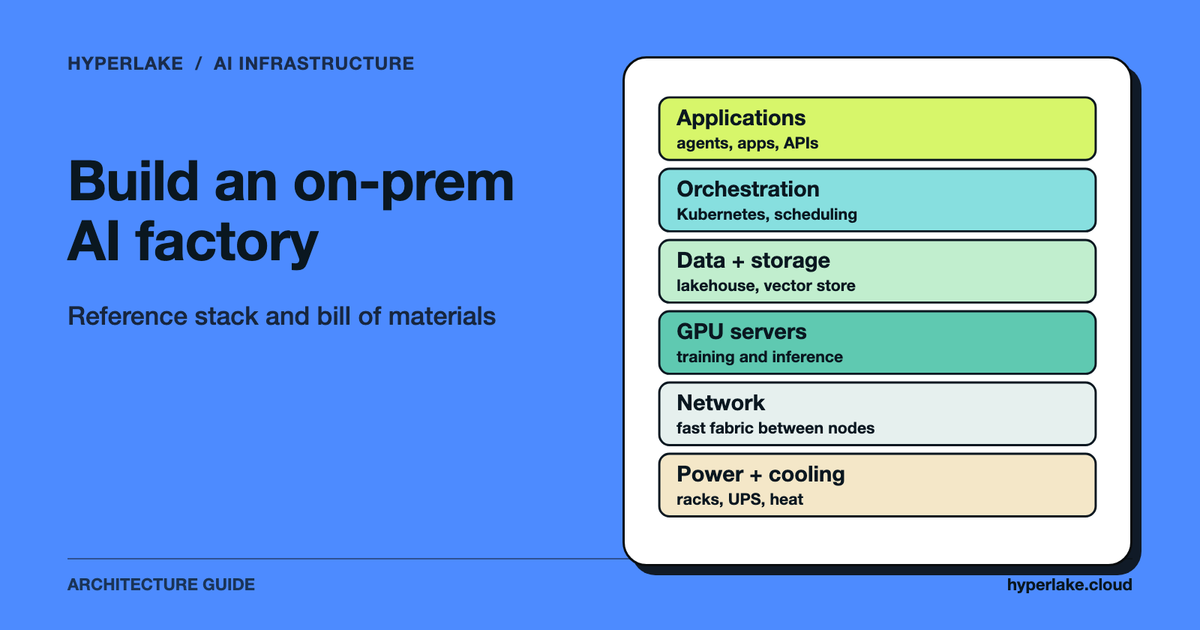
The NVIDIA GPU Operator handles the software components that let Kubernetes use NVIDIA GPUs. It's a piece of the infrastructure layer. The factory is bigger than that.
Robotics and simulation work is a separate case. NVIDIA's robotics platform includes relevant technologies, and whether they matter depends on the workload and on licensing. One caution: having simulation tools installed says nothing about whether a physical system is safe to run.
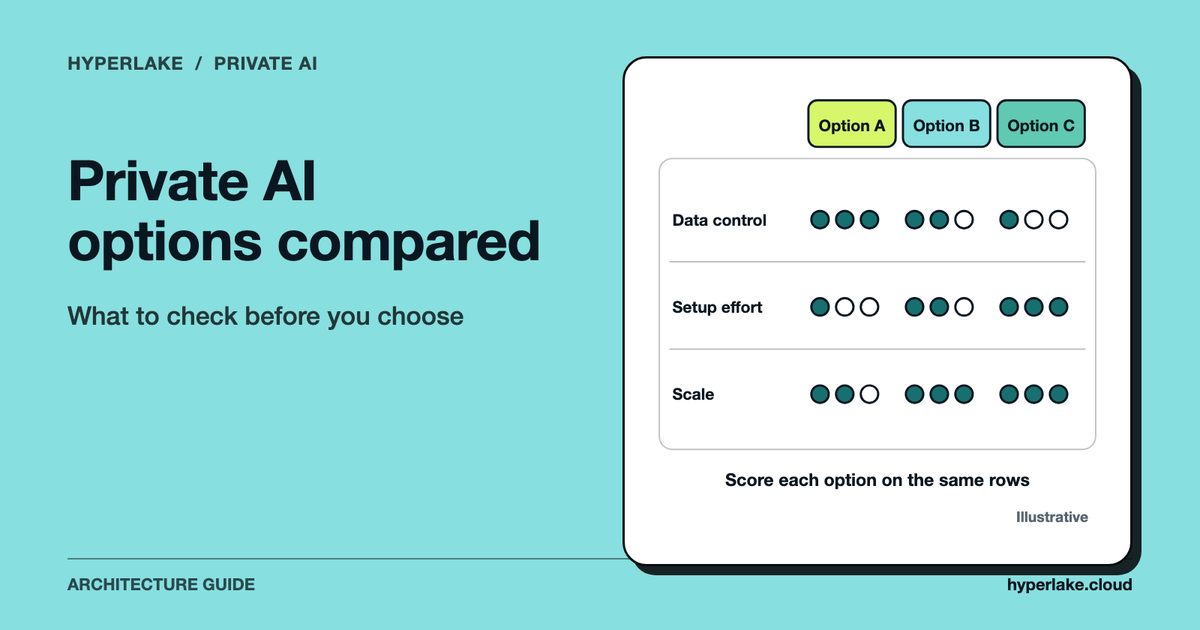
What are the main AI factory build options?
Four of them.
Managed cloud takes some infrastructure chores off your plate. The application design, the data permissions and the question of whether the service is fit for purpose stay with you, and you'll need to check where each service runs and what its terms say.
A customer-controlled cloud deployment puts more of the configuration and operations on your side. It's a fit for teams that want a say over placement and integration but are happy to keep renting infrastructure.
On-premises pulls facility, hardware and maintenance into the programme. It can suit local processing requirements or capacity you already own. It also needs an operating team and a recovery plan.
Hybrid mixes environments. Handy, sometimes, but data movement, identity and failure handling turn into first-class design questions. If you say "hybrid", name the specific split of work; a vague aspiration doesn't count.
What should the first investment cover?
One useful workload, plus whatever it takes to run it. Sort out the data path, the evaluation approach, the release process and ownership before you buy capacity for a dozen hypothetical uses.
Budget for storage, networking, identity, monitoring and recovery too. GPUs get the attention. In our view, services stall more often on a flaky data pipeline, or because nobody owns the certificate renewal, than on a lack of compute.
Then measure the workload under representative demand. Record output quality, latency and resource use side by side. You get a basis for capacity planning, and hardware utilisation doesn't become the only yardstick for value.
How do you know the factory is working?
When it can release a useful service again and again, with an evidence trail people can follow. It can also reject a poor model, recover from a failure and explain why a result changed.
Try three tests:
- Ask an operator to restore a previous release.
- Ask a researcher which source version sits behind an evaluation.
- Ask a user what happens when the system can't answer.
Those questions find gaps an infrastructure dashboard won't show.
Expand once the first workload has set patterns you can reuse. The next service should pick up the controls and operating knowledge you already have, and leave behind any assumptions that don't fit its use.
Where can HyperLake help?
HyperLake supports customer-environment deployment of modular data and AI components. Today that's the customer-controlled cloud option above, in your own AWS or Google Cloud account; private cloud and on-premises are coming soon. Depending on the deployment, its scope covers data engines, Kubernetes-based infrastructure, model serving and integrated access-policy controls.
It's relevant if you'd rather assemble a factory around your own environment and the components you've chosen. Whatever gets proposed to you should show which component does each job and who runs it.
For physical AI, HyperLake's direction includes integration with simulation and orchestration components such as NVIDIA OSMO and Isaac-related tooling, subject to validated integration and licensing. Put those requirements into the implementation design. Please don't assume universal compatibility.
Frequently asked questions
Is an AI factory just a GPU cluster?
No. Compute is one component among several. A useful factory also needs data handling, evaluation, release management, serving, governance and ongoing operations.
Must it be on premises?
Not at all. It can run on managed cloud, customer-controlled cloud, on-premises infrastructure or a hybrid arrangement. Let the workload and your control requirements decide.
Does every factory need model training?
No. Many useful deployments focus on evaluating and serving existing models, sometimes with retrieval. Training should follow a specific need and a suitable data plan.
What is the best first workload?
A bounded use case with available data, a clear decision owner and measurable acceptance criteria. It should be useful enough to justify running and small enough to understand.