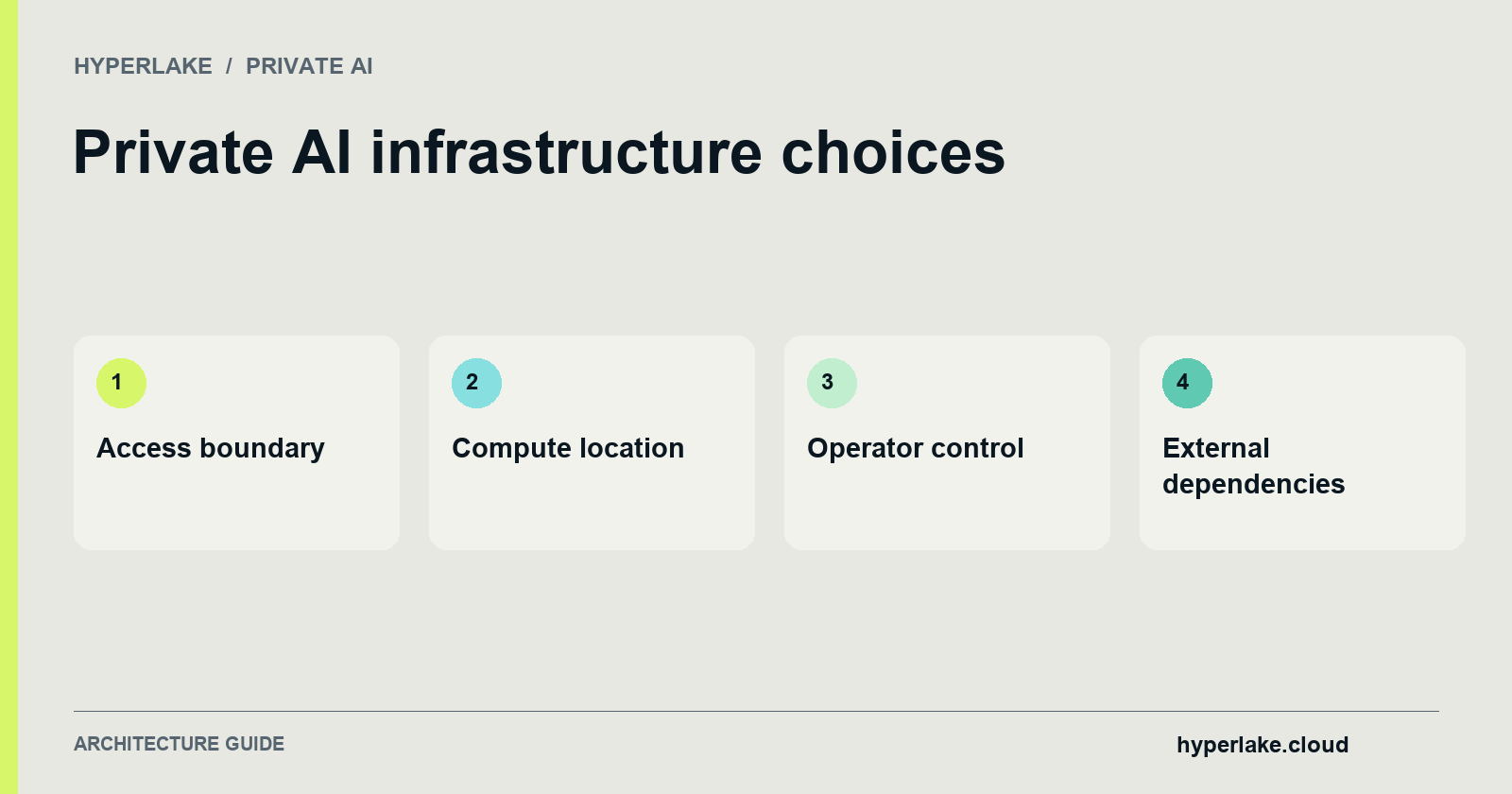
Choosing private AI infrastructure for an enterprise depends on whether "private" means contractual data isolation in a public cloud or full control over model weights, data, and encryption keys inside your own servers. Enterprise options fall into four categories: turnkey on-premises hardware stacks (Dell AI Factory, HPE Private Cloud AI, NVIDIA Enterprise AI Factory), hybrid virtualization and Kubernetes platforms (VMware Private AI Foundation, Red Hat AI Enterprise), VPC-isolated cloud services (Amazon Bedrock, Microsoft Foundry, Google Cloud Vertex AI), and sovereign AI operating platforms (Hyperlake) that assemble models, governed data engines, and agent policies inside customer-controlled environments.
Disclosure: Written by the Hyperlake team. We build Hyperlake, a sovereign AI operating platform. This comparison links to each vendor's public documentation.

Which level of private AI infrastructure do you actually need?
Before comparing hardware appliances against cloud APIs, platform architects must define where the security boundary sits. The term "private AI" borrows its core principle from the NIST definition of private cloud (SP 800-145): infrastructure provisioned for exclusive use by a single organization, whether operated on or off premises.
As detailed in our foundational guide on what private AI is for business, enterprise deployments span five distinct privacy levels:
- Level 1 — Hosted API with business terms: Prompts and outputs traverse the provider's shared cloud infrastructure, protected by contractual no-training commitments and retention limits.
- Level 2 — Dedicated hosted instance / VPC-isolated cloud: Private network links (such as AWS PrivateLink or Azure Private Link) and reserved throughput on provider-managed hardware.
- Level 3 — Customer-controlled cloud account: GPUs, model weights, data engines, and encryption keys run inside your own cloud VPC across AWS, Azure, Google Cloud, or regional providers.
- Level 4 — On-premises or private cloud: Servers you own or lease inside a private data center, bound directly to your enterprise identity provider.
- Level 5 — Air-gapped infrastructure: Servers with no external network path and offline update workflows (see our guide to air-gapped AI).
Many buyer disagreements happen because teams evaluating Level 1–2 cloud services compare them directly against Level 4 on-premises appliances. The table below maps each major option to the privacy levels it supports.
Enterprise private AI infrastructure compared
Turnkey hardware appliances and GPU blueprints
Dell AI Factory
Dell Technologies positions the Dell AI Factory as an end-to-end portfolio combining Dell PowerEdge servers, storage, networking, and workstations with validated partner software across on-premises, edge, and cloud environments.
- Capabilities: The Dell AI Factory with NVIDIA combines PowerEdge servers, NVIDIA GPUs, Spectrum-X networking, and NVIDIA AI Enterprise (including NIM microservices), often alongside Red Hat OpenShift AI. Dell also offers AMD Instinct (with ROCm) and Intel Gaudi 3 configurations on PowerEdge XE9680, paired with the Dell AI Data Platform.
- Best for: Enterprises purchasing physical on-premises GPU servers and storage that want pre-tested reference architectures across NVIDIA, AMD, or Intel silicon.
- Where it fits less well: Because it is anchored in hardware procurement, software teams that already operate cloud VPCs or bare-metal clusters may prefer a hardware-agnostic software platform.
HPE Private Cloud AI
Hewlett Packard Enterprise offers HPE Private Cloud AI as a turnkey appliance co-engineered with NVIDIA and managed through the HPE GreenLake platform.
- Capabilities: Combines NVIDIA GPUs, low-latency fabric, HPE Alletra storage, and NVIDIA AI Enterprise software with HPE AI Essentials (data pipeline integrations, lineage, compliance controls, and explainability tools for RAG and inference). Lifecycle updates run through the GreenLake portal.
- Best for: Organizations standardized on HPE GreenLake wanting a single-vendor on-premises appliance for RAG and inference.
- Where it fits less well: Tightly coupled to HPE hardware and GreenLake; teams deploying across AWS, Azure, OVH, or external client clouds will find a cloud-portable Kubernetes platform more flexible.
NVIDIA Enterprise AI Factory (and NVIDIA AI Enterprise)
The NVIDIA Enterprise AI Factory Validated Design and its AI Factory planning documentation define the blueprint for full-stack on-premises AI factories.
- Capabilities: Pairs NVIDIA Blackwell and Hopper GPUs with BlueField DPUs, Spectrum-X Ethernet networking, and Confidential Computing. The NVIDIA AI Enterprise software layer includes NIM microservices for inference, Base Command Manager, and NVIDIA Run:ai for fractional GPU scheduling.
- Best for: Enterprises standardizing on NVIDIA GPUs that want vendor-supported inference containers and GPU cluster orchestration.
- Where it fits less well: Optimized specifically for NVIDIA silicon. Enterprises still need to integrate their own lakehouse storage, operational databases, and application-level access governance.
Hybrid Kubernetes and virtualized private cloud platforms
Red Hat AI Enterprise (and OpenShift AI)
Red Hat AI Enterprise unifies Red Hat OpenShift AI, RHEL AI, and Red Hat AI Inference into a Kubernetes platform across hybrid clouds.
- Capabilities: Built on Open Data Hub, vLLM, and llm-d, executing across NVIDIA, AMD, and Intel accelerators (including the co-engineered Red Hat AI Factory with NVIDIA). It includes a central registry for validated models, Model Context Protocol (MCP) servers, and AI agents, plus runtime guardrails.
- Best for: Platform engineering teams running OpenShift or RHEL that want a hardware-agnostic Kubernetes platform for model serving and agent lifecycles.
- Where it fits less well: Requires OpenShift administration expertise, and analytical data engines require separate integration.
VMware Private AI Foundation with NVIDIA
Broadcom and NVIDIA offer VMware Private AI Foundation with NVIDIA for data centers running VMware Cloud Foundation (VCF).
- Capabilities: Extends VCF with automated provisioning of AI Workstation VMs and Kubernetes clusters, vGPU visibility, a Model Runtime and Gallery, an Agent Builder Service, and MCP support, running NVIDIA AI Enterprise and NIM on virtualized infrastructure.
- Best for: Existing VCF customers hosting private RAG, fine-tuning, and inference using familiar VMware operational tools.
- Where it fits less well: Requires VCF commitment plus separate NVIDIA AI Enterprise licensing; not aimed at lightweight, cloud-portable Kubernetes teams.
VPC-isolated managed cloud services (Privacy Levels 1–2)
Many enterprise buyers define private AI as cloud AI that does not train on customer data or traverse the public internet. In our framework, these services represent Privacy Levels 1 and 2.
Amazon Bedrock
Amazon Bedrock's security and compliance documentation specifies that prompts, outputs, and fine-tuning datasets are not used to train base foundation models or shared with third-party model providers. It supports AWS PrivateLink for private VPC connectivity, customer-managed keys via AWS KMS, HIPAA eligibility, GDPR tools, and FedRAMP High in AWS GovCloud (US-West).
- Fit: Best for AWS-standardized enterprises wanting rapid API access to models. However, it runs on AWS infrastructure and cannot be installed on customer-owned on-premises servers (Levels 4–5).
Microsoft Foundry (Azure AI Foundry)
According to Microsoft Learn documentation, Microsoft Foundry isolates customer prompts, completions, embeddings, and training data for Azure-sold models from third-party providers and base model training. It integrates with Microsoft Entra ID, Azure Key Vault, Microsoft Purview, and Azure Private Link, with optional modified abuse monitoring / Zero Data Retention (ZDR) for approved customers.
- Fit: Best for Azure and Entra ID enterprises wanting a managed cloud control plane. Workloads remain on Azure infrastructure, and ZDR requires eligibility approval.
Google Cloud Vertex AI
Under the Google Cloud AI/ML Privacy Commitment, Google Cloud states that customer data is not used to train Google foundation models without instruction, and models remain frozen during inference. Vertex AI and the Gemini Enterprise Agent Platform provide regional data residency, Cloud KMS encryption, VPC controls, and on-premises partner deployments with Dell.
- Fit: Best for Google Cloud and BigQuery users needing regional residency. Full multi-cloud or on-premises portability requires a Kubernetes layer or separate partner hardware agreements.
Where does Hyperlake fit (and who should pick something else)?
Hardware appliances provide servers and cloud APIs provide hosted endpoints, but production AI also requires connecting models, databases, vector stores, and policy engines without exposing sensitive data.
Hyperlake is a sovereign AI operating platform built for Privacy Levels 3 and 4. Teams use Hyperlake to assemble, deploy, and govern the data, models, applications, and tools behind Physical AI, enterprise agents, and AI-native products inside their own or their clients' environments.
- Deploy on Kubernetes across environments: Runs across AWS, Azure, Google Cloud, OVH, private cloud, and on-premises infrastructure so customers keep data, models, and keys inside infrastructure they control.
- Modular solution packs and engines: Combines open model serving (KServe, fine-tuning, evaluation) with workload-appropriate data engines, including Apache Iceberg, Trino, PostgreSQL, ClickHouse, MongoDB, Redis, Kafka, Qdrant, Milvus, and graph engines.
- Governed identity-to-data access: People and agents reach data through authenticated services rather than shared database passwords, using your identity provider and Open Policy Agent (OPA) policy enforcement with central audit logging.
- Control surface: Callable through a web application, CLI, and MCP-compatible tools where teams state an intent in natural language, inspect the proposed plan, approve, and deploy under organizational policies. (Note: This natural-language workflow is the experience Hyperlake is building toward; specific integrations depend on the deployment, and public documentation detailing specific MCP tool schemas is not yet included in product documentation.)
- Economics: Built on open technologies with no compute markup. Eligible inference endpoints scale down when idle.
Who should choose Hyperlake—and who should pick something else
- Choose Hyperlake if: You are a platform team that wants to own your AI environment across cloud accounts or on-premises clusters, or an AI service provider deploying repeatable, client-owned environments. See our use cases and FAQ.
- Pick a hardware OEM stack (Dell, HPE, NVIDIA) if: Your primary need is purchasing physical GPU servers, networking switches, and storage arrays.
- Pick a managed cloud API (Bedrock, Foundry, Vertex AI) if: Your compliance policies permit provider-hosted cloud services (Levels 1–2) and you prefer pay-per-token APIs.
Architecture, governance, and cost evaluation
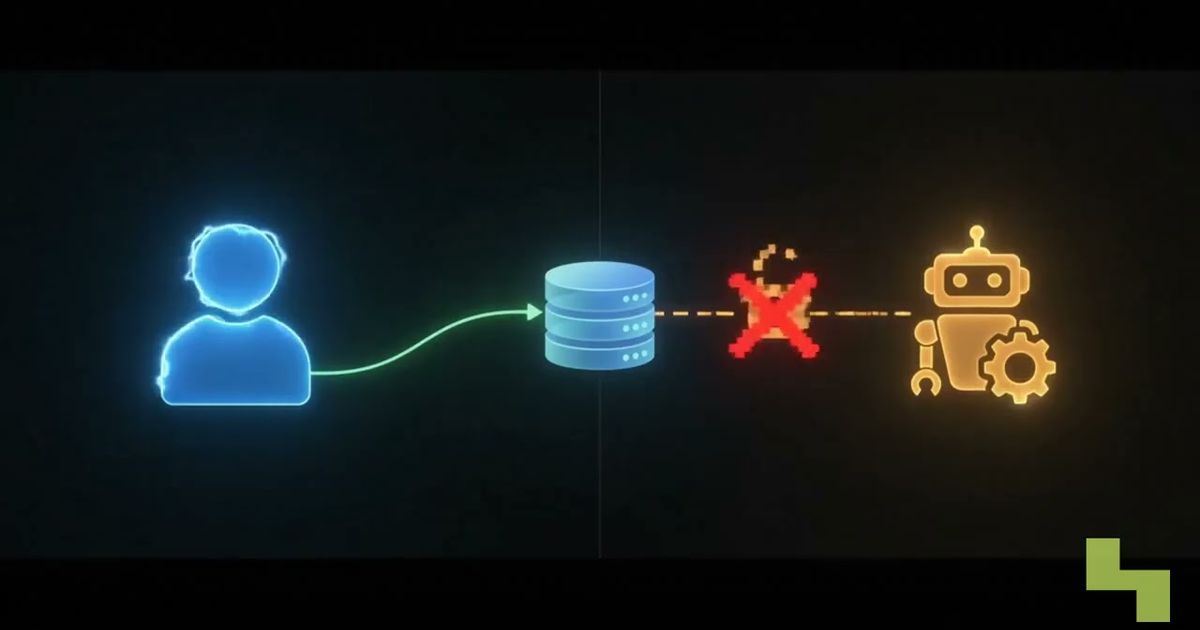
A common failure mode in private AI is placing a self-hosted LLM inside a private server (see how to deploy an LLM on premises) and connecting it to company documents using shared database passwords. Even if no data leaves the building, any employee or prompt injection could query unauthorized records. In Hyperlake's architecture, users and workloads authenticate through an enterprise identity proxy, pass scoped tokens, and rely on OPA policy decisions and a reviewed semantic layer to govern which data engines and tools an agent can reach, with human approval before consequential actions. For Kubernetes design details, see our Sovereign Physical AI Stack on Kubernetes and vendor lock-in prevention in AI infrastructure.
Moving from public cloud APIs to private infrastructure also shifts costs from per-use API pricing to capacity-based economics:
- When per-use APIs cost less: Low-volume tools and sporadic workloads with long idle periods often cost less on pay-as-you-go APIs.
- When owned capacity fits better: As agents multiply model calls, searches, and jobs, per-use pricing rises with each action. On well-used owned capacity—combined with eligible inference endpoints that scale down when idle—additional actions cost relatively little until more capacity is needed. The ROI case must be evaluated per workload.
Compare your parameters using the LLM API vs. Self-Hosted GPU Cost Calculator, check how many GPUs you need to serve an LLM, and review sovereign AI vs. private AI.
All trademarks belong to their respective owners.
Frequently asked questions
Does private mean on premises?
No. Private access can be implemented in a hosted environment. Local execution is a separate requirement.
Does local hosting mean air-gapped?
No. Software, identity, updates and support may still depend on external services.
How should hardware be sized?
Measure the intended model, input sizes and concurrent workload before choosing capacity.
What should a supplier demonstrate?
The request path, access controls, operator responsibilities and recovery process for the proposed configuration.