The best hybrid data platform for AI is the one that puts each workload where it has to run and still gives you one coherent approach to identity, data access and operations. Databricks, Snowflake, Microsoft Fabric, Google Cloud BigQuery, Cloudera, IBM watsonx.data and HyperLake take different approaches worth evaluating. "Hybrid" should describe a real division of work. It doesn't mean every product runs everywhere.
Start with a plain question. What has to stay local, what can move, and where will the model execute? Skip it and platform comparisons end up treating cloud analytics, private infrastructure and data integration as if they were the same thing.

What does hybrid mean for your AI workload?
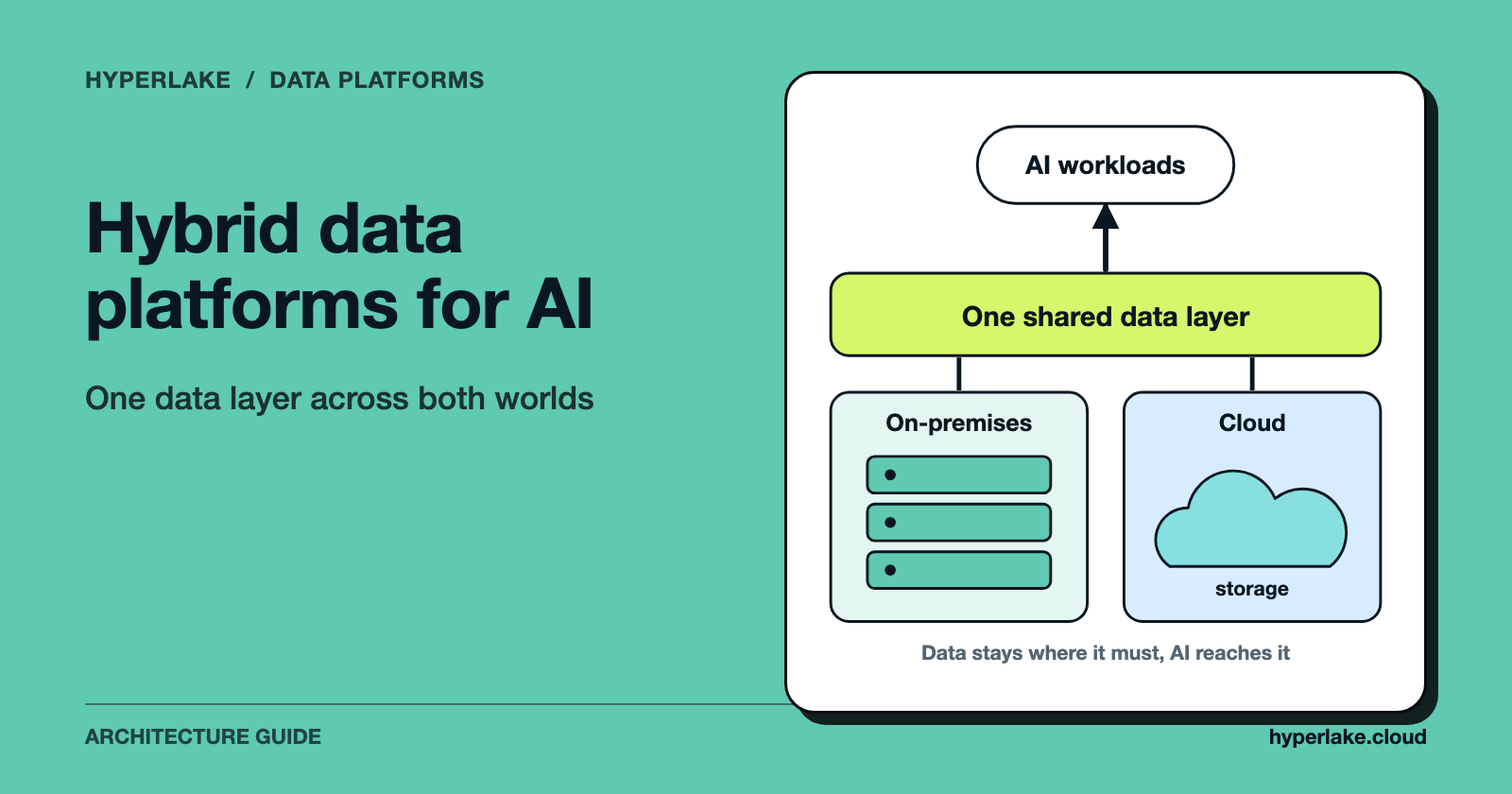
Three different things hide behind the one word. Local source systems might feed cloud analytics. Data might be queried across clouds. Or inference might run locally over data prepared somewhere else. Movement, latency and operating needs differ in each.
Next, draw two pictures: one of the data plane, one of the control plane. A service can read locally stored data while its administration or execution stays outside. For a sovereignty or disconnected-operation requirement, that difference settles the answer.
AI also makes copies: document chunks, embeddings, evaluation data, prompts and traces. Keep every main table local and one model call can still send sensitive context out.
Which hybrid data platforms deserve a look?
| Platform | Best fit to investigate | Hybrid boundary to verify |
|---|---|---|
| Databricks | Data engineering and AI workflows | Supported deployment and control-plane arrangement |
| Snowflake | Managed analytics and data services | Cloud execution and external data access |
| Microsoft Fabric | Integrated Microsoft analytics workflows | SaaS boundaries and connections to local sources |
| Google BigQuery | Managed analytics, including supported cross-cloud cases | What Omni or other selected services actually cover |
| Cloudera | Private and broader data-platform estates | Component availability across environments |
| IBM watsonx.data | Data-lakehouse and hybrid data needs | Exact deployment, engine and governance scope |
| HyperLake | Modular data and AI in customer environments | Integration and operations across selected components |
Treat these as architecture choices to investigate, not as one product installed in different places.
When does Snowflake fit?
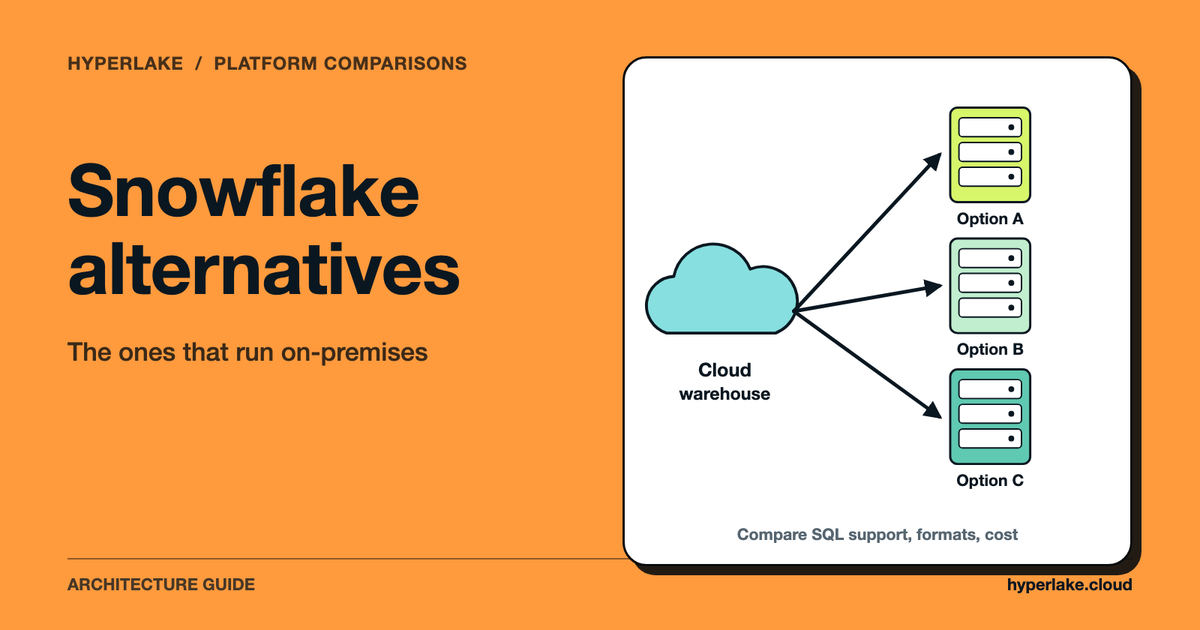
Let's take the one people assume wrongly first. Snowflake's documentation describes a managed cloud service. It can be part of a hybrid estate, but that doesn't mean you can install its execution service in a private data centre.
It suits organisations that are fine with managed cloud execution and want local systems to join the wider data workflow. Must the execution platform itself run locally? Then it doesn't fit.
Check how your chosen design reads and moves data, and which AI features add new processing paths. A table storage approval shouldn't quietly approve every model integration as well.
When should you evaluate Databricks?
Databricks is relevant when data engineering, analytics and AI development sit at the centre of the programme. Look at the supported deployment model, and at how it connects to your existing data and identity systems.
Bring a workflow that really crosses the boundary you care about, and follow it from source ingestion through processing and model development to consumption. A notebook running on data someone already cleaned tells you little.
Where do configuration, metadata and operational records live? The answer separates a useful integration with local systems from a requirement to run the whole platform locally.
What should Microsoft Fabric buyers check?
Already on Microsoft tools and after an integrated workflow? Microsoft Fabric brings analytics capabilities together in a SaaS platform, so it makes sense to look at.
For hybrid use, ask how it connects to local sources and where processing happens. Reaching an on-premises source isn't the same as running the analytics platform on premises.
The gateway or connector is part of your production system. It needs monitoring and an owner. Map identity, data refresh, network availability and failure handling around it.
What does BigQuery Omni change?
One specific thing. BigQuery Omni supports BigQuery analytics over data in supported Amazon S3 and Azure Blob Storage arrangements, which is a cross-cloud capability and no general promise that you can deploy it on premises wherever you like.
Check supported regions, editions and query behaviour for your use case, and work out what data or results move and what stays put. A cross-cloud query still carries network, cost and governance consequences.
Test with a representative query and a failure case. When one environment goes down or a permission changes, you should still be able to follow the design.
When should Cloudera or IBM watsonx.data lead?
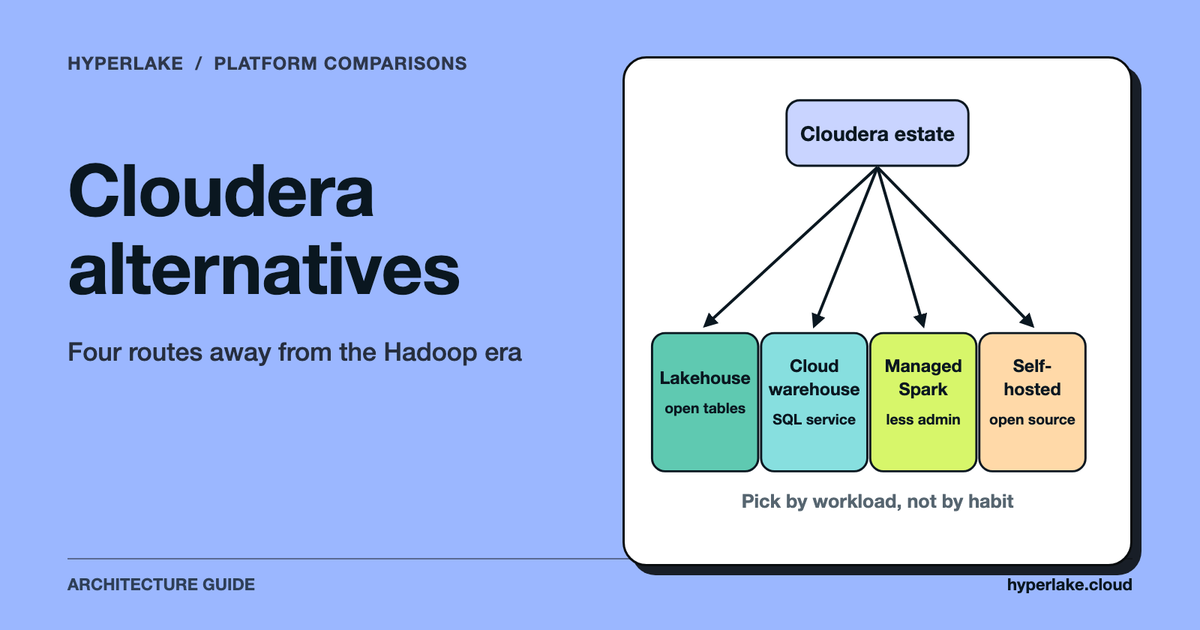
Cloudera and IBM watsonx.data deserve attention when private infrastructure and wider data-platform requirements are central.
Get the exact components supported in each environment in writing. A feature name shared across a portfolio doesn't prove the behaviour or administration is identical everywhere.
Then ask who does the work. Who patches local components, manages storage and picks up failed pipelines? Hybrid infrastructure gives you useful placement choices; it also puts more teams on the call when something breaks.
Where does HyperLake fit?
HyperLake supports modular data and AI components that run in the customer's own cloud account, on AWS and Google Cloud today, with private cloud and on-premises deployments coming soon. Depending on the workload, it can combine open-table storage, query engines, operational databases and model-serving components.
It's relevant when you want direct control over placement and integration. A good design names which engine does each job, how identity reaches it and where policy checks happen.
And skip the duplication. A hybrid platform doesn't need a copy of every service in every location. Place components by data, latency and control requirements, then write down the dependencies between them.
How should you design data movement?
Name each flow first: replication, query access, event delivery or artifact promotion. Freshness, consistency and recovery behave differently in each.
For replication, decide which system is authoritative and how corrections spread. For query access, measure latency and see what happens when the source is down. For model promotion, keep the evaluated artifact and its configuration; an untracked rebuild in production is a different artifact.
Put network and transfer costs beside the workload assumptions. Compute may look cheap on paper, yet the design turns slow or expensive once it keeps moving large datasets around.
What should a proof of value include?
Pick one data product that crosses the proposed boundary and reproduce its permissions, transformation and consumption path. Measure correctness, freshness and the effort it takes to run.
Then break something on purpose: a dropped connection, an expired credential, a source that's gone. The system should report the problem and recover. Quietly serving misleading data is the failure.
Compare the full cost and the full list of responsibilities: integration, duplicated storage, transfer, support, and the people who run both sides. We think the best hybrid design is simply the one your organisation can explain and keep running.
Frequently asked questions
Does hybrid mean the whole platform runs on premises?
No. Hybrid can mean cloud services connected to local sources, or supported cross-cloud processing. Check the deployment boundary of each component separately.
Does querying data in place mean nothing moves?
Not necessarily. Results, metadata, intermediate data or logs can still travel. Trace the actual query path and how the service you picked behaves.
What's the main AI-specific risk in a hybrid design?
Leakage through the side doors. Data can leave through prompts, retrieval context, embeddings and traces even while the source tables stay local, so put those flows in the architecture review.
How should a team choose its first hybrid workload?
Choose a bounded data product with a clear owner and measurable freshness, access and recovery requirements. Get the operating pattern right on that one before you expand.