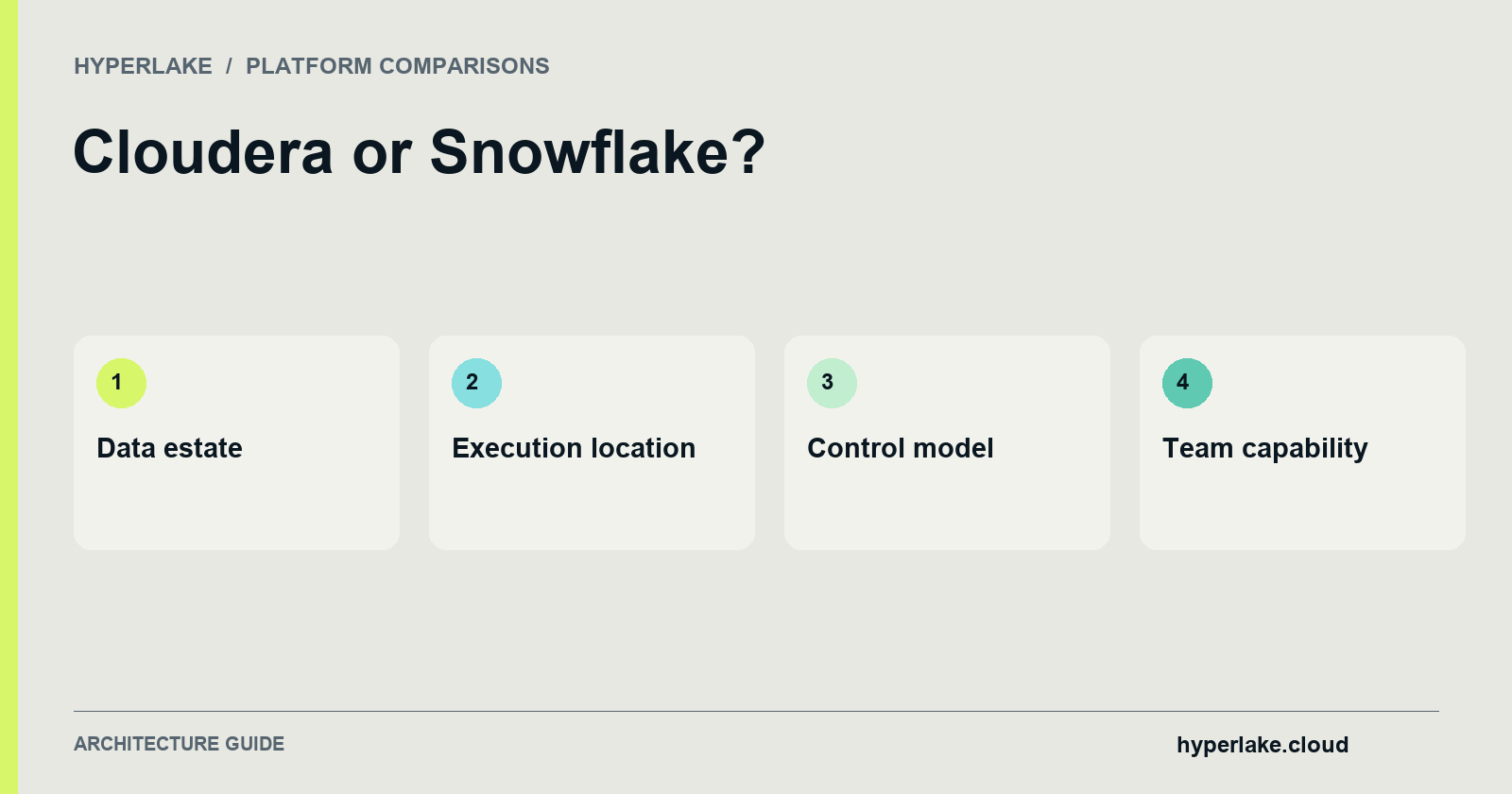
Snowflake operates as a fully managed, cloud-native data platform optimized for centralized data storage, seamless compute scaling, and ecosystem sharing. Cloudera relies on a "federation-in-place" architecture, focusing on hybrid and on-premises deployments using open standards to query data exactly where it lives without forcing a cloud migration. However, when an organization requires strict Sovereign AI capabilities—meaning they must deploy models, data, and applications securely within their own infrastructure or customer environments—neither a pure SaaS data cloud nor a traditional big data hybrid platform fully applies. For these scenarios, we build Hyperlake, an operating platform designed for private AI assembly and lifecycle management.
This article explores how Cloudera and Snowflake approach enterprise data in 2026 based on their architectural differences, how they handle federation and AI, and when teams should consider an alternative deployment model.

What fundamentally divides their architectures?
The core divergence between Snowflake and Cloudera lies in infrastructure management and deployment environments. Snowflake functions strictly as a managed service built for public cloud environments. Cloudera Data Platform (CDP) approaches the problem from a hybrid and private cloud baseline, accommodating on-premises infrastructure.
The Snowflake Data Cloud Architecture
As a self-managed service, Snowflake removes the need to manage virtual or physical hardware, allowing engineering teams to offload ongoing maintenance, tuning, and upgrades. The platform separates its architecture into three distinct layers: database storage, elastic multi-cluster compute, and cloud services.
- Database Storage: Snowflake automatically reorganizes loaded data into an internally optimized, compressed, columnar format known as micro-partitions. The platform supports structured data, semi-structured data (like JSON or XML), and unstructured files.
- Compute: Snowflake utilizes a single engine that automatically scales compute resources up and down based on usage, helping eliminate concurrency issues when massive numbers of users run simultaneous workloads.
- Cloud Services: This layer handles security, query parsing, infrastructure management, and the Snowflake Horizon catalog.
Because it requires no underlying hardware administration, Snowflake is heavily optimized for scenarios where organizations are willing to standardize on one cloud or operate across managed public cloud regions.
The Cloudera Private Cloud Base Architecture
According to Cloudera's Reference Architecture, CDP Private Cloud Base provides a unified distribution designed to run on-premises or across hybrid environments. Unlike Snowflake's managed abstract layers, Cloudera requires organizations to actively design and configure storage, network, and compute roles.
A typical Cloudera cluster allocates specific memory, disk layouts, and network connectivity across three types of nodes:
- Master Nodes: These house management services like ZooKeeper quorums, HDFS Journal nodes, and Namenodes to track metadata. In large clusters of more than 200 nodes, deploying up to five master nodes may be appropriate to maintain majority consensus.
- Worker Nodes: These do the heavy compute and I/O lifting for services like HDFS DataNodes, YARN NodeManagers, Impala Daemons, and Kafka.
- Utility Nodes: These handle services such as Cloudera Manager, the Hive metastore, and custom administration scripts.
By maintaining control over the underlying infrastructure, enterprises using Cloudera can keep workloads that are not ready for the cloud strictly on-premises.
How do they handle data federation and movement?
The philosophical divide over data movement fundamentally impacts storage costs, compliance, and multi-cloud strategy.
Snowflake has historically required ingesting data into its proprietary micro-partitions to achieve maximum performance. Today, it also supports external Apache Iceberg tables and Hybrid tables to accommodate broader ecosystems. Even so, Cloudera argues that consolidation-first models—like those heavily promoted by Snowflake or Databricks—often require data to be copied or replicated into a vendor-controlled platform. Cloudera claims that this replication expands the compliance surface, increases storage costs, and forces governance policy duplication across systems.
Cloudera champions a "Federation-in-Place" model. According to a 2026 Cloudera technical analysis, this approach leaves data exactly where it physically resides. By minimizing unnecessary data movement, Cloudera claims organizations can lower infrastructure costs, reduce duplication across environments, and maintain flexibility across multi-cloud and on-premises boundaries without assuming eventual cloud consolidation.
When considering federation, organizations must evaluate if data needs to be copied into a centralized cloud first or if it can be securely queried in place. For a deeper look into the mechanics of cross-system querying, see /blog/query-federation-what-actually-happens-when-you-query-across-data-systems.
What are the security and governance models?
Both platforms provide enterprise-grade security, but their enforcement mechanisms reflect their deployment environments.
Snowflake Horizon
Snowflake manages security natively through the cloud services layer. Snowflake Horizon provides a built-in suite that handles compliance, privacy, interoperability, and access control within the Data Cloud. Organizations can use Data Clean Rooms to define what analyses can be run against shared data, allowing external consumers to gather insights without unrestricted data access. Because it operates entirely as a managed service, Snowflake abstracts the underlying infrastructure security away from the user.
Cloudera Shared Data Experience (SDX) and Ranger
Cloudera's security is implemented at the infrastructure level and relies heavily on its Shared Data Experience (SDX) layer. According to Cloudera's Security Reference Architecture, Apache Ranger acts as the centralized policy management engine, providing role-based and attribute-based access control across components like YARN, Kafka, Hive, HDFS, and Solr. Authentication typically relies on integrating the cluster with existing corporate directories, such as Microsoft Active Directory, using Kerberos.
Cloudera refers to this architecture as "Zero Redundancy Security". They argue that because data isn't moved into a central cloud, access policies only need to be defined once and are enforced consistently everywhere—acting like a global corporate security badge.
Important operational caveat: When deploying self-managed platforms like Cloudera, administrators must manage OS-level security. If an enterprise requires SELinux enforcement, they must test and implement the policies themselves. While complexity might tempt teams to strip network encryption or run SELinux in permissive mode, doing so removes critical workload isolation and recovery protections without consequence mitigations. Always deploy robust TLS certificate management.
How are they tackling AI and Machine Learning?
The shift toward AI-native data processing sees both platforms racing to bring large language models (LLMs) to enterprise data.
Snowflake offers ML and AI suites directly through Snowflake Cortex, which embeds LLMs to help users understand unstructured data, answer freeform questions, and automate routine translation or summary tasks. Because this is a fully managed service natively utilizing Snowflake's compute, it allows SQL developers to integrate intelligence rapidly without provisioning separate GPU infrastructure.
Cloudera focuses on integrating specialized, sovereign intelligence into enterprise data securely on-premises. By partnering with providers like Mistral, Cloudera aims to bring models directly to where the data lives rather than sending proprietary data out to public cloud AI APIs.
Testing federation latency: a proposed architecture
To truly decide between Snowflake's centralized performance and Cloudera's federation-in-place model, a precise latency and throughput study mapping local data versus external compute is required. Where an original study or tested deployment is required but no independent evidence is supplied, organizations must architect their own evaluations.
Proposed Testing Architecture: Deploy a standard 10TB TPC-DS dataset partitioned locally in an on-premises object store. Run analytical queries directly against this local data using Cloudera Impala on local worker nodes. Concurrently, run identical queries from a Snowflake public cloud compute cluster connecting as an external table to the exact same on-premises storage environment.
Limitation: Without executing this specific tested deployment, any latency claims remain theoretical vendor assertions. Network transit times, firewall packet inspection overhead, and egress restrictions vary drastically per enterprise. Therefore, independent validation in your specific hybrid environment is mandatory before committing to a federation-in-place or consolidation-first architectural strategy.
Compact Platform Comparison
When neither fits: Hyperlake and Sovereign AI
If your business model demands full control over infrastructure, models, and data, both centralized SaaS platforms and heavy legacy Hadoop distributions pose operational challenges. Centralized platforms move data outside your infrastructure boundary; traditional on-premises distributions require extensive manual assembly for every new AI project.
We make Hyperlake to bridge this gap. Hyperlake is the sovereign AI operating platform. It lets enterprise teams and AI product companies assemble, deploy, and govern the data, models, applications, and tools behind Physical AI and enterprise agents directly in their own environments or their clients' infrastructure.
Instead of rebuilding security, policy, and data services from scratch for every deployment, Hyperlake uses reusable deployment patterns. It combines a governed data foundation (using open engines like Apache Iceberg and Trino) with AI serving infrastructure (KServe, vector stores like Qdrant or Milvus) under a unified natural-language control surface.
If you are deciding between cloud consolidation, on-premises data lakes, and owning your AI environment outright, explore our guides on the /answers/open-source-data-lakehouse-stack and /answers/sovereign-ai-vs-private-ai.
Frequently Asked Questions
What is the fundamental difference between Snowflake and Cloudera?
Snowflake is a fully managed cloud database platform where the vendor handles all infrastructure, software updates, and compute scaling. Cloudera is a hybrid platform that allows organizations to deploy on-premises or in private clouds, requiring the customer to manage infrastructure layers like worker nodes, OS configurations, and master node deployments.
Does Snowflake support on-premises deployments?
No. Snowflake uses public cloud infrastructure to host virtual compute instances and persistent data storage. You cannot install and run Snowflake locally or on private cloud infrastructures.
How does Cloudera handle data governance compared to Snowflake?
Snowflake utilizes Snowflake Horizon, a built-in centralized catalog and security layer for the Data Cloud. Cloudera uses a "federation-in-place" approach driven by Apache Ranger and SDX, allowing you to define access policies once and apply them globally across different environments without moving the underlying data.
What is Sovereign AI, and how does Hyperlake enable it?
Sovereign AI ensures that an organization keeps its data, custom models, applications, and encryption keys securely within infrastructure they control, without relying on vendor-hosted multi-tenant compute. Hyperlake enables this by providing a unified operating platform to deploy, observe, and maintain containerized AI workloads and data lakehouse engines natively inside your own—or your clients'—environments.