There's no universal winner here. The best on-premises data warehouses in 2026 are the ones that run your important queries, enforce your access rules and recover inside your service window, on infrastructure your team can actually operate. Teradata, Vertica, Greenplum, ClickHouse, SQL Server, Oracle Exadata and IBM Db2 Warehouse are worth investigating, but don't rank them without a common workload and deployment specification.
Begin with what your warehouse does today. A finance reporting estate, an event analytics service and a mixed operational reporting setup can each favour a different design, even at similar data volumes.

Which on-premises data warehouses belong on the shortlist?
| Candidate | Best fit to investigate | Question that should shape the evaluation |
|---|---|---|
| Teradata | Established enterprise warehouse requirements | Which on-premises configuration and support scope fit the estate? |
| Vertica | Analytical database workloads | How does the supported design handle your data lifecycle? |
| Greenplum | Distributed SQL with PostgreSQL-related skills | Which current distribution and compatibility requirements apply? |
| ClickHouse | Event and analytical query workloads | How do joins, updates and concurrency behave on your schema? |
| SQL Server | Microsoft-oriented estates and mixed SQL workloads | Can the selected edition and architecture meet warehouse demand? |
| Oracle Exadata | Oracle-centred database consolidation and analytics | What is included in the engineered-system proposal? |
| IBM Db2 Warehouse | Db2-oriented analytics and governed enterprise data | Which deployment and migration path fits existing applications? |
Treat these as starting points. The products don't offer the same storage, administration or commercial terms, and the table doesn't suggest they do.
When is a warehouse not the whole answer?
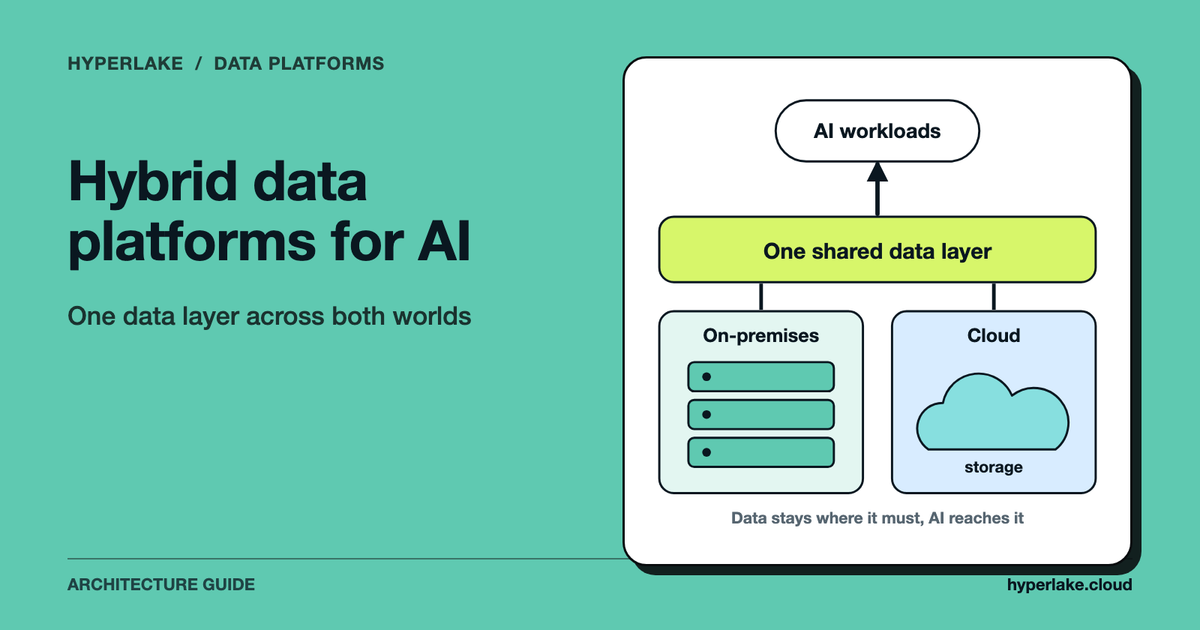
Some organisations don't need one warehouse for everything. They need several engines over a governed data foundation, with a lakehouse design that splits open-table storage, query execution and other processing.
Cloudera and modular approaches such as HyperLake belong in that broader platform discussion. HyperLake can combine customer-controlled data and AI components, including engines such as Trino and ClickHouse. (A note on where HyperLake runs: today that's your own AWS or Google Cloud account, with private cloud and on-premises coming soon.) Whatever you pick, each service and its failure modes still need a clear owner.
Be fair to both sides. Modular gives you choices, and choices create integration and operating work. Downloading an engine is not the same as getting a complete, supported warehouse service.
When should ClickHouse be considered?
When your workload is event data plus analytical queries. ClickHouse provides self-managed installation instructions, so a local deployment is practical, though fit still depends on your query and ingestion patterns.
Put recent-data queries, high-cardinality grouping, joins and corrections to existing records into the test. A business process that relies on transaction semantics or frequent row-level changes should be tested explicitly. Not every SQL database behaves the same way, and assuming otherwise is how projects slip.
Plan who owns it, too. Installing is day one; backup, capacity planning and version maintenance go on for as long as the service exists.
What should buyers check about Greenplum?
PostgreSQL roots help teams with related skills, but they don't make every PostgreSQL workload or extension compatible. Use current Broadcom Tanzu Greenplum material to pin down exactly which product you're discussing, then confirm support and licensing directly.
Before assuming the move is easy, list your functions, extensions, stored procedures and integration tools. Distributed execution changes some design choices, so look at the data distribution and query patterns your application really depends on.
Our yardstick for a Greenplum proof: two outputs, a compatibility list and an operating runbook. An elapsed query time alone won't make your implementation estimate believable.
Where does Vertica belong?
In an analytical warehouse evaluation. Before you design the proof, confirm the supported deployment architecture and software version for Vertica, now presented by Rocket Software.
Use realistic data distribution and retention. Plenty of databases shine on a small, tidy demo, then need different choices once they meet skewed production data or constant corrections.
Test the admin chores as well: loading, reclaiming storage, restoring data, applying an upgrade. Business users never see them, but your operating team lives with them.
How should Teradata be evaluated?
Eligibility is the easy part. Teradata's on-premises offering makes it clear you can deploy locally, so the real questions are about workload management, integration and the support model for your environment.
Bring the reporting jobs that fight each other at month end. One query run in isolation tells you almost nothing about users waiting on dashboards while ingestion and scheduled transformations run.
Ask for a proposal that keeps implementation services apart from ongoing operation. The commercial conversation should cover capacity changes, support boundaries and the work of moving existing SQL and downstream applications.
When does SQL Server make sense?
If you already run Microsoft database infrastructure, SQL Server lets you reuse existing skills and integrations. Its columnstore documentation is a reasonable starting point for analytical storage design.
Confirm the edition, version and hardware configuration you'd actually buy. A feature in the docs doesn't mean every licence or deployment has the same limits.
And ask whether warehouse work should share hardware with operational workloads at all. Familiarity is worth something, but it shouldn't hide resource contention or recovery needs that point to a separate design.
How do Oracle Exadata and IBM Db2 Warehouse compare?
Oracle Exadata comes into play when your estate is centred on Oracle and you're weighing an engineered system. The proposal should spell out hardware, database licences, support and who handles migration.
IBM Db2 Warehouse fits a shortlist where Db2 compatibility, existing skills or its deployment model matter. Confirm the exact offering and the supported local configuration, since Db2 services aren't interchangeable.
For both, list the applications that depend on the current database before you estimate migration. Reports, scripts and runbooks carry assumptions that a table-level schema comparison won't reveal.
What should a fair proof of value measure?
Correctness comes before speed. Pick representative outputs and agree how to compare them, covering null handling, time zones, rounding and late-arriving data. A faster answer is useless if it means something different.
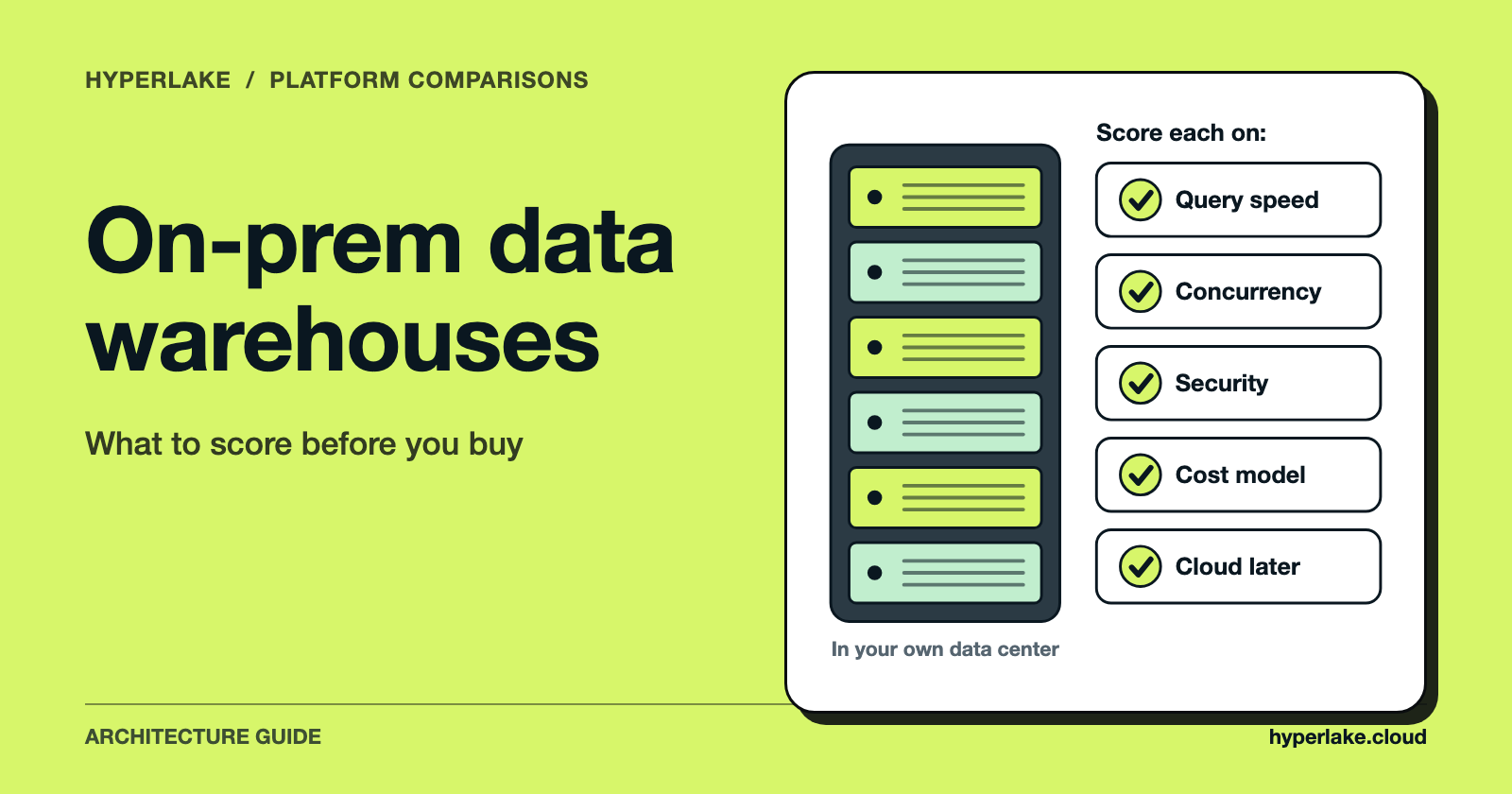
Then concurrency and routine maintenance. Include the busy reporting window, the longest transformation and a data correction, and record resource use and operating effort alongside query time.
Recovery is next, tested with the people who'll run the thing. Ask them to restore a dataset, find a failed ingestion and explain why someone was denied access. You'll learn quickly whether the platform suits the team and its support arrangement.
Tie the scorecard to business requirements. Give every feature equal weight and the biggest product tends to win on capabilities you'll never use.
How should costs be compared?
Use the same period and the same workload assumptions for every candidate. Count licences or subscriptions, infrastructure, facilities, support, migration and operating effort, plus anything that climbs with capacity or forces a new commercial tier.
Three questions to ask: what happens when demand doubles, when a node fails, and when you leave the contract? The answers often reveal obligations the first quote left out.
State the trade-off plainly in the final recommendation. Which requirements does this candidate meet, which need extra work, which are still open? A buying committee gets more from that than from a declared winner.
Frequently asked questions
Is an on-premises warehouse always cheaper than cloud?
No. It comes down to utilisation, existing capacity, licences, facilities and operating effort. Compare the complete service over the same period, migration and recovery included.
Do all SQL workloads move without changes?
They don't. Functions, data types, procedures, transaction behaviour and integrations can all differ, so prove compatibility with representative applications before you commit to a schedule.
Should we choose the fastest benchmark result?
Only if that benchmark looks like your workload and the other requirements are met too. Correctness, concurrent performance, access controls and recovery often matter more than one fast query.
Can HyperLake replace the warehouse engine?
Not by itself. HyperLake is relevant to the surrounding customer-controlled platform and to component selection, and you still choose and assess the underlying query engine for the workload.