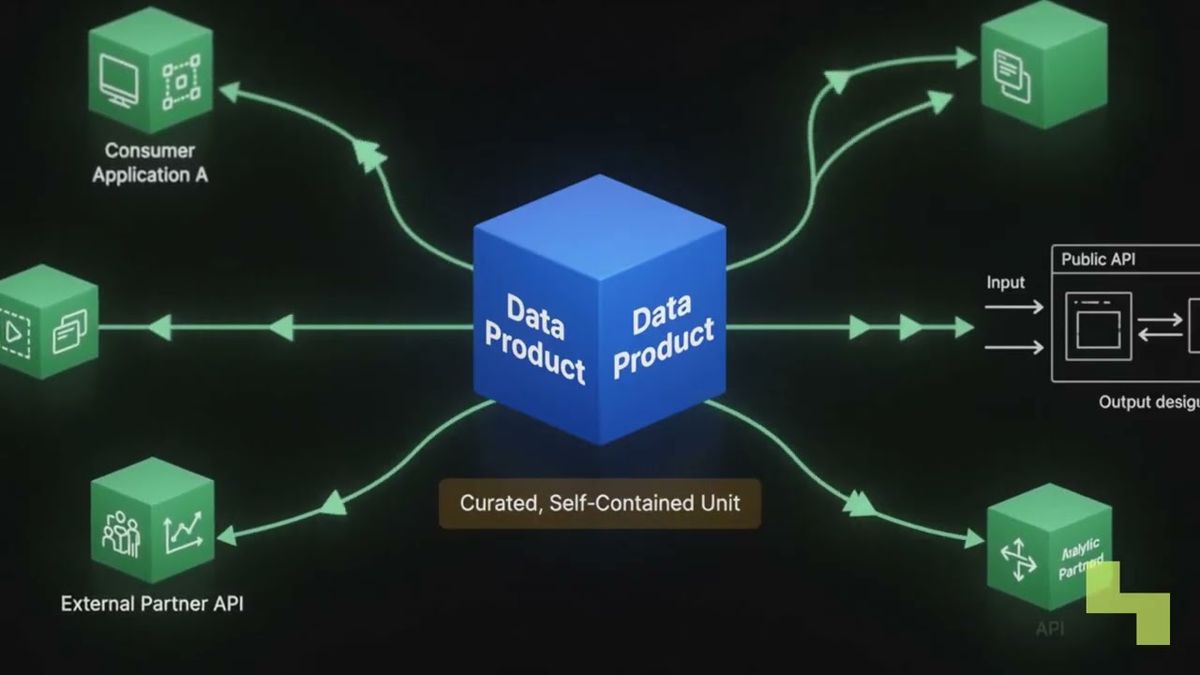
Data products for AI agents are governed, machine-readable data assets with explicit schemas, ownership, quality thresholds, freshness expectations, access requirements and lineage. They give an agent enough context to find suitable data, check it before acting, and trace a decision back to the exact inputs and versions behind it.
An analyst who spots a weird number stops and asks around. An agent just acts on it, and a bad input becomes a wrong action, a misrouted process or a flawed decision that spreads through every workflow downstream.
What are data products for AI agents?
Think of a managed data asset that software can find and rely on, with the operational and governance information an agent needs to use it correctly bundled in.
Traditional data infrastructure assumes a human analyst will read a table, notice something off, apply judgment and decide what to do. Agents don't work that way. They consume data, make decisions, call tools, update systems and sometimes set off other agents. Anything undocumented never reaches them, so their inputs need explicit definitions.
In practice, a suitable data product spells out a schema contract (fields, types, meanings, permitted changes) and names an accountable owner with an escalation path for data problems. It carries quality rules or thresholds that consumers can evaluate, and freshness expectations that show whether the data is current enough. Add access requirements, usage constraints, and version and lineage metadata for later investigation.
None of that makes data infallible. It makes the intended meaning, operating condition and accountability explicit. Think of it as established data product best practices carried over to machine consumers.
How does lineage make agent decisions auditable?
Without lineage you can see what an agent did, but you can't say why, and you can't reproduce the conditions. Lineage ties an output or action to the exact data product, version and upstream inputs behind it.
Useful records capture the product and version consumed, when it was accessed, the relevant transformation path and the identity of the workload making the request. Decision logs then link those inputs to the agent run, tool call, response or downstream event.
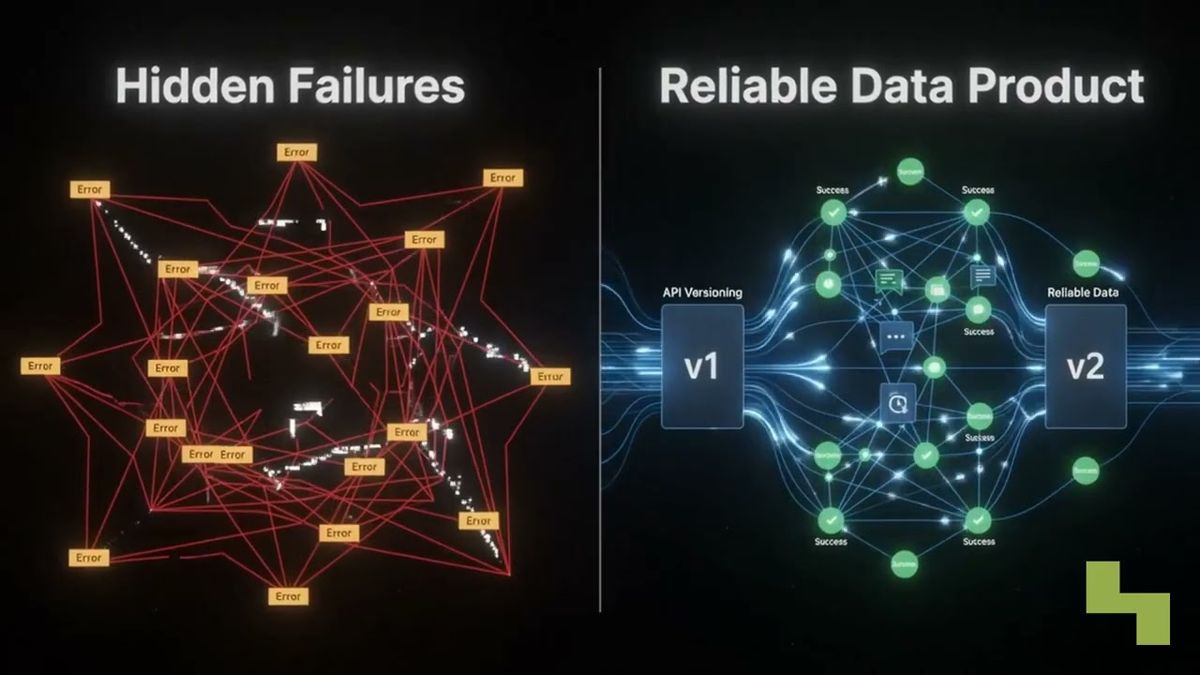
Stakes rise when agents trigger one another. Say an early decision rests on stale or malformed data: later agents can carry the error forward and bury where it started. End-to-end lineage lets operators trace backward through the workflow, so each downstream symptom doesn't look like its own isolated failure.
It helps with correction, too. Once you find a problem product version or a quality breach, you can see which decisions depended on it, pause the affected workflows and route cases for review.
Lineage won't prove a decision was right. It gives you the evidence to inspect and challenge it.
Why do AI agents need stronger data contracts?
Because their mistakes turn into actions. A bad input can make an agent route a case wrongly, send an unsuitable response, update the wrong record or hand a flawed conclusion to another automated workflow. A wrong number in a report is bad. A wrong action is worse.
A schema alone falls short. The agent also has to know whether required fields are populated, whether values sit within expected ranges, whether the product is fresh enough for the task, and whether a breaking change has happened.
What should it do when a condition fails? The contract should answer that. Depending on the workflow, the agent might stop, request fresh data, choose an approved alternative or escalate to a responsible person. Settle it before deployment, because improvising after a failure is how incidents happen.
We think this difference is bigger than it looks. Analysts work through ambiguity as they go. Autonomous or semi-autonomous systems need the ambiguity written down in a form software can evaluate.

How do agents discover and validate data products?
Through machine-readable catalogs. An agent can't lean on word of mouth or institutional memory, so catalog metadata has to say which products exist, what they hold, which tasks they support and what identity or authorization access requires.
Human-readable documentation still helps. Pair it with structured metadata that applications can query: a catalog entry can expose a product's schema, owner, freshness target, quality status, access policy and current version. More on this layer in what a data catalog does.
Then a reliable agent workflow runs through four stages:
- Discover candidate products by meaning, scope and intended use.
- Authorize: confirm the agent's workload identity has permitted access.
- Validate schema compatibility, freshness, quality and version.
- Act or escalate. Continue only when requirements pass; otherwise follow the defined failure path.
This is where machine readability turns into a first-class design requirement. Names, descriptions, policies and validation signals must be consistent enough that software can interpret them without guessing.

How Hyperlake helps
Hyperlake is the AI cloud for your team and your agents, on your cloud. It can assemble a governed data foundation with data, search, vector, graph and streaming services chosen for the workload, plus a reviewed semantic layer so agents see approved data. Its identity-to-data approach uses OAuth/OIDC sign-in, validated JWT identity, OPA policy decisions, enforcement, logging, audit and lineage at integrated access points. To talk through an agent data environment in infrastructure you control, talk to our team.
Frequently asked questions
What metadata should an agent-ready data product include?
Its schema, field meanings, owner, intended use, quality state, freshness expectation, access requirements and current version, plus enough lineage to identify its source and transformations. All of it has to be structured so software can read it. Prose documentation isn't enough.
What should an agent do when data quality checks fail?
Follow a predefined policy, and never assume the data is safe. The policy may say to stop, request refreshed data, use an approved fallback or escalate to a human or the product owner. Log the failure and the response, so operators can look into the data issue and what it did to the workflow.
Can a data catalog alone make agent decisions reliable?
No. A catalog is necessary and nowhere near sufficient. It helps an agent discover and understand data products, but reliability also depends on enforceable access controls, current quality signals, schema compatibility, freshness checks and application behavior. The agent has to validate those conditions before acting and keep evidence of the data and policy decisions it used.
Why must data product versions be recorded for agent runs?
Because a product name can't tell you which exact data state or contract shaped a decision. Record the version and teams can reproduce an agent run, investigate changes and find other actions that relied on the same input. Add lineage and execution logs, and an opaque output becomes a traceable event.