Data product best practices make shared data dependable: assign one accountable owner, version schema contracts, continuously measure quality, document for consumers, register the product in a catalog, and publish realistic service level expectations. These practices turn technically available data into a product that other teams can confidently discover, understand, and use.
Without these controls, consumers face hidden breaking changes, unclear responsibilities, stale data, and uncertain operating commitments. Retrofitting the missing practices becomes harder once reports, applications, and agents depend on the product. The video above walks through the core ideas.
Why does a data product need a named owner?
Every data product should have one named individual accountable for its quality, availability, and evolution. A team can perform the work, but accountability should not disappear behind a department name or shared mailbox.
Named ownership gives consumers a clear route for questions, incidents, and change requests. It also establishes who coordinates decisions when teams must correct a quality issue, delay a schema change, or revise an operating commitment.
The owner does not need to complete every task. That person ensures responsibilities are assigned, problems are resolved, and commitments remain realistic. Ownership information should appear in the product’s metadata so consumers can quickly find someone able to explain its meaning and status.
How should teams version schema contracts?
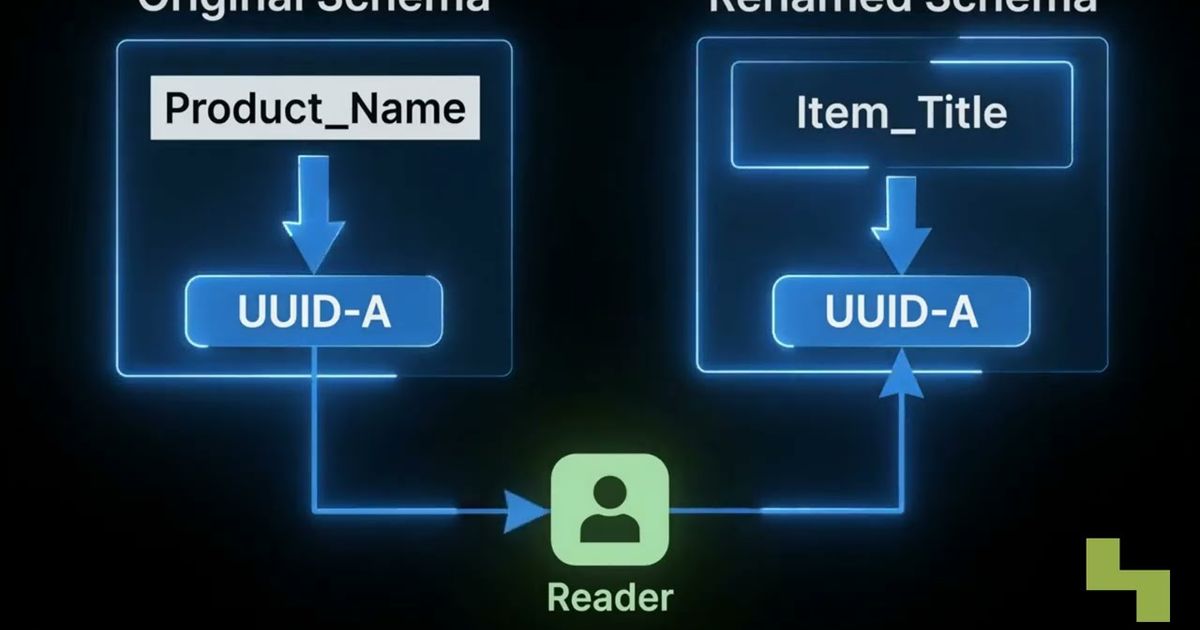
Teams should manage schema contracts with the discipline applied to public software APIs. Each meaningful change needs an explicit version, a compatibility assessment, consumer communication, and an appropriate deprecation window.
A contract defines the structure consumers can rely on, including field names, types, required values, keys, and relevant semantics. Unannounced changes can break transformations, dashboards, applications, and agent workflows even when the producing pipeline still runs successfully.
A practical change process is:
- Propose the change and assess backward compatibility.
- Increment the version and publish the updated contract.
- Notify consumers and provide impact details and migration guidance.
- Maintain the old version through the stated deprecation window.
Compatibility tests can identify structural problems before release, but they do not replace communication. Consumers need time to trace dependencies, schedule migration work, and validate results against the new contract.

Which data quality checks should run continuously?
At minimum, a data product should continuously check completeness, freshness, schema conformance, and referential integrity. Quality should be demonstrated through current evidence rather than inferred from a successful pipeline run.
The baseline checks answer distinct questions:
- Completeness: Are required records and values present?
- Freshness: Was the product updated within its expected interval?
- Schema conformance: Do records match published fields, types, and constraints?
- Referential integrity: Do relationships between identifiers remain valid?
When a check fails, the product’s status should warn consumers before they use stale, incomplete, or invalid data. Silently serving a failed product transfers detection and troubleshooting costs to every downstream team.
Thresholds should reflect the use case. A delayed analytical dataset and a delayed operational feed may have different consequences even when both fail a freshness check. An AI data quality framework can connect measurement with monitoring and remediation.

What should data product documentation include?
Documentation should answer the questions of a consumer who has never seen the data. It must explain how to interpret, access, and safely use the product without depending on the producer’s informal knowledge.
Useful documentation covers the business purpose, record grain, field meanings, units, keys, null behavior, update cadence, known limitations, and representative examples. It should also identify the owner, schema version, quality status, and service level expectations.
Pipeline details may help operators, but they do not tell consumers whether a timestamp represents creation or processing time, or whether missing values are expected. Documentation must evolve alongside schemas, limitations, and operating commitments.
How do catalogs and SLEs enable data self-service?
Catalog integration makes a data product discoverable, while explicit service level expectations help consumers decide whether it fits their architecture. Both are necessary for effective self-service.
A shared catalog should contain accurate metadata, ownership, documentation, schema details, access guidance, and current status. An unregistered or incomplete product still relies on personal introductions and manual support, weakening the self-service principle of data mesh architecture.
Service level expectations, or SLEs, describe the behavior consumers can reasonably expect, such as update frequency, freshness, availability, support, and incident communication. They should reflect the product’s purpose instead of copying a generic standard.
SLEs must also be realistic because consumers use them to make architectural decisions, including whether to cache data, build fallback behavior, or support operational workflows. A modest commitment the producing team can sustain creates more trust than an ambitious expectation it repeatedly misses.
Key takeaways
- Each data product should have one named individual accountable for its quality, availability, and evolution.
- Versioned schema contracts, deprecation windows, and clear communication reduce downstream failures.
- Continuous checks should measure completeness, freshness, schema conformance, and referential integrity.
- Consumer-focused documentation and accurate catalog entries make products understandable and discoverable.
- Realistic SLEs help consumers design around actual operating characteristics.
How Hyperlake helps
Hyperlake lets teams assemble and operate governed data and knowledge services alongside applications, models, policies, audit, lineage, and observability in infrastructure they control. Its modular capabilities support fitting analytical, operational, document, vector, graph, and streaming engines, with lifecycle procedures varying by engine and solution pack. To discuss repeatable data products in your environment or your clients’, talk to our team.
Frequently asked questions
What is the difference between a dataset and a data product?
A dataset is a collection of data. A data product is managed for consumption with ownership, documentation, quality controls, discoverability, and explicit operating expectations. The difference is not a particular storage technology but the commitment to make data dependable for other teams.
Who is responsible when a shared data product fails?
One named owner should be accountable for coordinating the response, communicating with consumers, and assigning corrective work. Engineers, stewards, and source-system teams may handle different tasks, but consumers should not need to navigate the producer’s organization to obtain help.
Can a data product be self-service without a data catalog?
Access is possible without a catalog, but scalable self-service becomes difficult. A shared catalog lets consumers discover the product, understand its meaning, identify its owner, review its contract and status, and learn how to request access without relying on informal knowledge.
Should every schema change create a new data product?
No. Backward-compatible changes can often remain within the product when they are versioned, tested, documented, and communicated. A major version or separate product may be appropriate when the meaning or structure changes enough that existing consumers cannot migrate safely during a reasonable deprecation window.