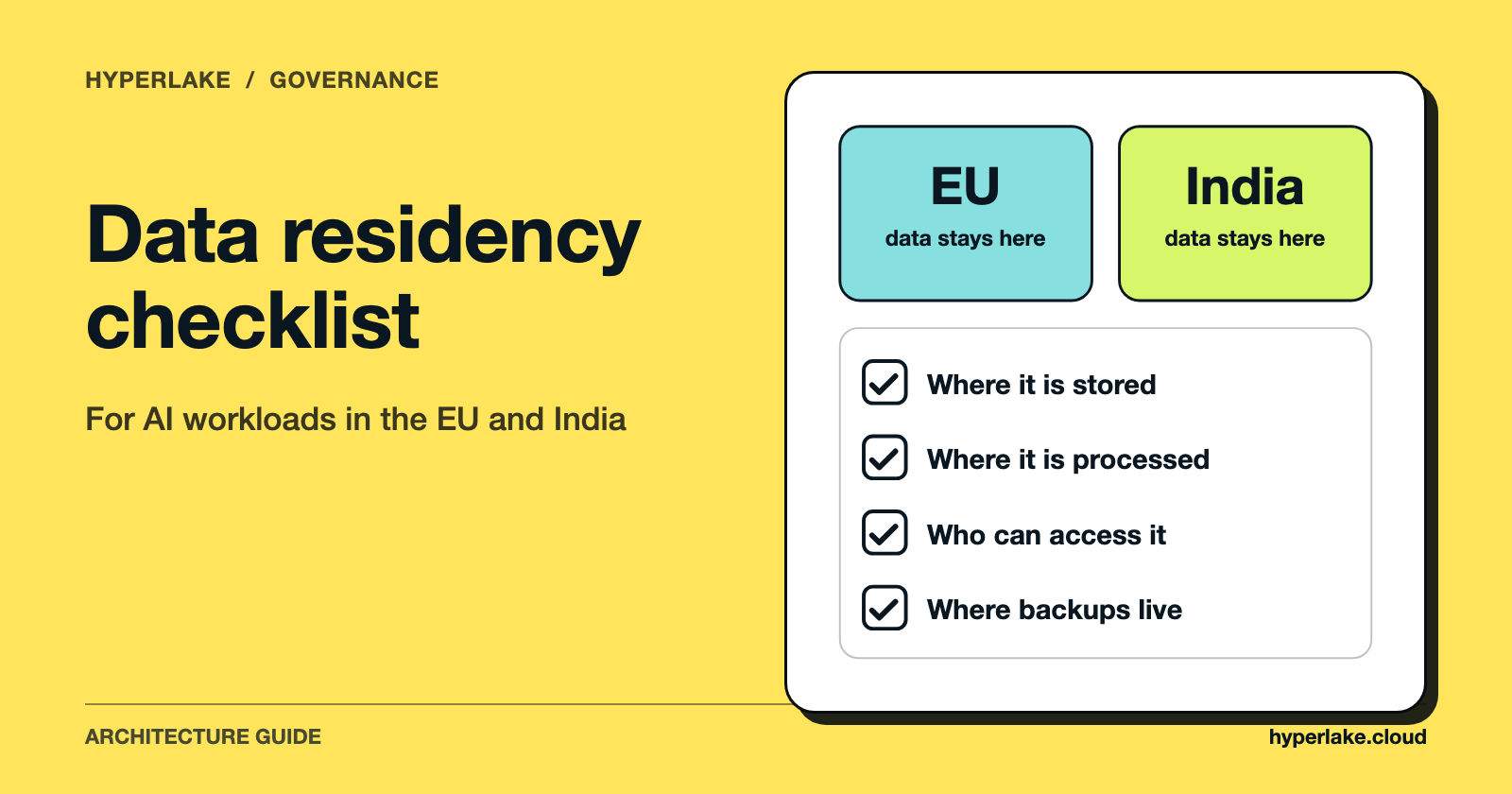
A regional database proves less than people think. Data residency for AI workloads covers every place the data is stored or processed: prompts, retrieved documents, model outputs, logs and backups. So build a complete data-flow map first, then assess the laws, contracts and operational access that apply to each flow.
This is an engineering checklist for preparing that review, nothing more. It won't classify a particular AI system under the EU AI Act, and it can't say whether an organisation has met its GDPR or India DPDP obligations. Your lawyers own that part.

What data can leave an AI application?
More than the architecture diagram admits. Pick a single user request and follow it. A question might go through an application gateway, an embedding service, a retrieval store, a model endpoint and an observability service before the answer comes back. Weeks later, a support engineer pulls the same trace into a ticket.
Write down what the payload contains at each hop. A vector database often holds document fragments and metadata, not only embeddings. A log may hold the whole prompt even though the application "retains no conversations." Error reports can keep input that a successful request would have thrown away.
Background jobs are easy to forget. Evaluation pipelines, fine-tuning runs, moderation services, backups and disaster recovery often take different routes from interactive traffic. Their locations and access rules need the same scrutiny.
| Component | Record these details | Evidence to collect |
|---|---|---|
| Application and gateway | Request routing and fallback destinations | Configuration and network flow records |
| Model and embedding services | Processing location, retention and onward use | Service terms and selected deployment settings |
| Retrieval storage | Document, vector and metadata locations | Storage policy and replication configuration |
| Logs and monitoring | Payload fields, retention and support access | Redacted sample traces and access roles |
| Backups and recovery | Copies, restore location and deletion behaviour | Backup policy and a restore record |
| Administration | Operator identity, location and access method | Access policy and reviewed audit events |
What should you ask a cloud or model provider?
Ask about the exact service and deployment option you've selected, not the brand. AWS, Microsoft Azure and Google Cloud each run many services with different configurations. A statement about one regional storage product tells you nothing about where a separate AI endpoint processes requests.
Our favourite procurement question: "Show us the complete request path when the primary endpoint fails." Fallback behaviour almost never appears in a normal demo, and it can quietly undo an otherwise careful regional design.
Other questions worth putting to them:
- Does failover change the location?
- Which telemetry leaves the region?
- How does support reach customer content?
- Which subprocessors are involved?
For every answer, ask for the contract language and the configuration that backs it up.
An open model, say a Llama or Mistral model, settles part of the deployment decision. It doesn't settle residency. The host, serving software, retrieval components, monitoring and operating practices still create data flows of their own.
What belongs in an EU data residency review?
Start with the people who own the legal reading. For personal data, ask counsel or the privacy team to assess the relevant GDPR obligations: processing purpose, lawful basis, minimisation, retention and transfers. Residency feeds that assessment. It can't stand in for it.
For cross-border arrangements, the EDPB guidance on Article 3 and international transfers is a good first read. What it pushes you towards is mapping who receives or can access data, rather than reasoning only from the address of the storage facility.
The AI Act is a different question. Describe what the system actually does and what role your organisation plays, because a document-search assistant and a system used in a consequential decision raise different issues. The European Commission's AI Act overview explains the risk-based framework; classification and the obligations that follow still need a current review of your specific system.
Then assemble a compact EU evidence packet. Put in the intended use, data categories, provider relationships, locations, access paths, retention settings and who signs off. Anything unresolved goes in as an open question, so assumptions don't harden into compliance statements.
What belongs in an India data residency review?
Begin with the right documents. Assessing India DPDP requirements means working from the final legal texts and the commencement provisions that apply, and an old consultation draft is no basis for a production checklist. Don't assume every provision starts on the same date, either. The MeitY publication page for the Digital Personal Data Protection Rules, 2025 is where the official material lives.
Your legal reviewer should pin down the organisation's role, the covered processing, notices, individual requests, security and breach processes, and any transfer or sector-specific constraints. Record the answer for the real workload and data category. A blanket rule for all AI traffic will be wrong somewhere.
On the engineering side, the packet needs to show how the application finds a person's data, applies the approved retention policy and pushes changes into derived stores. Say a document is removed from the source system. What happens to its chunks, indexes, caches and backups? Explain it.
Then find the places where a human has to step in. A deletion request that depends on an engineer hunting down every copy by hand is a different animal from a documented, repeatable process with an owner and an audit trail.
How do the EU and India checklists compare?
| Review area | EU workload | India workload | Engineering evidence shared by both |
|---|---|---|---|
| Applicable framework | Assess GDPR and AI Act applicability separately | Assess DPDP applicability and commencement, plus sector rules | Intended use and data inventory |
| Parties and responsibilities | Identify relevant controller, processor and AI roles | Identify the roles applicable to the processing | Contracts and responsibility map |
| Cross-border processing | Review recipients, access and transfer arrangements | Review applicable transfer and sector constraints | Data-flow and operator-access map |
| Individual requests | Implement the applicable rights process | Implement the applicable request process | Retrieval, correction and deletion workflow |
| Operational controls | Map controls to the applicable obligations | Map controls to the applicable obligations | Access, retention, incident and recovery records |
Use the table to organise the review. Please don't read it as saying the two frameworks demand the same things.
What should be checked before launch?
Walk through one normal request, one failure and one admin support case. Then open the traces and storage records they actually produced. Does the documented path match what got built? A diagram isn't evidence.
Next, rehearse a restore and a data-removal request. Both tend to turn up forgotten copies and fuzzy ownership. Be honest about limits, including retention constraints where a backup copy is removed on a schedule, not immediately.
Finish with a signed-off responsibility map covering who approves a new model endpoint, who changes retention, who reviews access and who responds to an incident. Residency is an operating job, and it stays one long after the first deployment.
Where does self-hosting help?
Running components in an environment you control makes placement, network policy and operator access more directly configurable. HyperLake supports deployment in customer environments with modular data and AI components. Today that means your own AWS or Google Cloud account, where you choose the region; private cloud and on-premises infrastructure are coming soon.
It's a deployment capability, not a compliance result. You still configure access, approve dependencies, control telemetry and run the system. A self-hosted model that ships traces to an external service still has an external data flow.
Begin with an egress inventory. For each outbound destination, note the purpose, payload, owner and approval. Keep package and model downloads apart from runtime data transfers, since you'll want to make different decisions about each.
Frequently asked questions
Does EU hosting make an AI system GDPR compliant?
No. Where it's hosted is one consideration among several. Purpose, lawful basis, individual rights, security, the relationships between parties and any transfer arrangements all need assessing too.
Does using an open model keep data local?
Only if the whole deployment keeps the relevant data local. Model hosting, embeddings, retrieval, monitoring, backups and support access all count.
Should prompts be included in the data inventory?
Definitely. Prompts can carry personal, confidential or commercially sensitive information, including text copied from retrieved documents. Include outputs and traces as well.
Who should approve the final checklist?
Each owner signs for their part: the system owner, the security owner and whoever handles privacy or legal review. Engineering evidence supports their decision, but it isn't a substitute for legal interpretation.