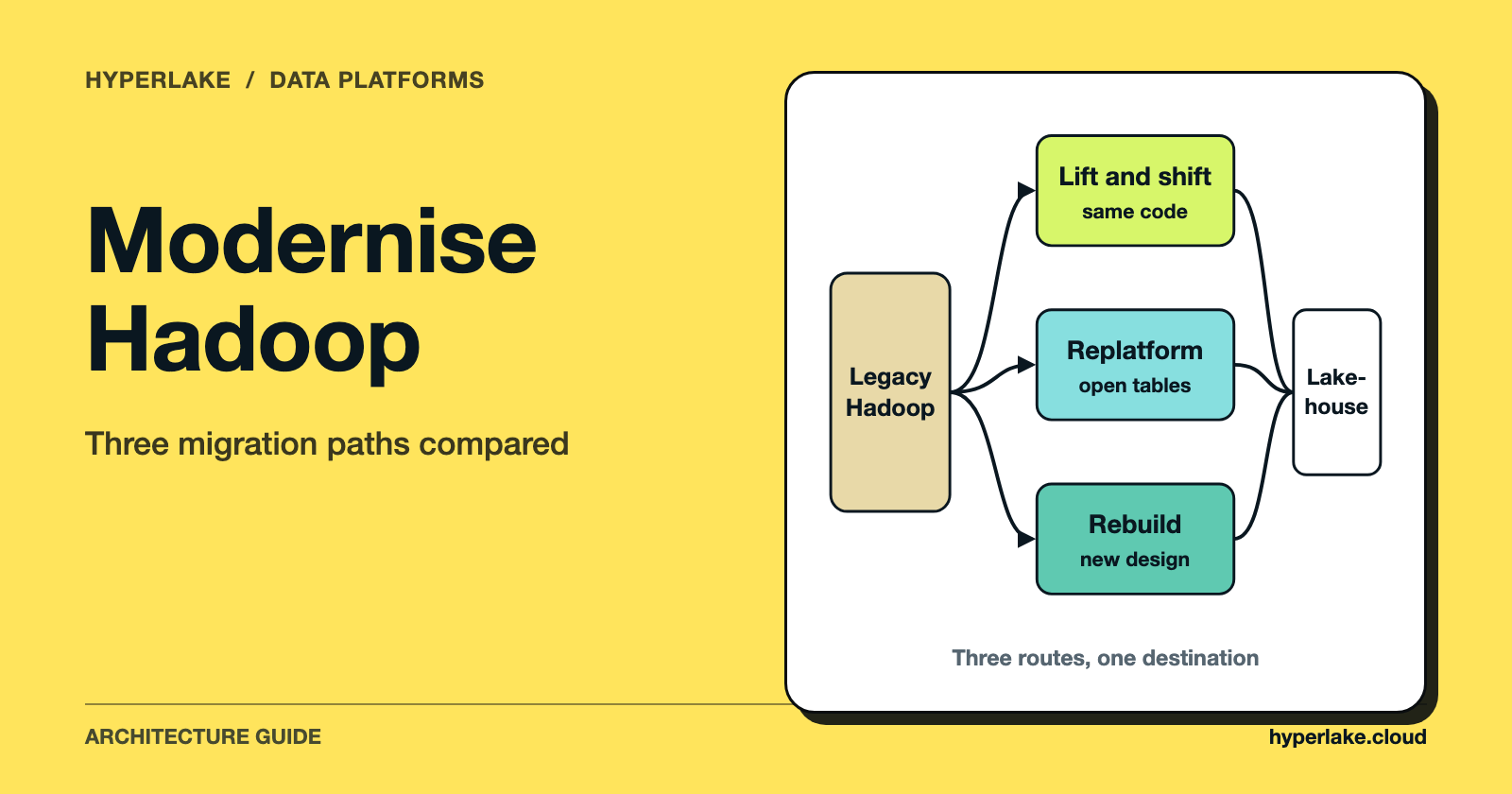
To modernise a legacy Hadoop environment, move well-understood data products in stages and keep their meaning, permissions and operating requirements intact. There are three main migration paths: a supported platform transition, managed cloud services, or a modular lakehouse built on open storage and chosen compute engines. Which one is right depends on the jobs that have to survive and where they're allowed to run.
Copying the files doesn't finish a migration. It's finished when the people and systems that depend on that data get correct, timely and properly controlled outputs from the new platform.

Which Hadoop migration paths are available?
| Path | Best fit to investigate | Main trade-off |
|---|---|---|
| Supported platform transition | Teams retaining a broad integrated data stack | Continuity versus platform and commercial constraints |
| Managed processing services | Workloads suited to cloud-managed frameworks | Reduced infrastructure work versus service dependencies |
| Managed warehouse or analytics platform | SQL-centred consumption | Operational convenience versus rewrite and deployment boundaries |
| Modular open lakehouse | Teams needing component and placement control | Flexibility versus integration and operating work |
| Selective retirement | Unused or superseded workloads | Lower complexity versus the need to establish real dependencies |
Mix them if you like. One programme can use several paths, as long as every data product gets a deliberate destination and nothing gets duplicated by accident.
When should a supported platform transition be considered?
Does your organisation lean on several integrated components, with the operating skills to match? Then a supported transition within a platform family may be worth evaluating. Continuity doesn't mean nothing changes, so compare the target version and architecture with the estate you actually run.
Which jobs, security configurations and storage patterns will need adapting? Ask early. Put the commercial and support timeline into the plan as well; otherwise the technical migration can leave you running something unsupported for a stretch.
The route can save some redesign. It still has to clear out obsolete work. Carry every old service forward and you carry its cost and complexity with it.
When do managed services make sense?
Managed services shift who handles operations. They don't remove the review of your applications and dependencies. Amazon EMR and Databricks are examples to assess for processing and data-platform workloads in supported cloud environments.
Snowflake is a different route, aimed at workloads that suit managed analytical SQL and data services. A move to a warehouse can mean redesigning the processing logic, rather than carrying existing jobs across unchanged.
Trace the whole workflow for any of them, plus its recurring cost: data transfer, scheduled compute, storage and support. A single successful run proves very little about what it costs, or how reliable it is, when it runs every day.
What does an open lakehouse path involve?
Think of three layers: storage, table metadata, compute. A modular lakehouse usually keeps them separate. Apache Iceberg and Delta Lake are table-format options to evaluate against engine support and workload needs.
Apache Spark can handle processing; Trino can provide distributed SQL querying. Around them you'll still need a catalog, ingestion, access control, maintenance and observability.
Open formats give you choices, but compatibility has to be checked per operation and per version. Reading a table, writing it and maintaining it are three different capabilities. An engine that supports a format won't necessarily support every operation the same way.
What should the Hadoop inventory include?
Whichever route wins, start by listing what exists: datasets, jobs, schedules, service accounts and downstream consumers. Add the rarely run processes, the custom libraries and the scripts that sit outside the main orchestration system. Old estates are full of important work documented only in one team's habits.
Who owns each data product, and what is it for? A table name won't say whether it feeds billing, an internal dashboard or an experiment someone abandoned years ago. The owner can tell you what to retire and what needs careful continuity.
Then write down the operating requirements: freshness, recovery, retention and access. They make a far better migration target than reproducing every historical configuration setting.
How should you select storage?
Leaving a filesystem-oriented design tends to expose hidden assumptions about paths, rename behaviour, permissions and small files. Find them in your jobs and libraries before you treat the copy as a transparent storage swap.
The target might be object storage such as Amazon S3, Azure Data Lake Storage or Google Cloud Storage, or a suitable private object-storage arrangement. Choose by deployment requirements, supported interfaces and the way the workload reads data.
And give the data lifecycle owners. Compaction, retention, metadata maintenance and backup don't disappear when storage and compute are split.
What should happen to orchestration?
Don't replace the scheduler until you've inventoried the scheduling logic. Dependencies, retries, alerts and manual steps may be scattered across scripts and runbooks.
Apache Airflow is one orchestration option to assess for suitable workflows. Pick any tool and the new schedule should make failures and dependencies visible to the people running it.
An opaque script turned into an equally opaque task is a wasted chance. Use the migration to spell out inputs, outputs and retry behaviour. Can the job be rerun safely under its documented conditions? If not, say so explicitly.
How should the first wave be chosen?
Choose something bounded: a data product with an engaged owner, known consumers and manageable dependencies. It should teach the team something real without carrying the whole organisation's risk.
Move the complete path, meaning ingestion, transformation, permissions and consumption. A copied table with no validated consumer proves only half of what you need.
The old path stays up during reconciliation. Settle the acceptance criteria and rollback conditions before anyone sees the new results, because a deadline has a way of quietly replacing the quality standard you agreed.
How do you prove the migrated data is correct?
Row totals match. Great, but that tells you little. Matching counts can hide changed joins, time-zone handling, null semantics or rounding, so compare business outputs, and include late-arriving and corrected records.
Then check access, once as an ordinary user and once as each service account. Right numbers with wider access means you haven't preserved the data product's requirements.
Log intentional differences too. Some will genuinely improve the old logic, and they should still be reviewed as changes instead of tucked inside a migration everyone calls equivalent.
Where does HyperLake fit?
HyperLake supports modular data and AI infrastructure in customer environments. It can be relevant to a lakehouse path that uses components such as Iceberg, Trino and other selected engines while keeping your placement and operational choices.
Map each workload to a component and name the policy enforcement points. Integrated controls don't automatically cover direct storage access or every independently configured engine.
Hold a HyperLake design to the same acceptance criteria as any other destination: correct outputs, appropriate access, reliable operation and a release you can recover from.
How should the old Hadoop environment be retired?
Before anything gets switched off, get evidence that consumers have moved and that required records are kept. Check scheduled jobs, dormant integrations and the reports that only run occasionally.
Parallel running needs an end date. Without one, savings you expected disappear and nobody is quite sure which source is authoritative.
Archive the relevant configurations, mappings and reconciliation results under your retention policy. You'll want that knowledge for audit and troubleshooting, and you won't want unneeded infrastructure kept alive to hold it.
The last milestone includes operational ownership of the new platform. If only the project team knows how to recover it, it isn't fully migrated, and we'd hold the sign-off until that's fixed.
Frequently asked questions
Should we move all Hadoop workloads at once?
Usually not. Staging the work makes dependencies and rollback much easier to manage, so move complete data products and let each wave sharpen the estimate for the next.
Is copying HDFS data to object storage enough?
No. Jobs, metadata, permissions, file assumptions and downstream consumers all need review, and the complete workflow has to be validated on the target architecture.
Does an open table format eliminate lock-in?
It can make you more portable. Catalogs, engine features, governance and operating practices still create dependencies, so look at the real exit path and which operations are supported.
When can the old cluster be shut down?
Once required consumers have moved, outputs and operations are accepted, retention needs are handled and rollback decisions are settled. Confirm the infrequent workloads as well as the daily jobs.