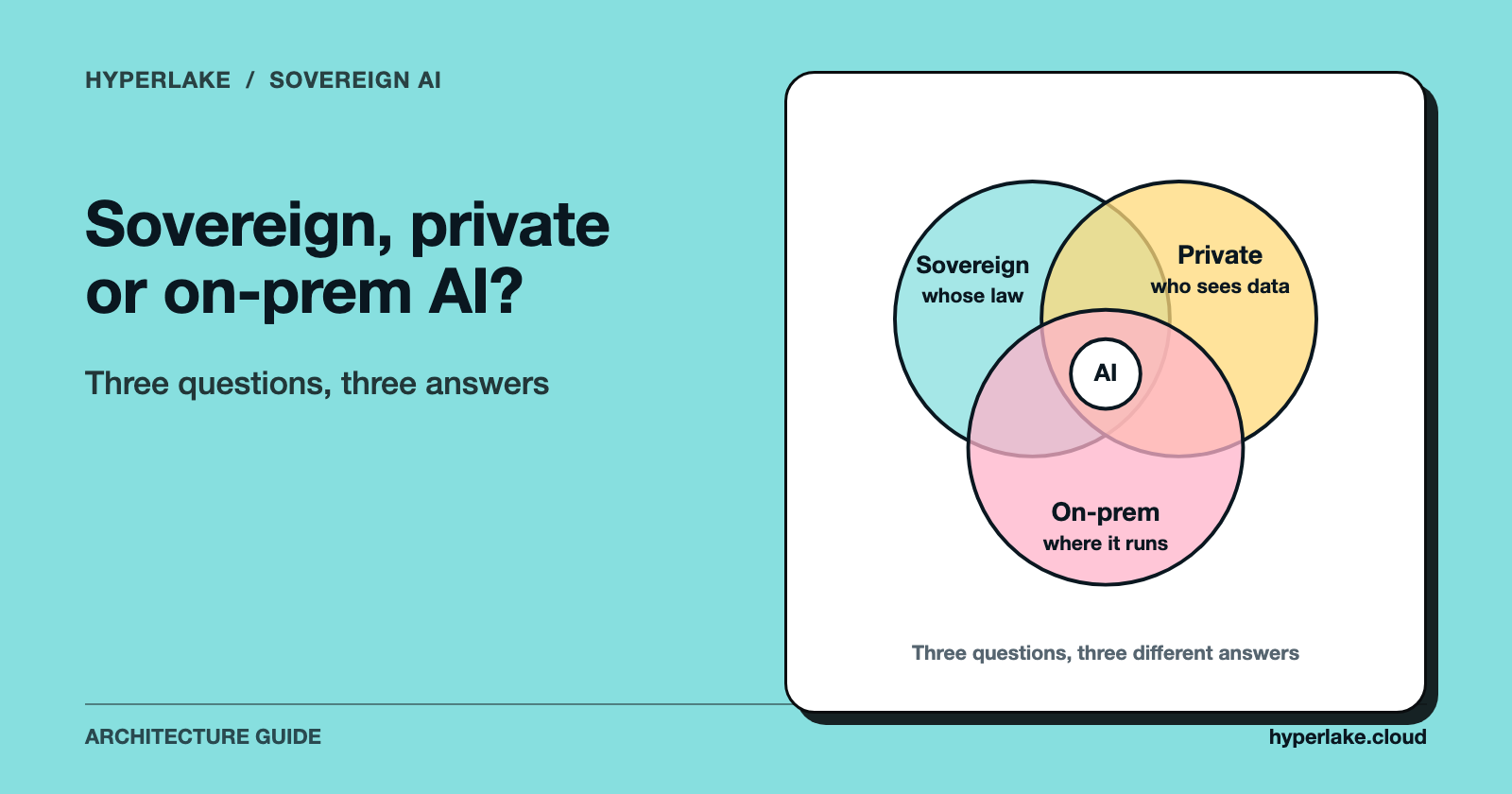
These three terms get used as if they mean the same thing. They don't. In the sovereign AI vs private AI vs on-prem AI question, private AI is about restricting access to an AI system and its data, on-prem AI is about where the infrastructure runs, and sovereign AI is about authority and practical control over the system, its data and its dependencies. A deployment can meet one description and miss the other two.
Attach each term to a decision and it gets clearer. "We need a private endpoint" is an access requirement. "The model must run in our facility" is a placement requirement. "Only approved operators may administer it, and we must keep control during an outage" adds operational requirements on top.

What does on-prem AI mean?
The relevant infrastructure runs at your organisation's premises. The hardware can be owned or contracted, and outside software and support providers may still be involved.
Being on site gives you a direct say in facility, network and hardware decisions. Power, cooling, maintenance, capacity and recovery become yours too; a managed cloud service would handle them differently.
Local doesn't mean disconnected, though. A model server might still need external package repositories, licence services, identity systems or support access. Need it disconnected? Say so as a separate requirement, and make the supplier demonstrate it.
What does private AI mean?
Usually, a deployment where the organisation restricts access to the model service, its data, or both. Suppliers use the word loosely. So ask what exactly is isolated, and how.
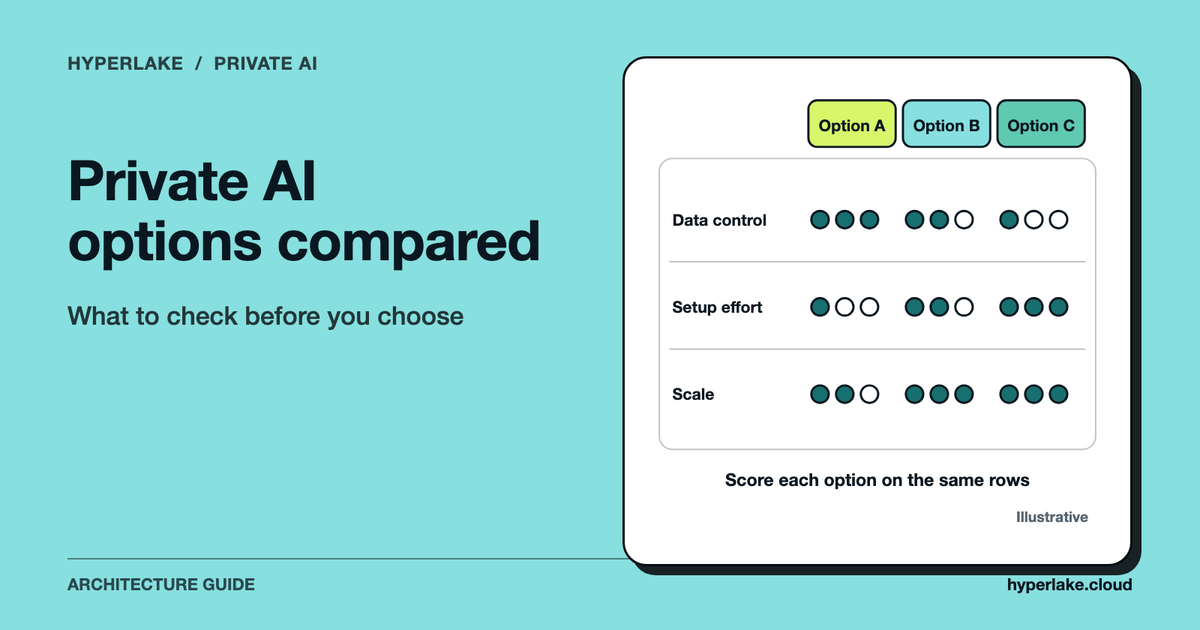
Three controls tend to sit under the label. A private network endpoint can restrict connectivity. Dedicated infrastructure can cut down sharing with other customers. Contract terms can limit how submitted data gets used. Document each one on its own.
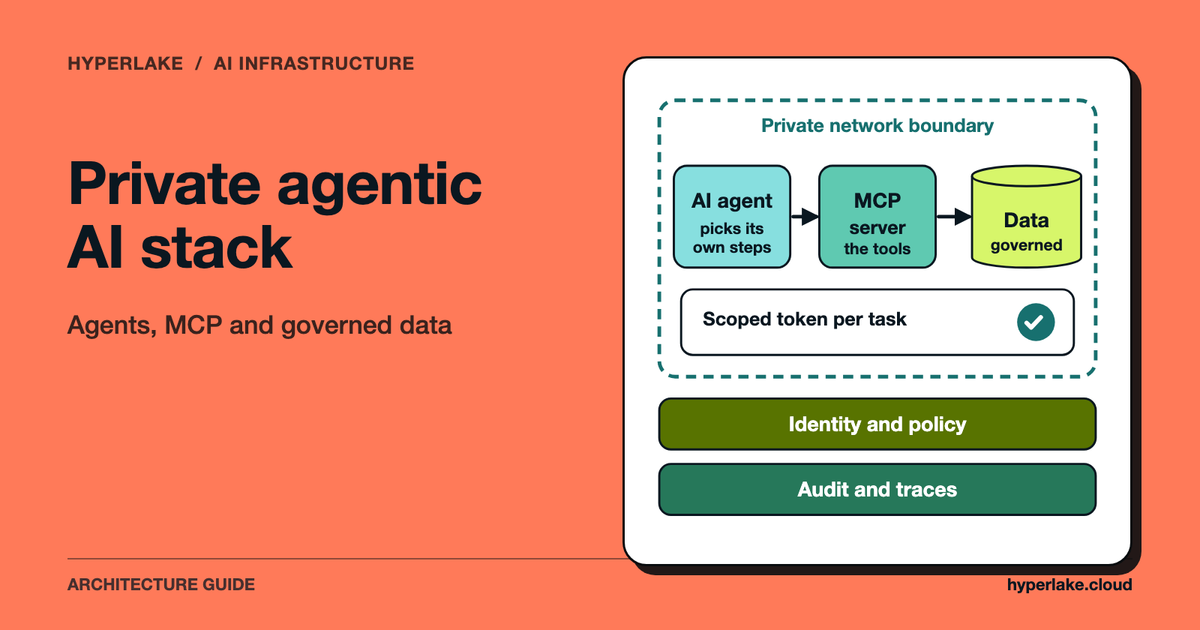
Then look at the whole application. A private model endpoint can still pull documents from a badly governed repository, or ship traces to some separate external system. Privacy depends on the complete workflow and the purposes you've approved.
What does sovereign AI mean?
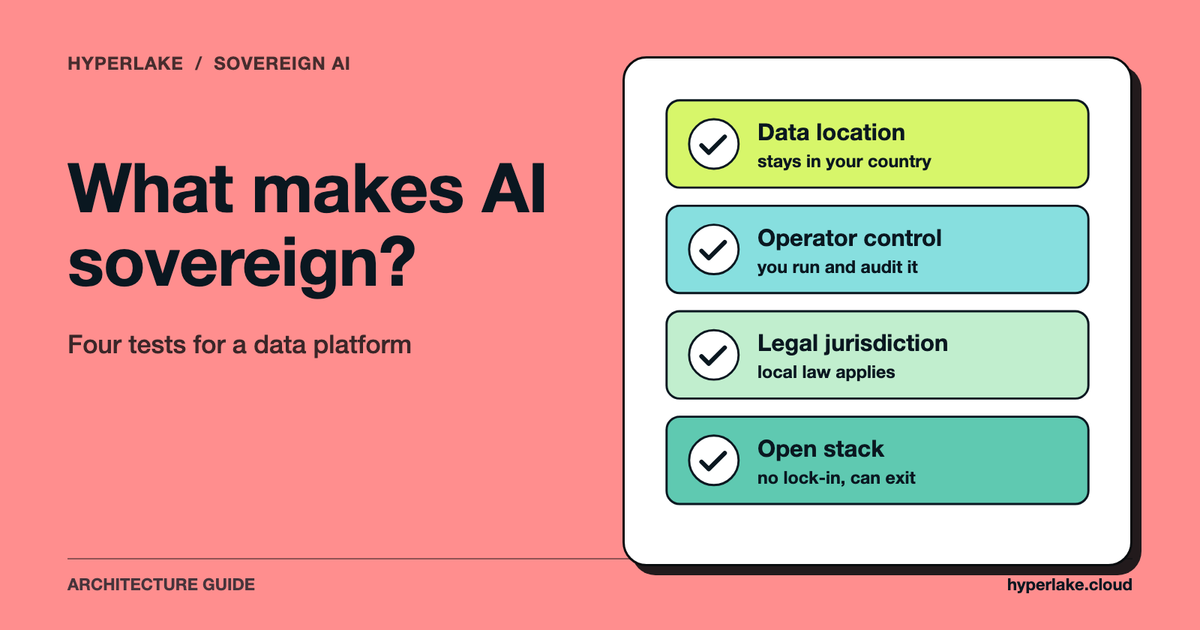
Who can administer the system? Which legal and contractual relationships apply? Who controls keys and artifacts, and how dependent are you on outside parties? Sovereignty is the answer to those control questions.
You can't read it off a supplier's nationality or a server's location. A locally hosted system can depend on an external control plane, whereas a cloud arrangement can provide controls that matter for a particular requirement.
"Sovereign" becomes useful once you write the control arrangement as requirements someone can inspect, so a reviewer can tie it to architecture, contracts and operating evidence.
How do the three concepts compare?
| Question | Private AI | On-prem AI | Sovereign AI |
|---|---|---|---|
| Who can connect? | Central concern | Depends on configuration | Part of the control arrangement |
| Where does compute run? | May be cloud or local | At the organisation's premises | Must meet the defined requirements |
| Who operates the service? | Must be clarified | Customer, supplier or shared team | A central requirement to assess |
| Are external dependencies allowed? | Depends on the design | Possible unless restricted | Depends on the sovereignty requirements |
| Is compliance automatic? | No | No | No; assess the applicable obligations |
Requirements often arrive bundled into one vague request, and the table pulls them apart. Expect the design you end up with to need controls from every column.
Which approach should an organisation choose?
Begin with whatever is mandatory. Data that must be processed at a site with no external connectivity probably can't use an ordinary managed endpoint. Controlled employee access to a general assistant? A suitable private cloud arrangement may be plenty.
Compare complete costs and responsibilities. On-premises hardware gives you control and capacity, with maintenance work attached. Managed services take some operational burden away and add dependencies you'll need to review.
Write down the trade-offs you've accepted. A plain decision that names the remaining dependencies beats an ambitious label that hides them.
What would the difference look like in practice?
Picture a fictional manufacturer building an assistant for maintenance manuals. Suppose it limits access to employees on a managed model service in a private cloud deployment. That meets the access requirement, but not a local-compute one.
Now run the model and retrieval store in the factory's data centre instead. Better for placement. If diagnostic traces go to an outside monitoring service, though, some information still leaves the building.
A sovereignty review asks more. Who can read those traces, and who can change the model? What happens during a supplier outage: could the manufacturer keep running or move the service? Those answers fill in the detail the deployment decision needs.
How should requirements be written?
Skip the broad adjectives. Write concrete statements: permitted processing locations, authorised operator groups, key ownership, retention, outbound destinations and recovery behaviour.
Then the exceptions. Support access, a failed region, a model update and a contract exit can each change who controls the system or where data goes, so all of them belong in the design review before launch.
Every requirement needs an owner. Security, legal, infrastructure and application teams each bring different evidence, and a requirement nobody owns tends to stay an assumption forever.
How can the design be checked?
Trace one request from the user through retrieval and inference to the final output, and inspect the logs and other copies it leaves behind. Repeat for an admin support action.
Rehearse a dependency failure and a restore. Is the documented fallback the one the application really uses? A system that has to stay inside a boundary needs a failure path that stays inside it too.
Last, exit. Can you get your data, model artifacts and configuration back in a usable form? Do any licences or services stop you running it yourself? Real control includes being able to change direction.
Which supplier categories are involved?
Cloud providers such as Oracle, AWS, Google Cloud and Microsoft publish sovereignty-related offerings or guidance. Compare the named service and configuration, not the brand as a whole.
IBM Sovereign Core is another control-oriented option to look into. Hardware and platform suppliers, including NVIDIA, HPE, Dell and Red Hat, may supply parts of a private or on-premises design. Their presence alone doesn't establish the control properties of the whole system.
Managed data platforms such as Databricks and Snowflake may be in the architecture too. Assess their specific service boundaries and dependencies; a private networking option doesn't make the entire application sovereign.
Where does HyperLake fit?
HyperLake supports customer-environment deployments with modular data and AI components. Today that means your own AWS or Google Cloud account; private cloud and on-premises deployment are coming soon. It's relevant if you want to bring data services, model serving and access controls together in an environment you control.
The operating model is still yours to define. Who administers the components, where are policies enforced, which external services remain, and how are updates approved? A customer-controlled environment is a good starting point for answering those.
Pick components to suit the workload. A database, vector store or orchestration service that can be included isn't automatically one that should be. We'd usually take a smaller system the team understands, since it's easier to operate and easier to assess.
Frequently asked questions
Can private AI run in the public cloud?
Yes. You can build private access and data-handling arrangements on cloud services; just assess the exact controls and service terms instead of trusting the label.
Is every on-premises deployment sovereign?
No. External administration, control planes, licences and support dependencies can all still be there, so review the whole authority and operating arrangement.
Does sovereignty require open-source software?
Not necessarily. Open components help with portability and inspection, but sovereignty also involves operations, contracts, keys and dependencies. Licence and support choices need their own review.
What should we decide first?
Start by defining the required locations, access, operator authority and failure behaviour. With those written down, choosing a deployment and a supplier becomes a meaningful comparison.