A data lakehouse is a unified architecture that combines the scalable, low-cost storage of a data lake with the transactions, metadata, governance, and reliable SQL access of a data warehouse. Analytics and machine learning workloads can use one governed copy of data instead of moving data between separate lake and warehouse systems.
This matters because maintaining two platforms creates duplicate data, delayed updates, inconsistent governance, and extra ETL pipelines. A lakehouse reduces that separation while supporting both business intelligence and AI workloads. The video above walks through the core ideas.
What is a data lakehouse?
A data lakehouse stores data in standard object storage while adding a management layer that makes files behave like reliable warehouse tables. It combines flexible storage with structured data management and dependable querying.
Traditional architectures use a data lake for large volumes of raw or semi-structured data and a separate warehouse for curated, structured datasets. ETL pipelines copy and transform data between them so analysts can run SQL queries. That model creates two storage systems, multiple data copies, and separate governance concerns.
A lakehouse instead structures and governs data in place. Raw, refined, and curated datasets can remain on one storage foundation while different compute engines access them for analytics, processing, and machine learning. It does not eliminate ingestion or transformation; it removes the need for a separate warehouse copy solely to gain warehouse-style management.
For a layer-by-layer view, see this guide to data lakehouse architecture.
How does a data lakehouse architecture work?
A lakehouse separates durable storage from table management, governance, and compute. Compatible engines query governed tables through metadata instead of treating object storage as an unmanaged collection of files.
Its main layers are:
- Object storage: Holds structured, semi-structured, and other data in common file formats.
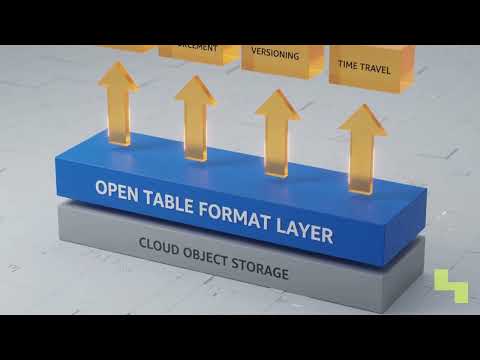
- Open table format: Organizes files into tables and records schemas, snapshots, partitions, and changes.
- Metadata catalog: Supports discovery and tracks definitions, access policies, lineage, and quality information.
- Compute engines: SQL engines, processing frameworks, and machine learning tools read the same governed datasets.
Separating storage and compute lets teams choose engines according to each workload while retaining a shared data foundation. Practical interoperability still depends on whether each engine supports the selected table format, catalog, and required operations.

What do open table formats add to a data lake?
Open table formats add transactional and metadata capabilities that files in object storage do not provide alone. Apache Iceberg, Delta Lake, and Apache Hudi are common examples.
Depending on the format and engine, these capabilities include:
- ACID transactions that maintain consistent table states during concurrent reads and writes.
- Schema enforcement and evolution that manage structural changes under defined rules.
- Versioning and snapshots that identify table state at a particular point.
- Time travel that allows authorized users to query earlier table versions.
- Metadata-based planning that helps engines locate relevant files efficiently.
Data warehouses traditionally supplied these functions through proprietary storage and query engines. Open table formats make them available over commodity object storage to compatible compute systems. Learn more in open table formats explained.
Why use one governed data layer for analytics and AI?
A shared governed layer reduces the need to synchronize separate lake and warehouse copies. Business intelligence tools and machine learning pipelines can work from the same underlying data while using interfaces and controls suited to each workload.
This approach can provide several operational benefits:
- Removing the lake-to-warehouse copy avoids latency caused by that transfer.
- Fewer duplicate datasets reduce drift between analytics and machine learning inputs.
- Shared metadata helps teams apply schemas, lineage, quality information, and access policies consistently.
- Independent compute supports SQL analytics, batch processing, and model training without duplicating durable storage.
A lakehouse does not automatically create clean data or effective governance. Teams still need reliable ingestion, transformation, ownership, quality checks, access controls, and catalog maintenance. They must also verify that their engines implement the required transaction, schema, and time-travel behavior correctly.
For organizations running business intelligence and AI, the architecture provides a common foundation for curated SQL tables and model training data. Its value is highest when shared storage and metadata replace duplication rather than becoming another platform alongside existing systems.

Key takeaways
- A data lakehouse combines object storage with warehouse-style transactions, metadata, governance, and SQL reliability.
- Open table formats organize files into dependable tables that compatible engines can read.
- A metadata catalog tracks schemas, policies, lineage, quality information, and table definitions.
- One governed layer can reduce transfer latency, duplicate copies, and drift between analytics and AI systems.
- A lakehouse still requires reliable pipelines, access controls, data quality practices, and engine compatibility.
How Hyperlake helps
Hyperlake can assemble and operate a governed data foundation in infrastructure controlled by an organization or its client. Depending on the workload and deployment, that foundation can use Iceberg and object storage with a fitting query engine such as Trino, alongside other data services. Hyperlake adds shared controls for identity, access, observability, lineage, audit, and lifecycle operations; to discuss a specific deployment, talk to our team.
Frequently asked questions
Does a data lakehouse replace ETL and ELT pipelines?
No. A lakehouse can remove the ETL process used only to copy data from a lake into a separate warehouse, but data still needs ingestion, validation, transformation, and curation. These pipelines can operate directly against lakehouse tables, reducing unnecessary movement while preserving the processing required to make data useful.
Can multiple query engines use the same lakehouse tables?
Yes, when the engines support the selected table format, catalog, file formats, and required operations. Separating storage from compute allows SQL engines, processing frameworks, and machine learning tools to share a foundation. Teams should test compatibility because support for writes, schema evolution, transactions, and time travel can vary.
Is a data lakehouse suitable for machine learning training data?
A lakehouse can support machine learning by storing large datasets, preserving versions, and making governed data available to training pipelines. The same foundation can serve curated tables to analytics tools. Teams still need feature preparation, quality validation, access controls, and reproducible references to the data versions used for training.
What is the difference between a data lakehouse and a data warehouse?
A traditional data warehouse usually combines managed storage and compute in a system optimized for structured analytics. A lakehouse places table management and transactional metadata over object storage, allowing compatible engines and workload types to share data. The better choice depends on workload requirements, governance needs, operational skills, and existing infrastructure.