Apache Parquet is a self-describing, columnar file format built for analytical workloads. It stores values from the same column together, so query engines read only the columns they need, compress similar data efficiently and skip irrelevant groups of rows using statistics kept in the file metadata.
Analytical queries are picky eaters. A table might have dozens of columns while a given report touches three. Once that clicks, it's obvious why physical storage layout drives so much of your I/O and processing cost.
How does Parquet skip irrelevant row groups?
The fastest read is the one you never do.
Parquet keeps column statistics in its metadata, usually minimum values, maximum values and null counts for each row group. Say a query wants July transactions. A row group's minimum and maximum dates say it holds only May records, so the engine drops it without reading or decompressing a single data page. That's called predicate pushdown, and at the storage layer, row-group pruning.
The engine turns the query filter into a predicate and reads the Parquet footer and the relevant statistics. It rules out row groups that can't hold matching values, then opens the needed columns in the groups left over.
One caveat. Statistics say a group might match, not that every row does. If the value you're after falls between a group's minimum and maximum, the engine still has to read and filter it. Pruning works best when the layout produces useful value ranges, so how you sort data when you write it matters.

Why is Apache Parquet used in data lakehouses?
Because one file packs in a lot: selective column reads, efficient compression, metadata-driven pruning and an embedded schema. Together that makes it a common physical file format for analytical data in object storage.
The footer carries the schema alongside statistics and other metadata, so a compatible reader can work out one file's fields and data types with no external schema registry. A table built from many files is different. It may still need a catalog or table format to manage file locations, partitions, schema evolution and snapshots.
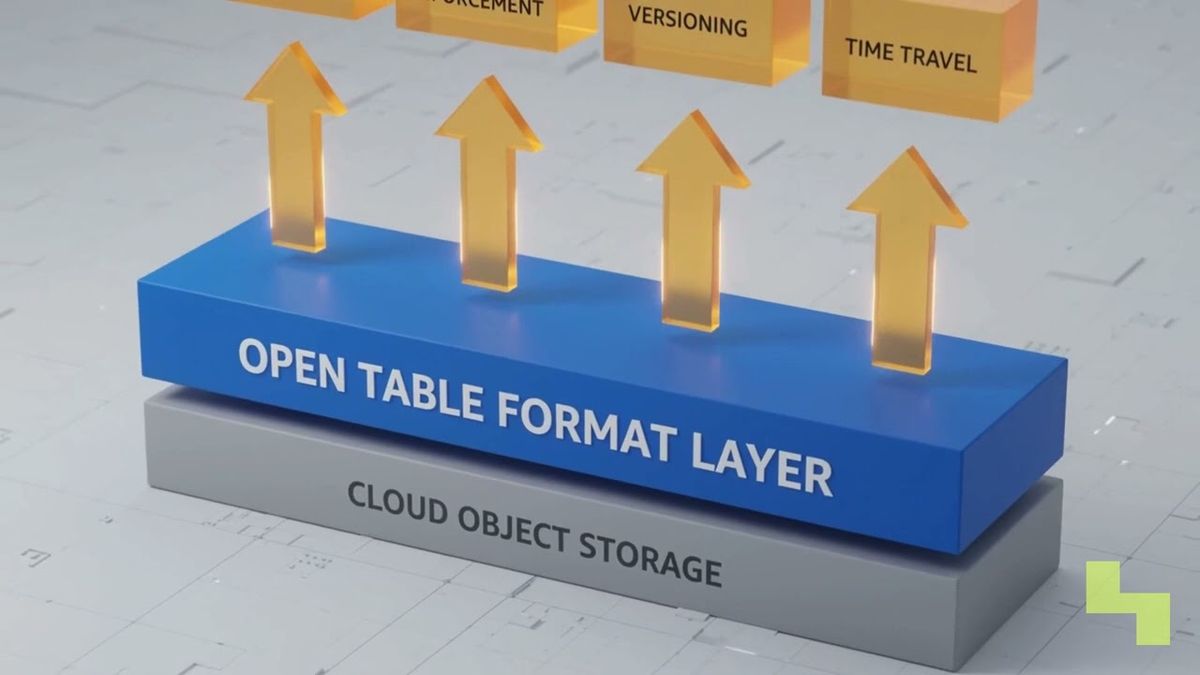
That's where Apache Iceberg comes in. Open table formats such as Iceberg commonly use Parquet for their data files: Parquet defines how values are represented inside each file, and Iceberg manages how a pile of files becomes one consistent table over time. There's more on that split in what Apache Iceberg is.
Parquet alone gives you no table transactions and no coordinated metadata changes. Those come from the table format, catalog, storage system and query engine around it.
How does Parquet reduce data reads and improve compression?
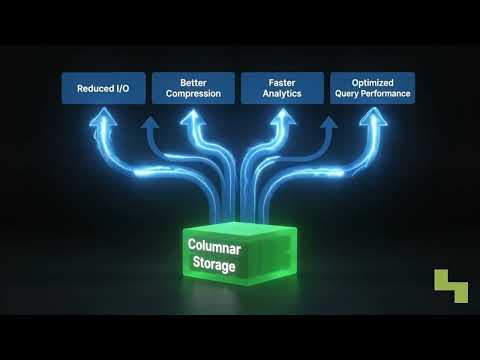
Two mechanisms do most of the work. The first is column projection: the engine loads only the columns in the query plan. The second is compression, which gets better because each column holds one data type, often with similar or repeated values.
Picture a revenue-by-region query. It reads three columns out of a much wider table, and customer notes, shipping details and product descriptions are never transferred, never decoded, never held in memory.
Keeping like values together also shows patterns that encodings and codecs can exploit. A timestamp column has one consistent representation, and a region column may repeat a handful of values over and over. Columns like that usually compress better than rows mixing strings, numbers, booleans and timestamps.
Encoding and compression are two steps, not one. Encoding stores values compactly with methods like dictionary or run-length encoding; a compression codec then shrinks the byte stream. What you actually get depends on value distribution, ordering, cardinality, codec choice and the software that wrote the file.
No surprise, then, that Parquet data shows up all over data lakehouse architecture, where engines scan large analytical datasets all day.

What is Apache Parquet?
An open file format that organizes tabular data by column. A row-oriented format keeps each record as one contiguous unit; Apache Parquet doesn't. It was designed for analytical systems that filter, scan and aggregate large datasets.
Take a sales table with 50 columns. A report on monthly revenue by region needs the date, revenue and region columns and nothing else. In a row layout every field of every record sits together; with Parquet the engine fetches those three columns and leaves the other 47 alone.
Inside the file, data is split into row groups. Within each row group, values sit in separate column chunks, and the chunks are cut into pages for encoding and reading. You get column-level access while related ranges of rows stay together.
Parquet is built for analytics, and we wouldn't stretch it further. A workload that keeps fetching or changing whole individual records, like transaction processing, may be happier with row-oriented storage.
How Hyperlake helps
Hyperlake can assemble and run governed data foundations using Iceberg and object storage with a suitable query engine, depending on the workload and the deployment. Data services come paired with identity, access policy, observability, audit and lifecycle controls, in infrastructure the organization or its client controls. To talk through a Parquet-based analytical environment, talk to our team.
Frequently asked questions
Is Apache Parquet a database or a file format?
A file format. It isn't a database or a query engine. Apache Parquet specifies how columnar data, schemas, encodings, compression and statistics are laid out inside files, and databases, lakehouse table formats and analytical engines can use it as one piece of a bigger data platform.
Does a Parquet file need an external schema registry?
Not for a single file. The schema is embedded in the file metadata, so a compatible reader can identify it without a registry. A dataset made of many files may still need a catalog or table format to coordinate discovery, partitions, schema changes and snapshots.
Are Apache Parquet and Apache Iceberg the same thing?
No, they work at different levels. Parquet is a physical file format: how data is stored inside individual files. Apache Iceberg is a table format. It tracks collections of data files and adds table-level features like snapshots, schema evolution and consistent metadata management. An Iceberg table can use Parquet as its data file format.