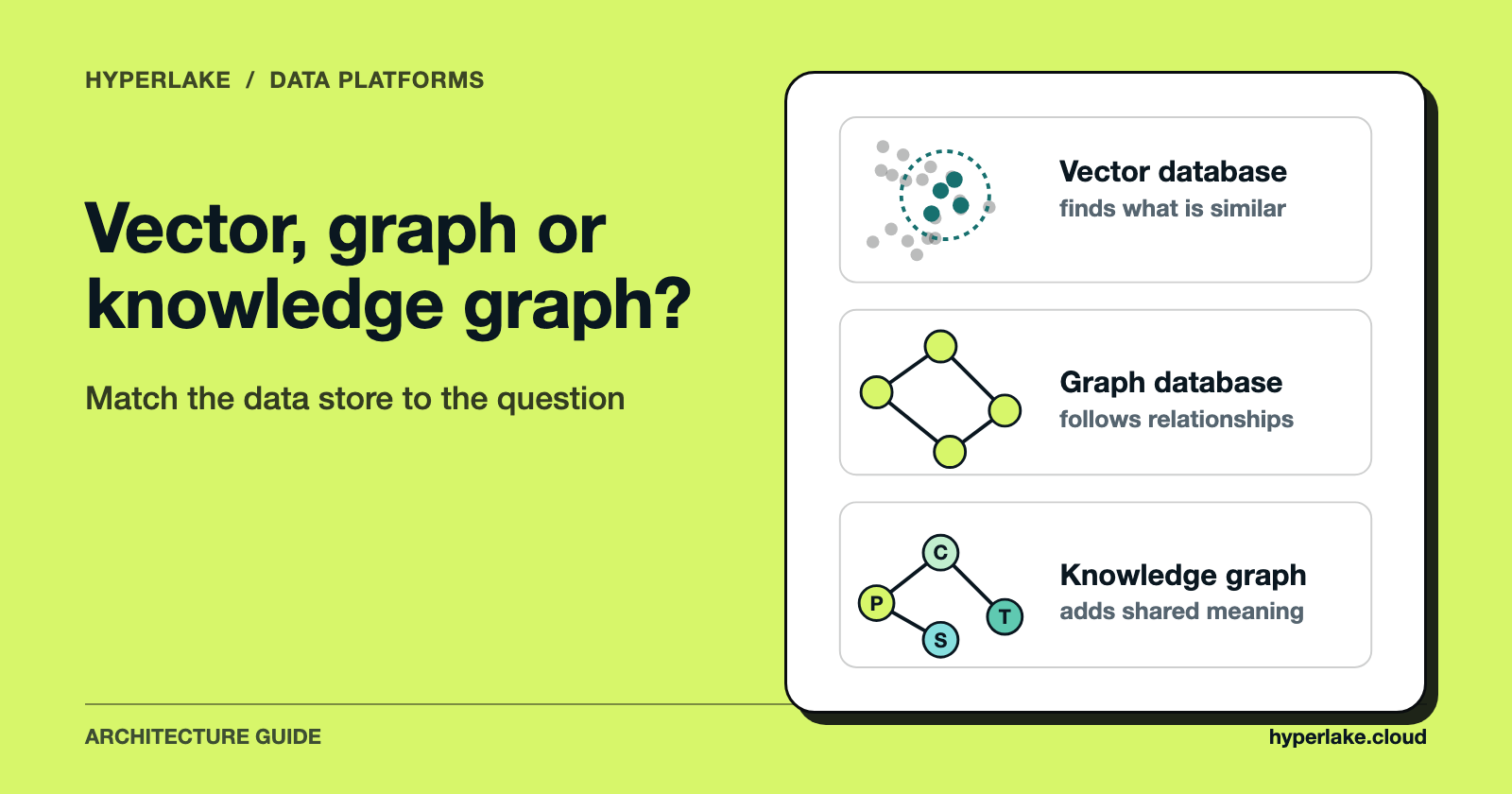
Short version: a vector database finds things that are similar in meaning, a graph database stores and walks explicit connections between things, and a knowledge graph is a model of entities and relationships that usually lives in a graph database. Two are database types and one is a way of organising knowledge, so "vector database vs graph database vs knowledge graph" isn't quite a like-for-like contest. Plenty of AI systems use a vector index to find starting points and a graph to follow relationships from there.
We make HyperLake, a sovereign AI operating platform. It isn't a vector or graph database, and the section on where it fits explains exactly how it relates to the tools below.

What is the difference between a vector database, a graph database and a knowledge graph?
| Vector database | Graph database | Knowledge graph | |
|---|---|---|---|
| What it is | A database built to store embeddings and search them by distance | A database that stores nodes, relationships and properties | A model of entities and typed relationships, plus the data in it |
| Core question it answers | "What is most similar to this?" | "What is connected to this, and how?" | "What do we know about this entity, and where did it come from?" |
| Query style | Nearest-neighbour search over vectors, often with metadata filters | Pattern matching and path traversal | Same as a graph database, often with an ontology on top |
| Main strength | Fuzzy, meaning-based retrieval over unstructured text | Multi-hop questions and explainable paths | Shared, governed meaning across systems |
| Main cost | Results are similar, not guaranteed correct; no explicit reasoning | Someone must model the relationships | Building and maintaining the graph and its schema |
| Typical AI use | Retrieval for RAG, semantic search | Relationship lookups, fraud and dependency analysis | Grounding agents in curated facts |
Look at the middle column for a second. A graph database is a storage engine. A knowledge graph is what you put into it, and how you structure it. So when a team says it's choosing between "a graph database or a knowledge graph," what it's usually deciding is whether to model the domain explicitly at all.
How does a vector database work?
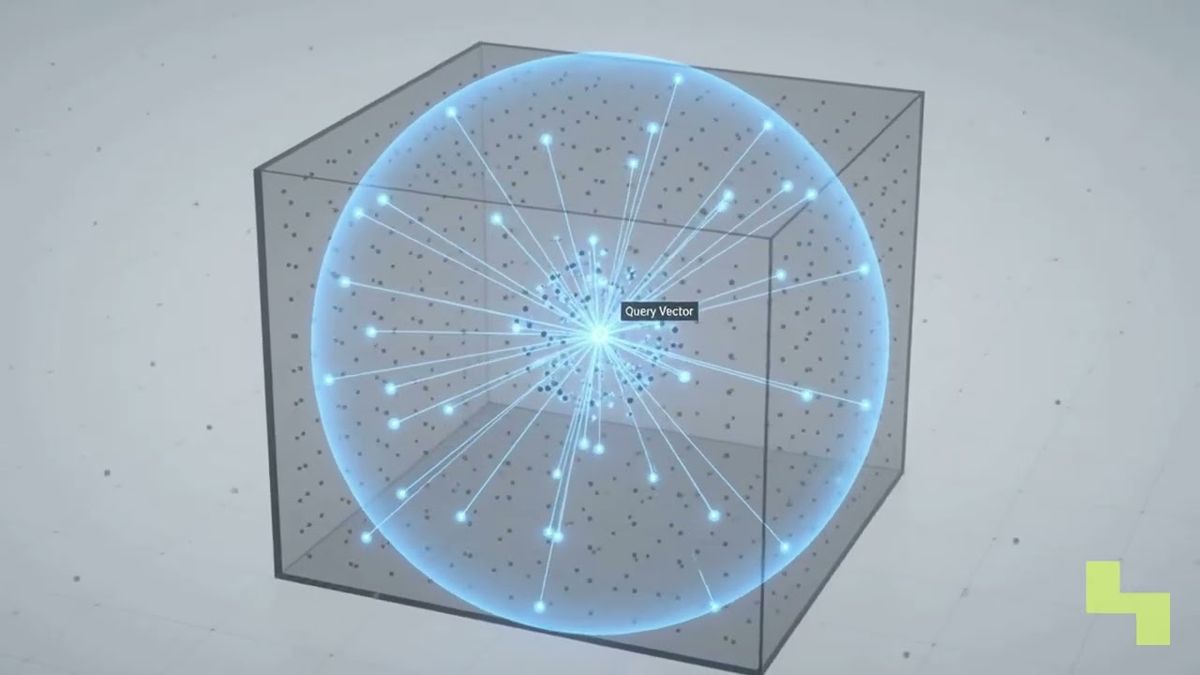
It stores embeddings, which are lists of numbers a model produces so that similar content ends up close together. Your query gets embedded the same way, and the database hands back the nearest stored vectors. For more on indexing and storage, see Vector Databases and Semantic Search Explained.
Here's a small SQL example using pgvector, the open-source PostgreSQL extension, whose README shows ordering by a distance operator. The three-number vector is only for illustration. Real embeddings usually have hundreds or thousands of dimensions.
-- Hypothetical table of support articles with an embedding column
SELECT id, title
FROM articles
ORDER BY embedding <=> '[0.12, -0.40, 0.88]'  -- cosine distance to the query embedding
LIMIT 5;
You get back the five articles closest in meaning to the query, even if they share no keywords with it, as long as the embeddings capture that similarity. What you can't get is the fact that article 12 was written by someone who reports to the owner of product X. That information simply isn't in the vectors.
How does a graph database work?
Instead of tables or documents, a graph database stores nodes, relationships and properties, according to Neo4j's documentation. In that property graph model every relationship has a start node, an end node, a type and a direction. You query by describing a pattern you want found.
Below is a hypothetical Cypher query (Cypher is Neo4j's query language). It asks which products depend, directly or through up to three links, on a part supplied from a particular country.
// Hypothetical data: Product, Part, Supplier, Country nodes
MATCH (p:Product)-[:DEPENDS_ON*1..3]->(part:Part)
      -[:SUPPLIED_BY]->(:Supplier)-[:LOCATED_IN]->(:Country {name: 'Germany'})
RETURN DISTINCT p.name
Try that with vector search and you'll struggle, because the answer hangs on chains of exact relationships, not on how alike two descriptions sound. In a graph the path is the answer. You can show it to a reviewer and they can check it.
What is a knowledge graph, and how is it different?
A knowledge graph represents entities (people, products, contracts) and the typed relationships between them, often with an ontology that says which types and relationships are allowed. It's usually stored in a graph database, though other systems can expose one too.
Why bother, for AI? Because it gives a model curated facts to reason over. Microsoft's GraphRAG project is a good example. It extracts entities, relationships and key claims from a text corpus to build a graph, groups the graph into communities and summarises them, then uses those structures to augment prompts. Its documentation also notes that the basic search mode relies on standard vector search, so the two approaches sit side by side in one tool.
The price is effort. Someone has to define the entities, keep them current and resolve duplicates. If most of your questions are "find me the passage about this," a knowledge graph is more work than the question deserves.
When should you use a vector database, a graph, or both?
Here's our starting rule. Test it against your own questions before you trust it.
- Mostly unstructured text and fuzzy questions: start with a vector index. It's the simplest route to retrieval for RAG. See Vector Storage: How Semantic Search Works.
- Questions about connections, ownership, dependency or lineage: use a graph. Multi-hop questions are exactly what graphs are for.
- Both kinds of question: use vectors to find candidate entities or passages, then the graph to expand to related facts. Several tools now offer both in one engine (more on that below).
- Governance and consistent meaning across teams: a knowledge graph with an agreed ontology helps, but only if someone owns it.
One warning. Before you add a graph, check whether better chunking, metadata filters or reranking would fix your retrieval problems. A graph is a modelling commitment, not a tuning knob.
Which tools are worth knowing?
This is a starting list, not a ranking. Descriptions come from each project's own public pages and are accurate as of October 2026.
| Tool | Type | Best for |
|---|---|---|
| Qdrant | Open-source vector database (Apache 2.0, per its GitHub repository); also offered as managed, hybrid and private cloud | Teams that want vector search with payload filtering plus BM25 and sparse vectors, self-hosted or managed |
| Milvus | Open-source vector database (Apache 2.0) with Lite, Standalone and Distributed modes | Teams that want to start on a laptop and scale to a Kubernetes cluster with the same system |
| pgvector | Open-source PostgreSQL extension for vector search | Teams already on PostgreSQL that want vectors beside their relational data |
| Pinecone | Search engine for AI agents and applications (dense, sparse, full-text and hybrid), with a Bring Your Own Cloud option | Teams that want full-text, semantic, sparse and hybrid search in one index, with optional integrated embedding |
| Neo4j | Graph database with Community and Enterprise editions | Teams modelling connected data and querying it with Cypher; its docs state vector indexes are available in both editions |
When something else is the better pick: if you only need nearest-neighbour retrieval over a modest corpus and already run PostgreSQL, pgvector saves you a new system. If your core problem is path-finding and relationships, a graph database such as Neo4j makes a more natural primary store than a vector database. And if you want no database operations at all, a managed service takes that work away.
Where does HyperLake fit?
HyperLake isn't a vector or graph database, and it doesn't replace one. It's a platform for assembling, deploying and governing the data, models and applications behind AI in a customer's own environment or a client's; today that's an AWS or Google Cloud account. According to HyperLake's product description, the engines it works with follow the workload, and they include Qdrant or Milvus for vectors and graph engines for relationships.
What it adds sits around the engine. Its stated approach to private AI is grounding models in governed enterprise context (structured data, documents, vector search, and knowledge graphs or ontologies) with policies on data and tool access. People and agents reach data through authenticated, governed services, and OPA makes the policy decisions. Choosing between vector and graph retrieval stays a workload decision. HyperLake becomes relevant when you also have to decide where the chosen engines run and who's allowed to query them.
Frequently asked questions
Is a knowledge graph the same as a graph database?
No. A graph database is software that stores nodes and relationships, while a knowledge graph is a structured model of entities and their relationships, most often stored in a graph database.
Can a vector database replace a graph database?
Not for relationship questions. Vector search ranks by similarity, so it can't reliably follow exact chains like supplier to part to product, though it can help find the starting entity for a graph query.
Do I need a graph for RAG?
Often you don't. Many RAG systems do fine with a vector index plus good chunking and metadata. Add a graph when questions depend on relationships across documents, and plan to maintain it.
Can one database do both vector and graph search?
Some can. Neo4j documents vector indexes alongside its graph model, and PostgreSQL with pgvector keeps vectors next to relational data. Test whether the combined system meets your latency, scale and query needs.
What is GraphRAG?
It's a retrieval approach that builds a knowledge graph from a text corpus and uses it, together with community summaries, to augment an LLM's prompts. Microsoft publishes an implementation with documentation.