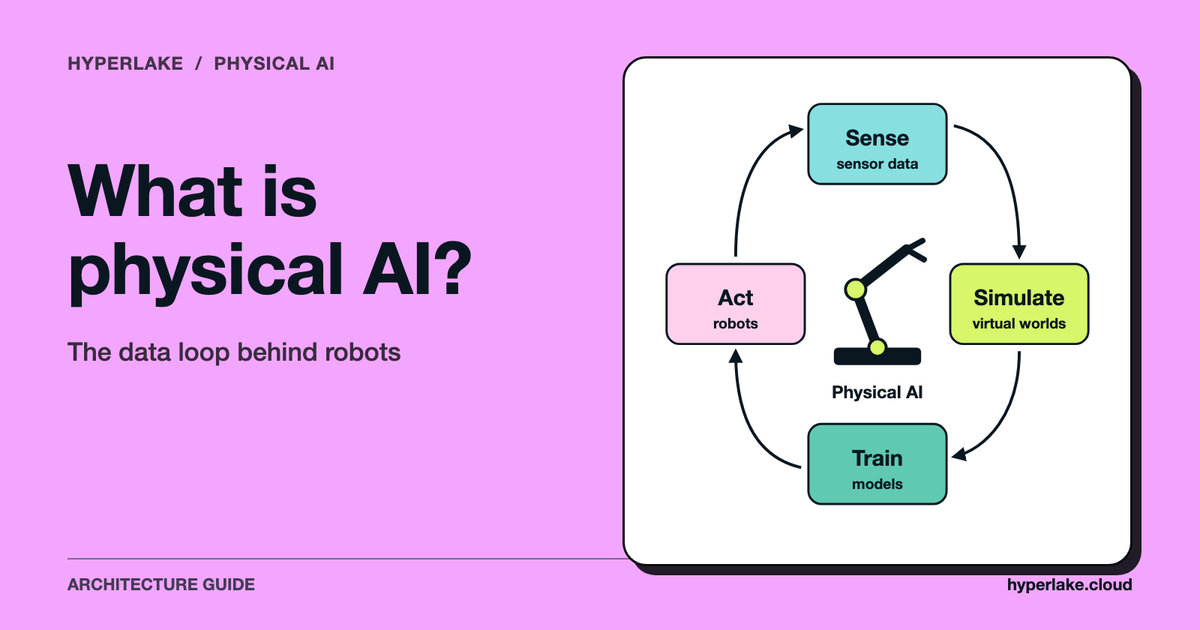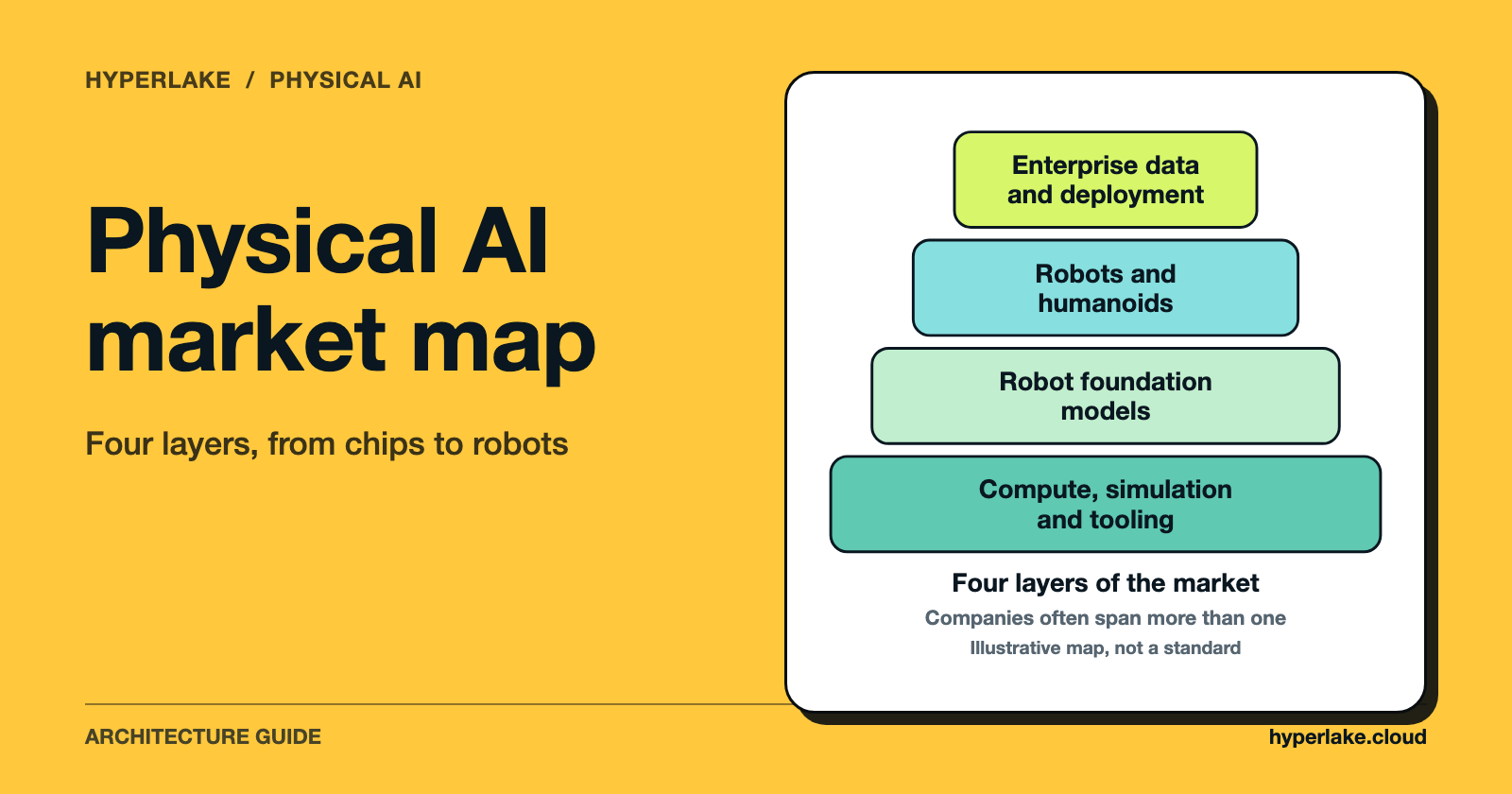
Physical AI is AI that lets machines such as robots perceive, decide and act in the physical world. Read the physical AI market as layers, not as one ranked list: chips and simulation tools, "robot brain" foundation models, and the robots themselves, with an enterprise data and deployment layer underneath. This guide covers well-known companies in each layer using what they say on their own public pages as of October 2026. It doesn't rank them.
We make HyperLake, a sovereign AI operating platform. It isn't a robot maker or a model lab, and the section on where it fits says exactly how it relates to the companies below.

What is physical AI?
NVIDIA's glossary page puts it like this: physical AI "enables autonomous machines, such as robots in factories and robotaxis, to perceive, understand, and perform complex actions in the physical world" (NVIDIA). What sets it apart from a chatbot is that the model's output can drive a machine that moves. Timing, safety and sensor data quality suddenly matter a lot more. For a primer on the data side, see our physical AI overview.
How is the physical AI market structured?
Nobody has an agreed map of this market, and we won't claim a market size. We haven't opened a primary source for a market-size figure, so we've left one out. The layers below are our own way of organising the companies, not an industry standard.
| Layer | What it covers | Companies discussed below |
|---|---|---|
| Compute, simulation and tooling | Chips for robots, simulators, synthetic data, robot-learning frameworks | NVIDIA |
| Robot foundation models | General "brain" models that turn camera and language input into actions | Physical Intelligence, Skild AI, Google DeepMind |
| Robots and humanoids | The machines that are sold or deployed | Figure, Agility Robotics, Boston Dynamics |
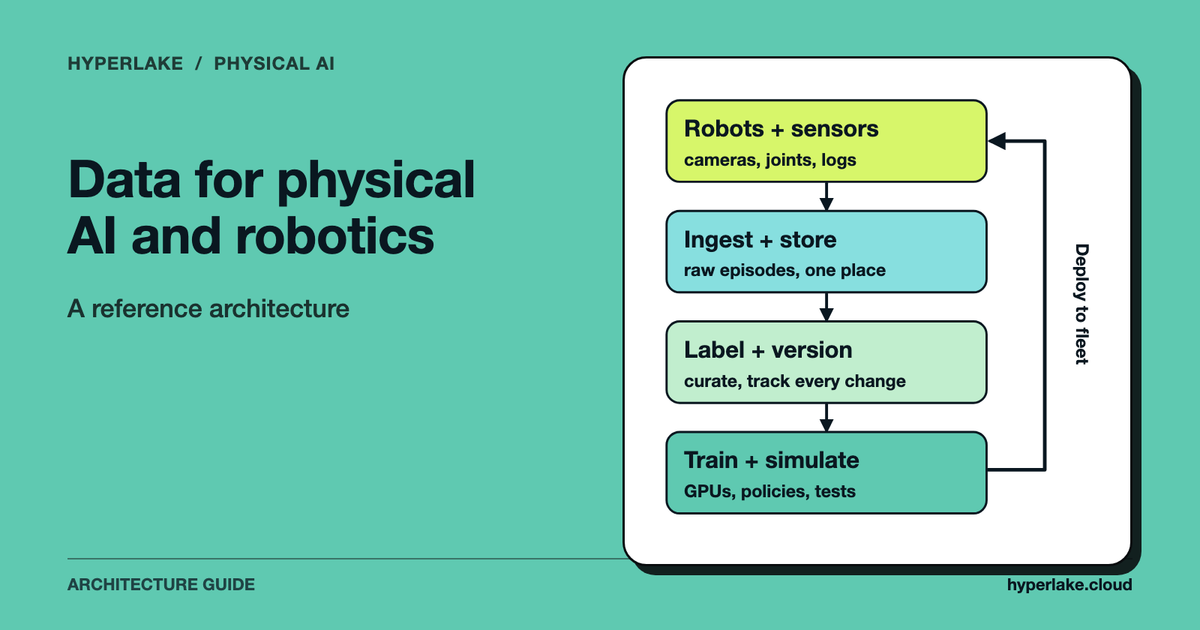
| Enterprise data and deployment | Where data, models and fleets are stored, governed and run | Platforms such as HyperLake |
Companies cross layers all the time. Several robot makers build their own models, and model labs partner with hardware makers. Use the table as a reading aid.
What does the broader robotics market look like?
Physical AI sits on top of a robotics industry that already exists. The International Federation of Robotics (IFR) reported on September 24, 2026 that factories worldwide installed more than 600,000 new industrial robots in 2025, an 11% rise, and that the global operating stock rose 9% to a record 5 million units (IFR press release). It named China as the largest market with 354,000 installations, ahead of the United States at almost 38,500.
Be careful with those numbers. They describe industrial robots in general, not AI-driven robots. What they show is the size of the installed base that learning-based systems might one day extend or replace. They don't measure a "physical AI" market.
Who are the top physical AI companies in 2026?
"Top" is hard to pin down without a neutral ranking, and we haven't found one we can cite. So this is a selection of widely discussed companies, each described only with facts from its own pages. Being included isn't a recommendation, and plenty of relevant companies are missing.
NVIDIA
NVIDIA describes Isaac as an "open robotics development platform" for building autonomous mobile robots, robot arms, manipulators and humanoids, including simulation and robot-learning frameworks, CUDA-accelerated libraries, AI models and reference workflows (NVIDIA Isaac). Its glossary page also names Isaac GR00T and Cosmos among its open model families for physical AI, and Jetson as a platform for autonomous machines and embedded applications (NVIDIA).
Our read: worth a look if you need simulation, training tools or on-robot compute. NVIDIA sells tools and platforms, not robots.
Physical Intelligence
Physical Intelligence describes itself as "bringing general-purpose AI into the physical world" and says it's developing learning algorithms for a single model that can control many kinds of robots for many tasks. Its site names a series of models from π0 to π0.7 (Physical Intelligence).
Our read: a model-focused company. Follow it if you care about research on general robot policies. It won't help if you need a finished robot.
Skild AI
Skild AI says it's building "a unified, omni-bodied brain to control any robot for any task." Its page describes the Skild Brain model as handling low-level skills such as grasping, navigation through API calls, and says it learns partly by watching human video (Skild AI).
Our read: another model-focused company, aiming to work across robot types.
Google DeepMind
Google DeepMind describes Gemini Robotics as "The intelligence layer to power any kind of robot." Its page lists a vision-language-action model, an embodied reasoning model that plans multi-step tasks, and an On-Device version designed to run locally on robot hardware (Google DeepMind).
Our read: relevant if you're watching how general-purpose AI labs approach robotics, including the split between a reasoning model and an action model.
Figure
Figure says it builds a humanoid robot, Figure 03, which its site calls "a general purpose humanoid robot for every day," with an AI called Helix meant to help it navigate changing home environments (Figure).
Our read: a humanoid maker whose public positioning leans toward homes.
Agility Robotics
Agility Robotics builds Digit, a humanoid robot for industrial work. Its site cites "65,000 hours of real production experience," describes a cloud platform called Arc for running customers' robot fleets, and names GXO, Schaeffler and Toyota Motor Manufacturing Canada as customers (Agility Robotics).
Our read: a humanoid maker focused on warehouse and factory work. We haven't verified the production-hours figure independently. It's the company's own claim.
Boston Dynamics
Boston Dynamics presents Atlas as an enterprise-grade industrial humanoid. Its page targets material handling, lists part sequencing, machine tending and order building as planned skills, and says skills learned by one Atlas can be deployed across a fleet (Boston Dynamics).
Our read: relevant for industrial material handling. The page describes several uses as planned, so ask the vendor directly what's available today.
What trends stand out in physical AI?
These are observations from the vendor pages above. They aren't forecasts.
- General-purpose models. Physical Intelligence, Skild AI and Google DeepMind all describe a single model meant to work across many robot types or tasks.
- Fleet software. Agility Robotics and Boston Dynamics both describe software for running many robots, not just one.
- Simulation and synthetic data. NVIDIA's Isaac description puts simulation and robot-learning frameworks at the centre. For the data side, see Physical AI Datasets and World Models for Robotics Training.
- On-device inference. Google DeepMind offers a model built to run locally on the robot. What Is Edge AI? covers the underlying trade-offs.
If we had to pick one to watch, it'd be the first. Whether a single model really can drive many different bodies will shape who ends up owning which layer.
Where does HyperLake fit?
HyperLake isn't a robot maker, a simulator or a model lab. According to HyperLake's product description, it's a platform for assembling, deploying and governing the data, models, applications and tools behind Physical AI and other AI workloads, in the customer's own environment or a client's. For Physical AI, that means simulation, orchestration, training, data and model services in the customer's cloud, integrating tools such as NVIDIA OSMO, Omniverse, Isaac Sim and Isaac Lab, subject to licensing and validated integration.
In the table above, it sits in the enterprise data and deployment layer. It doesn't replace any of the companies listed, and this article makes no claim of partnership with any of them. Comparing humanoids or foundation models? HyperLake won't help with that choice. It's relevant once you know which tools you want and need to decide where they run and who can reach robot data and models. For the architecture side, see the open-source physical AI stack map and the sovereign physical AI stack on Kubernetes.
Frequently asked questions
What is physical AI?
Per NVIDIA's definition, it's AI that lets autonomous machines, such as robots in factories and robotaxis, perceive, understand and act in the physical world. Unlike software-only AI, its outputs can drive physical equipment.
Who are the top physical AI companies?
We can't cite a neutral ranking. Widely discussed names include NVIDIA for tools and compute; Physical Intelligence, Skild AI and Google DeepMind for robot models; and Figure, Agility Robotics and Boston Dynamics for humanoids. Treat that as a selection, not a ranking.
How big is the physical AI market?
We don't give a figure, because we haven't verified a primary source. The IFR reports more than 600,000 industrial robot installations worldwide in 2025 and a stock of 5 million, but that covers industrial robots in general, not physical AI specifically.
What is the difference between a robot foundation model and a humanoid robot?
One is software and one is hardware. A foundation model turns inputs such as camera images and instructions into actions for many kinds of robots, while a humanoid is the body. Some companies build both, and others focus on one.
Is physical AI the same as robotics?
Not quite. Robotics includes machines driven by fixed programming, and physical AI refers to the learning-based perception and decision-making added to them. The IFR figures above count industrial robots, and not all of those are AI-driven.
Do I need to run physical AI on my own infrastructure?
Not always. Teams decide based on data sensitivity, latency and cost, and since robot recordings can include people and sites, many want control over where data and models live. Our physical AI overview and the primer on what physical AI is and why it needs data infrastructure go through the considerations.