Vendor lock-in prevention in AI is the practice of designing applications, evaluations, data controls, and inference paths so teams can change models or providers without rebuilding the system. It relies on standardized interfaces, portable prompts, organization-owned test sets, controlled data, and routing that supports more than one provider.
AI model capability, pricing, contracts, and regulation can change quickly, turning an acceptable dependency into an urgent migration. Designing for portability in advance costs less and creates less operational risk than adding it during an outage, deadline, or compliance incident. The video above walks through the core ideas.
What causes vendor lock-in in AI infrastructure?
AI lock-in usually appears in code, prompts, evaluation, and data. Each creates a different switching cost, so teams need to identify dependencies beyond the model endpoint itself.
- Direct SDK dependencies: Application code that calls a proprietary client library spreads provider-specific logic across the codebase. Replacing the provider then requires changes at every integration point.
- Model-specific prompts: Prompts tuned around one model’s behavior may lose quality when sent to another model. Differences in instruction following, tool use, and output formatting can require extensive reworking.
- Proprietary evaluations: Provider-defined metrics and scoring methods can make results difficult to compare across models. The organization may be unable to reproduce its own quality decisions independently.
- Provider-controlled data: Storing prompts, documents, embeddings, logs, or training assets in provider-managed systems can complicate migration when prices, terms, or compliance requirements change.
These dependencies often reinforce one another. An application may use a proprietary SDK to reach a model whose prompts, evaluation history, and grounding data all reside in the same provider environment.

How do you prevent AI vendor lock-in?
Prevent lock-in by separating application intent from provider implementation and owning the artifacts used to judge and operate the system. Portability must cover interfaces, behavior, evaluation, and data—not just API syntax.
- Create a common interface. Route model calls through an internal API or abstraction layer, with provider-specific adapters behind it. Application code should express the requested task without directly depending on a proprietary SDK.
- Keep prompts portable. Store prompts outside application code, use stable role and message structures, and avoid unnecessary reliance on one model’s undocumented quirks. Test important prompts against multiple eligible models.
- Own evaluation assets. Maintain organization-controlled test datasets, rubrics, expected behaviors, and acceptance thresholds. This creates a consistent basis for comparing quality across providers.
- Control the data layer. Keep sensitive source data and governance controls in infrastructure the organization controls, regardless of which provider handles an inference request.
This separation is a core principle of compound AI system architecture: models remain replaceable components within a wider system of data, tools, policies, and applications. Abstraction still requires testing because identical API shapes do not guarantee identical model behavior.
Why is multi-provider routing the strongest defense?
Multi-provider routing is the strongest architectural defense because it turns alternatives into operating capacity rather than a document. Requests can move when availability, price, contractual status, or regulatory eligibility changes.
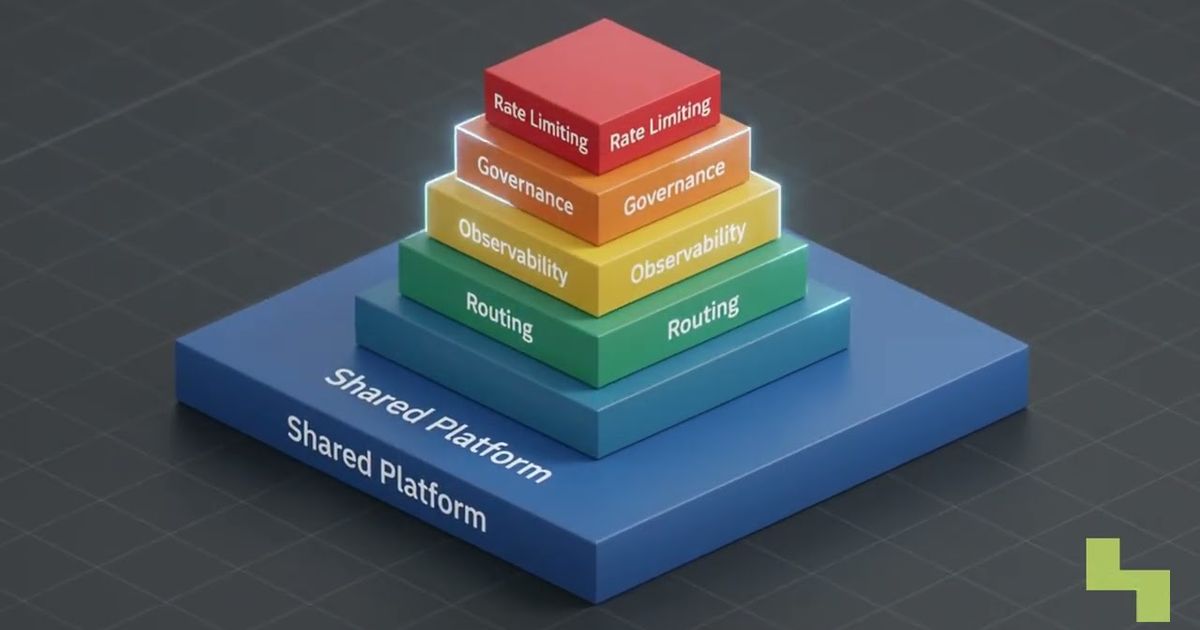
A request first reaches a common interface, where routing policy selects an eligible provider or model. That policy can consider workload requirements, data restrictions, observed health, cost, and required capabilities. Monitoring then records the selected route, response behavior, latency, errors, and usage so teams can evaluate whether alternatives remain viable.
This arrangement provides several practical options:
- An outage at one provider can trigger failover to an approved alternative.
- A pricing change can lead to a routing adjustment instead of an application rewrite.
- A contractual or regulatory issue can remove one provider from the eligible pool without halting every workload.
- Active alternatives create negotiating leverage that a single-provider architecture lacks.
Effective routing requires tested fallbacks, not merely multiple credentials. The same operational principles used for LLM failover and load balancing apply, although not every request can go to every provider because security, residency, capability, and quality requirements may differ.

When should teams build and test portability?
Build portability before a forced migration, then test it often enough to know it works. An untested abstraction or dormant backup provider is not a reliable exit path.
A practical portability review should:
- Inventory proprietary SDK calls, prompt assumptions, evaluation dependencies, and provider-held data.
- Run representative evaluations against alternative models using the same owned rubric.
- Verify that data and operational records can be exported in usable formats.
- Simulate removing a provider from routing without changing application code.
- Document migration triggers, approvals, and rollback procedures.
Teams do not need to treat every model as interchangeable. They need to know which workloads can move, which alternatives meet their requirements, and what engineering work remains before a switch becomes urgent.
Key takeaways
- AI vendor lock-in can accumulate across application code, prompts, evaluations, and data storage.
- A common interface reduces code coupling, but cross-model testing is still necessary.
- Organization-owned datasets and rubrics make model quality comparable across providers.
- Multi-provider routing creates operational alternatives for outages, price changes, and policy constraints.
- Portability should be tested before a deadline, incident, or regulatory change forces migration.
How Hyperlake helps
Hyperlake lets teams assemble and govern modular data, model, application, and tool services in infrastructure they or their clients control. Its Kubernetes-based foundation, open technologies, governed identity-to-data access, and support for open and custom model services can help keep applications and enterprise context separate from a single provider, subject to the engines and validated integrations used in each deployment. To evaluate a portable deployment pattern for your workloads, talk to our team
Frequently asked questions
Can a common API make every AI model interchangeable?
A common API removes code-level coupling, but it does not make model behavior identical. Models differ in instruction following, context handling, tool use, latency, and output structure. Portability therefore also requires cross-model prompt tests, owned evaluations, and explicit acceptance thresholds before traffic moves.
Does multi-provider routing send sensitive data to every provider?
No. A routing policy can restrict each request according to data classification, region, contract, model eligibility, and workload identity. Sensitive workloads may use only approved private or controlled endpoints, while less restricted traffic can use a broader provider pool; each route should be logged and auditable.
What should an AI provider exit plan contain?
An AI exit plan should identify replaceable interfaces, data export paths, owned prompt and evaluation assets, alternative models or endpoints, and the people authorized to switch. It should also define how teams test quality, security, cost, and operational readiness before a migration becomes urgent.