AI observability is the discipline of making probabilistic AI systems understandable from the outside. It combines operational telemetry with evaluation to determine not only whether a system responded, but whether its output was correct, appropriate, useful, and aligned with the task, policies, and product behavior it was designed to support.
This matters because a technically healthy AI service can still return misleading, unsafe, irrelevant, or unnecessarily expensive results. Teams need evidence that connects system behavior to output quality, user experience, policy compliance, and cost. The video above walks through the core ideas.
What is AI observability?
AI observability extends software observability so teams can inspect both system operation and output quality. Its four core dimensions are logs, metrics, traces, and evaluation.
Logs record events, metrics quantify behavior over time, and traces reconstruct a request across distributed components. Evaluation assesses whether the resulting output meets task-specific quality criteria. Together, these signals help teams understand what the system did, why it produced a result, and whether that result was acceptable.
This broader scope distinguishes AI observability from infrastructure monitoring. CPU utilization, latency, and error rates remain important, but they cannot reveal whether a fluent answer contains unsupported claims or whether an agent selected an inappropriate tool.
Why aren’t logs, metrics, and traces enough?
Traditional telemetry is necessary but insufficient because AI outputs are probabilistic and often lack one predefined correct answer. A request can complete successfully while producing a low-quality result.
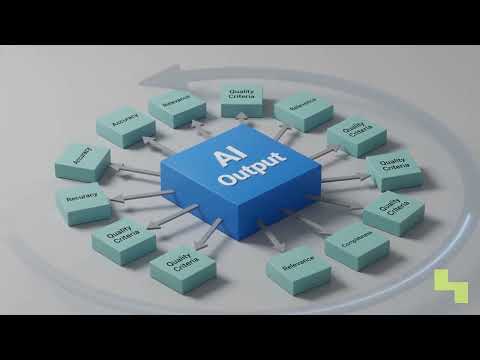
Deterministic software usually supports direct comparisons between expected and actual outputs. AI systems instead require criteria such as factual support, relevance, policy adherence, security, completeness, or task success. Those criteria vary by use case.
For example, customer support evaluation might check whether an answer resolves the stated issue without inventing information. Code generation evaluation might test syntax, edge cases, correctness, and compliance with organizational security standards. This quality layer is why LLM observability must examine more than service availability.

What should an AI observability trace capture?
An AI observability trace should reconstruct the inputs, context, decisions, outputs, and evaluations behind a result. The trace needs enough detail to explain both technical failures and quality failures.
Where security and retention policies permit, request-level traces should capture:
- The full prompt and relevant request metadata.
- Retrieved context when retrieval-augmented generation is involved.
- Tool calls, parameters, outcomes, and errors.
- The complete model response and assigned evaluation scores.
For agentic systems, tracing must span multiple model calls and tool invocations. A useful trace follows the chain from the original goal through intermediate decisions to the final action, rather than treating each call as an isolated request. Sensitive prompts, context, credentials, and tool results also need appropriate access controls and retention rules.

How do teams evaluate AI output at scale?
Teams evaluate AI output by defining a rubric, applying it consistently, and feeding the results into development and operations. The rubric translates a broad idea of quality into criteria that can be reviewed or measured.
Evaluation may combine deterministic checks, task-specific tests, model-assisted scoring, and human review. The right mix depends on the consequences of an incorrect result and whether quality can be verified automatically. High-impact actions generally require stronger evidence and may require human approval.
Evaluation results become operationally useful when they connect back to traces, model versions, prompts, retrieved data, tools, and application changes. Teams can then investigate regressions, compare configurations, and identify recurring failure patterns rather than treating each poor response as an anecdote.
Who needs AI observability data?
AI observability is cross-functional because different teams need different views of the same system behavior. A unified layer is more efficient than separate monitoring programs that cannot connect quality, operations, compliance, and cost.
- Engineering teams use traces and evaluations to debug failures and detect regressions.
- Product teams assess whether AI features deliver the intended user experience.
- Compliance teams use evidence and audit trails to verify applicable policy and regulatory requirements.
- Finance teams connect model calls, searches, and jobs to infrastructure usage and spending.
Cost therefore belongs alongside quality and reliability. AI cost observability helps teams identify which workloads and actions consume resources without separating financial governance from operational context.
Key takeaways
- AI observability adds evaluation to the traditional combination of logs, metrics, and traces.
- Successful requests can still produce incorrect, unsafe, irrelevant, or noncompliant outputs.
- Agent traces should reconstruct the full decision chain across model calls, retrieval, and tools.
- Evaluation requires task-specific rubrics, scalable assessment, and an operational feedback loop.
- One shared observability layer can support engineering, product, compliance, and finance needs.
How Hyperlake helps
Hyperlake provides shared observability, lifecycle, audit, security, and access controls for AI services, applications, data services, and agent workloads running in infrastructure the customer controls. Teams can inspect health, maintain deployed services, govern identity-to-data access, and evaluate open or custom models, with procedures and integrations depending on the engine and deployment. To discuss an observability architecture for your environment, talk to our team.
Frequently asked questions
How is AI observability different from general application monitoring?
Application monitoring focuses primarily on availability, latency, errors, resource use, and request flow. AI observability retains those signals but also evaluates output quality, retrieved evidence, prompts, tool use, and decision paths. It is designed to explain cases where the service worked technically but the answer or action was still unacceptable.
Can AI evaluation be fully automated?
Some evaluation can be automated through deterministic checks, task-specific tests, and model-assisted scoring. Human review remains important when criteria are subjective, consequences are significant, or automated evaluators cannot reliably verify the outcome. Most production systems benefit from combining automated coverage with targeted human assessment.
How can teams detect regressions in probabilistic AI systems?
Teams can run stable evaluation sets against model, prompt, retrieval, tool, and application changes, then compare quality and operational signals over time. Production feedback and sampled traces can reveal failures that test sets miss. Each result should remain connected to the configuration and context that produced it.
Should AI traces store complete prompts and responses?
Complete prompts and responses can be valuable for debugging, evaluation, and audit, but they may contain sensitive data. Retention, encryption, redaction, and access controls should reflect the organization’s security, privacy, and regulatory requirements. Teams should preserve enough context for investigation without collecting or retaining data unnecessarily.