Massively parallel processing (MPP) is a query architecture that splits data and computation across many nodes, runs tasks at the same time close to their assigned data, and combines the partial results into one answer. It speeds up large analytical queries through horizontal scaling. How much it helps depends on partitioning, network movement and the shape of the workload.
Every single machine runs out of road eventually: CPU, memory, storage throughput, or plain practical size. Spreading the work out lets analytical systems keep pace with growing data without betting everything on ever-bigger servers.
What is massively parallel processing?
Many machines, one query.
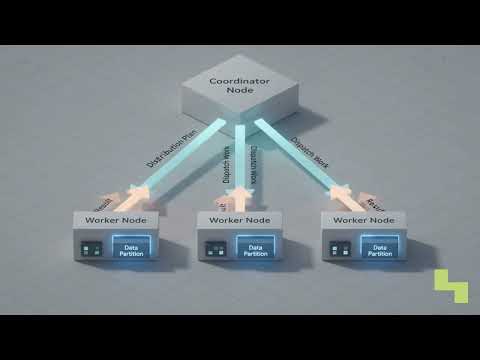
Several processing nodes cooperate on a single query, and nobody scans and transforms the whole data set in sequence. Each node takes a slice and works at the same moment as the others. In a classic MPP architecture the data is partitioned across worker nodes, each worker owns or processes its partition, and a coordinator hands applications and users one query interface. Seen from outside, the cluster looks like a single analytical system.
Don't confuse an MPP database or MPP engine with a pile of unrelated queries running on separate servers. MPP breaks one query into coordinated tasks that run concurrently, which is why it suits scans, joins, aggregations and transformations over big volumes of data.
How does MPP architecture scale, and where does it fit best?
Is MPP right for your workload? If you mostly scan or aggregate large data sets, probably yes. It fits data warehouses, lakehouse query engines and other analytical systems. If you mostly do small point lookups or transactional operations, probably not: the overhead of distribution can outweigh the benefit of parallel execution.
The scaling is horizontal. Add nodes instead of swapping one server for a bigger one, and you get more total CPU, memory and throughput, provided the engine can split the work evenly.
"Provided" is doing a lot of work there. Query coordination, data shuffling, storage throughput, skewed partitions and stages that can't run in parallel all cap what one more node adds, so the gains aren't always proportional. Extra capacity pays off most when the workload has plenty of independent work to hand out and the cluster stays balanced.
A broader data lakehouse architecture may use MPP-style execution while treating storage and compute as separate concerns.

How does an MPP query execute?
The application that sent the query never sees any of this. The coordinator hides the cluster layout and walks the query through planning, distributed execution and result assembly.
- Receive and plan. The coordinator accepts the SQL statement and builds a distributed execution plan.
- Dispatch parallel tasks. It hands scans, filters, joins or aggregations to the worker nodes responsible for the relevant data.
- Process and exchange. Workers compute locally, and send intermediate results to other nodes when an operation needs it.
- Merge. The coordinator gathers the partial results, finishes any last processing and returns one result set.
Take a plain sum. Each worker totals its own partition; the coordinator (or another distributed stage) adds the totals together. A query that could take an hour on one machine might finish in minutes on a big enough, well-balanced cluster. Just don't count on linear gains, because network costs and work that can't run in parallel get in the way.

Why does partitioning decide MPP performance?
If we had to name the one thing that makes or breaks an MPP cluster, this is it.
Partitioning decides where the data lives and how much of it has to move during a query. The best case: workers scan relevant local partitions and do real work without trading big intermediate data sets. So before you pick a partitioning strategy, look at four things:
- Filter columns, so partition pruning can kick in.
- Join keys, so related rows stay colocated.
- Even distribution, so no worker gets most of the work.
- Stability, since repartitioning large data sets can be costly to operate.
What happens when a join or aggregation doesn't line up with how the data is spread? The system may redistribute rows between nodes. That's a shuffle. It eats network bandwidth, adds serialization and coordination work, and can leave workers idle waiting on the slowest task.
Partition design is a workload decision as much as a storage one, so check the common filters, joins, aggregations and data skew before choosing keys. The same idea shows up in Iceberg table partitioning, though storage-table partitioning and an MPP engine's runtime distribution are separate mechanisms.
How Hyperlake helps
Hyperlake lets teams assemble, deploy and govern data and AI capabilities in infrastructure they or their clients control. Engines are chosen to fit the workload, such as Iceberg and Trino for lakehouse analytics or ClickHouse for fast analytics, and lifecycle procedures depend on the engine and deployment. To talk through an analytical architecture for your environment, talk to our team.
Frequently asked questions
Is MPP the same as distributed SQL?
Not quite. MPP describes parallel query execution across multiple nodes, while distributed SQL is a broader category of SQL systems that distribute storage, computation or both. Plenty of analytical distributed SQL engines use MPP techniques. A distributed SQL database may also put transactions, replication and consistency ahead of large-scale parallel analytics.
Why does adding more MPP nodes sometimes fail to speed up a query?
Extra nodes only help if the engine can give them enough to do. A query can stay stuck on data skew, network shuffles, storage throughput, coordinator work or a stage that has to run serially. Small queries can even spend more time on distributed coordination than parallel processing saves.
Can an MPP system run transactional workloads?
Some MPP-capable systems support limited transactional behavior, but the architecture is generally tuned for analytical scans, joins and aggregations. High-volume point writes and low-latency record lookups usually favor databases built for online transaction processing. The right call depends on the specific engine and workload, not on the MPP label.