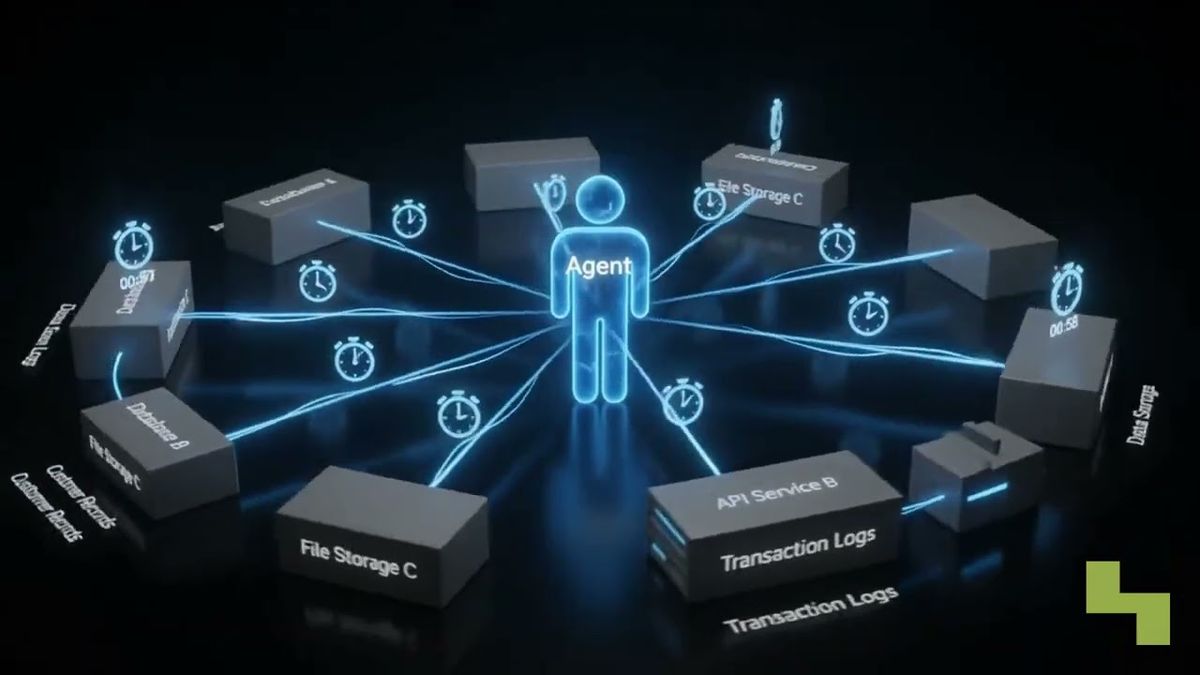
Control plane vs. data plane, in one line: the control plane decides, the data plane does. In AI infrastructure the control plane sets the rules for access, routing, policy, cost attribution and audit. The data plane runs the models, agents, GPU workloads and tool calls inside those rules. Keeping them apart is what keeps a big AI system governable.
The awkward part? You can run AI for months with no real control plane and never see a red light. Every request returns. The dashboards look fine.
Then someone from security asks which agent opened the customer database last Tuesday, and the room goes quiet.
How do control planes and data planes work in networking and Kubernetes?
Network engineers have lived with this split for a long time. Their control plane figures out routes and sets policy; their data plane forwards packets. Normal traffic never touches the control plane, and the forwarding hardware never invents routing rules.
Kubernetes copied the shape for compute.
Its control plane is the API server, the scheduler and the controller manager. You tell it the state you want, it picks where each workload should run, and it keeps pushing the cluster back toward that state whenever it drifts. The worker nodes are the hands: they run your containers and hand out the CPU, memory, networking and other resources workloads need.
Nothing new, then. What AI changes is the size of the control plane's job. It now has to decide about models, agents, tools, enterprise data, identity, policies, costs and audit evidence, all at once, which is why the AI version is harder to get right.
Control plane vs. data plane: what's the difference?
Think of a theatre. The director decides who stands where, and the actors do the scene. Nobody wants the director walking onstage for every line.
The same idea applies here. The control plane holds the desired state and makes the decisions; the data plane carries the traffic, runs the compute and takes whatever actions it's been allowed to take.
The payoff is scale. One control plane can push the same rules out to lots of execution environments without turning into a checkpoint that every packet, inference request or agent action has to queue at.
People often misread this as "all enforcement lives in one central service." It doesn't. Enforcement can sit right beside the workload, in a gateway, a data system or a tool. The control plane writes the policy and ships it out. The data plane applies it while the work happens, then sends the relevant events back for monitoring and audit.
So the line runs both ways. The data plane doesn't get to choose its own policies, and the control plane doesn't do the application's actual work (put it in that path and you've built yourself a bottleneck).

When should teams add an AI control plane?
Sooner than you think you need one.
Most teams build the data plane first, and honestly that's fine. The trouble starts when execution outgrows a deployment small enough to check by eye and nobody adds the control side. Gaps in governance and accountability grow quietly in the meantime.
A quick test. Can you answer these with confidence?
- Which agent touched that sensitive data source?
- Which team or product owns this model cost?
- Which policy governed that workflow or tool call?
- What record can investigators look at after a wrong action?
If any answer is "let me ask around," you're due.
These gaps hide so well because the data plane carries on regardless. Agents finish tasks, models reply, GPU jobs complete. It all seems fine until a security review, a cost investigation, an incident or an audit asks for evidence nobody captured.
Where to start? Write down what you have: workloads, identities, data boundaries, model and tool permissions, routing rules, who owns which costs, and the audit events you're required to keep. Then put enforcement and logging at the execution points that matter. Shared credentials and rules buried in each app won't carry you.

What belongs in an AI control plane and an AI data plane?
Begin with whatever actually runs, because that's your AI data plane. GPU pools for inference or training. Model deployments answering requests. Agents running workflows and holding task state. MCP tool integrations that search, update and act. Data and knowledge services answering authorized queries.
Now the AI control plane, whose questions are about permission and expectation. Which models and tools can this caller reach? Where should the request go? Which policies cover this agent or workflow? Who pays for it, and what must end up in the audit trail? You'll notice that's much more than model deployment; we go further in agentic control plane architecture.
Identity runs under all of it. A user, a service or an agent each needs a scoped identity, or the policy engine has nothing to decide on. Cost records are similar: they need enough context to land on the right workload, product, customer or team. Our piece on LLM cost attribution covers that part.
This is where AI governance stops being a slide and turns into config.
How Hyperlake helps
Hyperlake is the AI cloud for your team and your agents, on your cloud. It gives you one control surface to assemble, deploy, govern, observe and maintain AI data, models, applications and tools in infrastructure you control. It supports identity-aware access, network isolation, scoped secrets, policy decisions, audit, lineage and reusable deployment patterns; the operational details depend on the engine and the deployment. If you'd like to see how these controls fit your environment, talk to our team.
Frequently asked questions
Can an AI control plane be added after models and agents are deployed?
Yes, and that's the usual order. Lots of teams ship execution first and add governance later. Do it in steps: inventory the workloads, give each one an identity, set access and routing policies, agree who owns which costs, then capture audit events at the enforcement points that matter.
Does an AI control plane replace the Kubernetes control plane?
No. Kubernetes still handles cluster resources, where workloads go and desired state. The AI control plane sits a layer up, covering model and tool access, agent policy, request routing, cost attribution and AI audit records. Kubernetes can be its foundation.
Why can a missing AI control plane go unnoticed?
Because nothing breaks. Models answer, agents finish tasks, tools act. You find out when someone asks who accessed sensitive data, which policy applied, who owns a cost or what happened in an incident, and there's no authoritative record to hand them.