Build vs. buy for AI infrastructure should be decided component by component: adopt commodity capabilities whose value comes from reliable availability, and build the logic shaped by proprietary data, domain requirements, or unique performance constraints. Most mature architectures are hybrid, with replaceable components that preserve future flexibility.
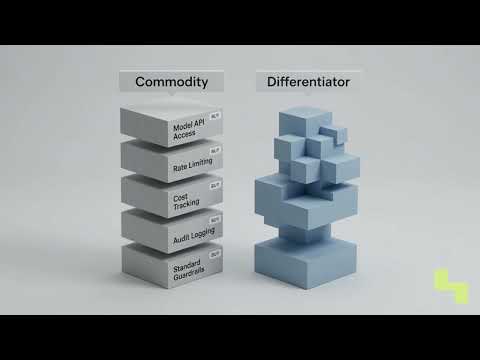
Teams often default to building because they already employ engineers for the AI application and the surrounding work looks incremental. The consequences may appear six to 12 months later, when product engineers are handling upgrades, incidents, and platform maintenance. An explicit framework exposes those trade-offs before they become operational commitments. The video above walks through the core ideas.
How should teams make the build-versus-buy decision?
Teams should classify each infrastructure component according to whether it creates competitive differentiation or simply provides a standard capability. They should then compare total lifecycle costs, control requirements, and risks rather than initial implementation effort alone.
A practical review follows three steps:
- Define the requirement. Identify the necessary behavior, performance, security, data handling, and deployment environment.
- Classify the capability. Decide whether meeting the requirement uniquely creates value or whether the organization benefits mainly from having a reliable implementation.
- Evaluate the lifecycle. Include integration, operation, upgrades, incidents, staffing, migration, and future usage—not only the cost of the first release.
This process should be applied to individual components rather than the entire platform. A team may adopt standard model serving and audit services while building its own domain evaluation, routing, or application logic.
What belongs in the commodity or differentiating layer?
Commodity infrastructure has standard requirements and well-understood solutions; differentiating infrastructure reflects proprietary knowledge or constraints that general-purpose systems cannot adequately express. The distinction depends on the workload, so the same component may fall into different categories for different organizations.
Typical commodity capabilities include:
- Model API access and common serving interfaces.
- Rate limiting and usage controls.
- Cost tracking and infrastructure visibility.
- Audit logging and standard guardrails.
These capabilities are necessary, but implementing them uniquely rarely improves the product. Buying them from a provider or adopting an established open-source project is usually more economical than assigning product engineers to recreate them.
Differentiating capabilities can include a custom evaluation rubric for a specialized domain, a fine-tuning pipeline for proprietary data that cannot leave controlled infrastructure, or a routing strategy designed around a unique quality and cost trade-off. These are stronger build candidates because their output differs materially from a standard service.
The classification can change over time. A once-specialized capability may become commodity as tools mature, while regulatory, data residency, or performance requirements may make a standard component unsuitable.

What hidden costs change the build-versus-buy decision?
Building creates operational and opportunity costs, while buying introduces dependency, pricing, and contractual risks. Both sides need to be modeled over the expected life and scale of the workload.
The commonly underestimated costs of building are:
- Keeping pace with a fast-moving model and infrastructure ecosystem.
- Diverting engineers from product development into maintenance.
- Handling edge cases, incidents, and performance degradation over time.
The commonly underestimated costs of buying are:
- Vendor lock-in that limits future architecture choices.
- Pricing risk as model calls, searches, and jobs increase.
- Data-handling terms that may conflict with security or regulatory requirements.
Teams should make usage and infrastructure costs observable before they become billing surprises. A practical AI cost observability approach connects consumption to workloads, models, users, and capacity. Governance requirements also deserve explicit validation through an AI audit checklist, especially when purchased services process sensitive data.

Why does a hybrid AI infrastructure architecture work?
A hybrid architecture lets teams adopt commodity infrastructure while concentrating engineering effort on differentiating logic. It also avoids treating the original build-or-buy choice as permanent.
Replaceability should be an architectural requirement. Teams can use stable interfaces, portable data formats, explicit identity boundaries, externalized configuration, and documented operational dependencies so that a model provider, data engine, or serving layer can be changed without rewriting the entire application.
Replaceability does not mean every service must support instant migration. It means the architecture identifies dependencies and prevents unnecessary coupling. The resulting ownership model is straightforward: adopt what is standard, build what is unique, and preserve the option to revise either decision as requirements change.
Key takeaways
- Build-versus-buy decisions should be made for individual infrastructure components, not the platform as a whole.
- Commodity capabilities provide value through reliable operation rather than unique implementation.
- Proprietary data, domain-specific evaluation, and unusual performance constraints can justify building.
- Lifecycle costs include maintenance, incidents, opportunity cost, lock-in, pricing risk, and contractual restrictions.
- Hybrid architectures work best when components are designed to be replaceable.
How Hyperlake helps
Hyperlake packages identity, data services, models, applications, policies, and monitoring into reusable deployment patterns for infrastructure controlled by the customer or its clients. Its modular, Kubernetes-based foundation supports different workload engines and deployment environments without a compute markup, while lifecycle procedures and integrations depend on the selected engine and solution pack. For a workload-specific deployment review, talk to our team.
Frequently asked questions
Is using open-source AI infrastructure considered building or buying?
Open source can fall on either side of the decision. Adopting an existing project avoids creating the underlying capability, but operating, securing, upgrading, and integrating it still creates ownership responsibilities. Teams should classify it according to the work they retain, not whether they pay a software license.
How often should an AI infrastructure decision be reevaluated?
Reevaluate when usage patterns, model options, regulations, performance requirements, or vendor terms change materially. A scheduled architecture review can also identify capabilities that have become commodity or dependencies that now create excessive risk. Replaceable interfaces make these reviews actionable rather than theoretical.
Should regulated AI workloads always be built in-house?
No. Regulation does not automatically require custom implementation, but it can constrain where data runs, how identities and access are enforced, and what evidence must be retained. A purchased or open-source component may still fit if its deployment model, data handling, contracts, and auditability satisfy the organization’s requirements.