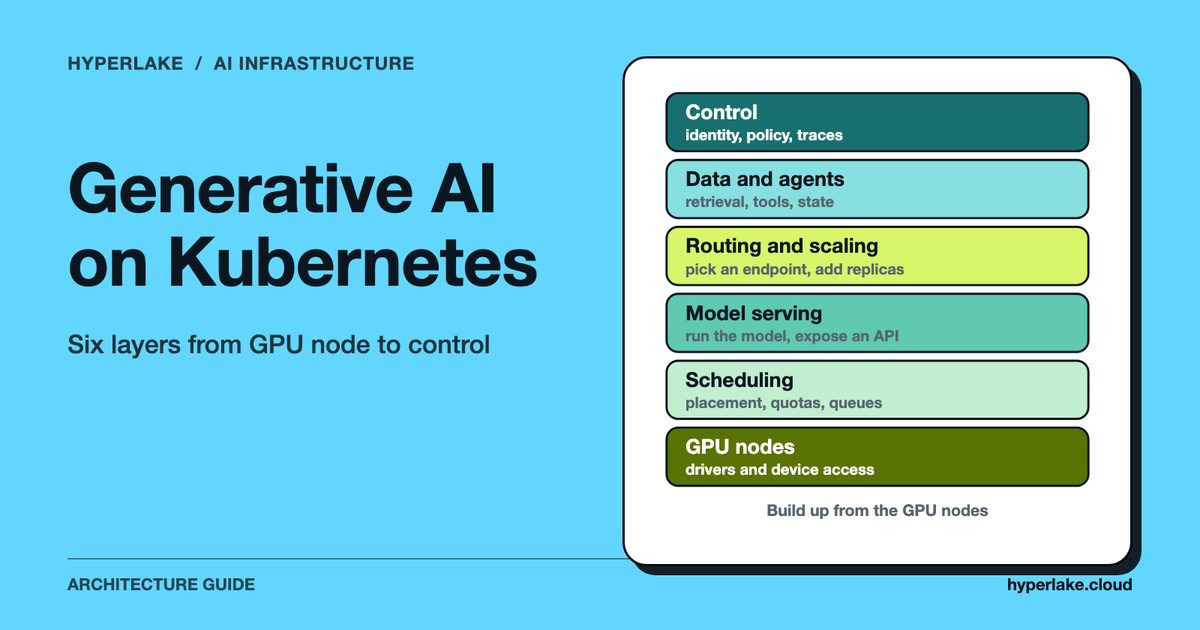
LLM deployment at scale means serving models to many users at once with predictable reliability, cost and governance. Getting one model to answer one request leaves the broader production requirements unresolved. The rest takes optimized inference, GPU-aware scheduling, queues, caching, model routing, failover, endpoint security, audit controls and capacity protections that every application shares.
Demos lie. A model that looks great on a laptop can run out of GPU memory the afternoon real traffic arrives, or pile up a queue nobody planned for, or quietly skip every company control.
Our opinion: model serving is shared infrastructure, and no single app team should be hacking it together alone.
How should security and governance be enforced for LLM endpoints?
Once, at the deployment layer. If every team rebuilds authentication, auditing, filtering and capacity limits, you get a dozen slightly different versions of each, and the weakest one sets your real security level. Apps can still add their own domain rules on top of a shared baseline.
Four controls belong in that layer:
- Authentication, so every endpoint knows which user, workload or client is calling.
- Prompt and response logging for audit and compliance, with retention and access rules that respect sensitive content.
- Output filtering that catches policy violations before text reaches users or downstream systems.
- Rate limiting, so one client can't eat the inference capacity everyone else needs.
They live in infrastructure because they have to hold across models, applications and teams, and a single enforcement point is easier to inspect and change. When something goes wrong, request identity plus logs are what you'll investigate with.
How does multi-model routing work in production?
Not every request deserves your biggest model.
A router looks at each request and picks a model that fits its complexity, cost, latency and capability needs, with a way to escalate when the task turns out harder than it looked. Sorting a support ticket? A fast, cheaper model will do. A tricky reasoning task may need a stronger one, and a request in a particular language, or with a huge context, may need a model chosen for exactly that.
We'd keep the routing policy out of application code. That way a team can change which model answers without rewriting every client.
Fallback chains use the same idea for availability: if the primary model is down or unhealthy, the serving layer sends traffic to an approved alternative. It's how you serve LLMs efficiently across several workloads, and it pairs with LLM failover and load-balancing patterns.

How do inference optimizations improve LLM serving?
Four techniques, four different constraints, so the gains can stack.
Quantization stores model weights at lower precision to shrink their memory footprint; which method fits depends on your quality bar, your hardware and the serving engine. Speculative decoding proposes several candidate tokens and has the target model check them, which can cut the token-by-token work when the workload and models suit it.
Continuous batching adds and removes requests from the running batch as generation goes on, so GPUs stay busier than if they waited for the slowest request in a fixed batch (the continuous batching architecture walks through the serving pattern). KV cache management keeps the attention state from earlier tokens so prefill isn't recomputed, and allocation, reuse and eviction matter more as contexts get longer and concurrency climbs.
No single trick fixes every bottleneck.
Test the combination against realistic prompt lengths, output lengths, arrival patterns and quality needs. Peak throughput on a synthetic benchmark says very little about a Tuesday afternoon in production.
What infrastructure does LLM deployment at scale require?
More than an endpoint. You need an inference server, managed GPU capacity, request queues, caching, and a plan for failures and overload. Pull on one of these and the others feel it: a full queue turns up as latency, and a starved GPU turns up as an outage somewhere else.
The inference server does the model-specific work of LLM inference, while GPU resource management decides which accelerator gets which model and which request. Aim for high utilization, but don't saturate every GPU. A cluster running flat out has nothing left for a spike or an urgent job.
Queues soak up short bursts, and they need timeouts so a request that nobody is waiting for any more stops eating resources. When things get tight, degrade on purpose: turn away low-priority traffic, trim optional work, or hand requests to another service. That beats a system that freezes.
Caching saves compute at two levels. Prompt caching reuses work for repeated prompt prefixes or identical inputs. Semantic caching reuses an earlier result when a new request means nearly the same thing, if freshness, privacy and correctness allow it.
Without these layers, a model endpoint is a thin API wrapped around a GPU process. With them it's a managed production service.

How Hyperlake helps
Hyperlake lets teams host and serve open and custom models on infrastructure they or their clients control, including open-model serving through KServe where the deployment supports it. It combines model services with identity, network isolation, access policy, scoped secrets, observability, audit and lifecycle controls, and eligible inference endpoints can scale down when idle. To discuss an architecture for private, governed model serving, talk to our team.
Frequently asked questions
Why does an LLM demo fail when exposed to production traffic?
A demo proves the model can answer a request, nothing more. It says nothing about concurrency, bursts, GPU memory pressure, timeouts or failures. Real traffic brings competing requests with unpredictable prompt and output lengths, so you need queuing, batching, capacity management, caching and graceful degradation to stay responsive.
Should every LLM request use the most capable model?
Usually not. Classification, extraction and routing can often go to a faster, cheaper model, while hard reasoning may justify a stronger one. A central router can pick by task complexity, latency target, cost limit and required capability, then escalate or fall back when it has to.
What is the difference between prompt caching and semantic caching?
Prompt caching reuses work for identical prompts or repeated prefixes, which trims redundant processing during prefill. Semantic caching tries to reuse an earlier answer for a request that means about the same. That second kind needs tighter controls, because small differences in context, authorization, freshness or intent can make a cached answer wrong.
Which LLM serving optimization should a team implement first?
Start with whichever one hits your measured bottleneck. Quantization helps when model memory is the limit, continuous batching helps utilization under concurrency, KV cache management matters for repeated prefill and long contexts, and speculative decoding can speed up generation in the right conditions. Benchmark on a representative workload and check quality before you commit, instead of trusting synthetic throughput numbers.