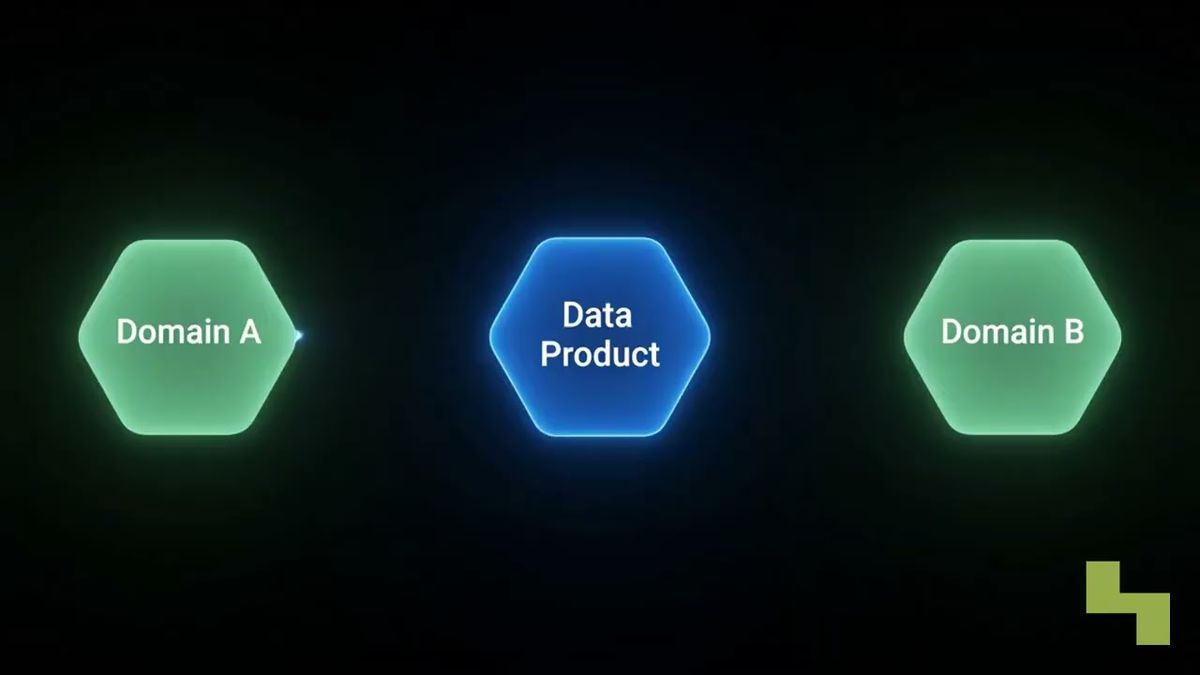
Federated computational governance is a data mesh model: a distributed group agrees on common governance standards, and the platform enforces them as executable rules. Domain teams keep their autonomy, yet every release passes the same gates for quality, metadata, access control and lineage. Automated validation replaces the routine committee approvals. Shared oversight stays.
A governance committee that reviews everything is fine at five data products. At fifty, it's the queue everybody complains about. Ownership spreads across domains, products multiply, and central review turns into the bottleneck. This model exists to fix that.
Why does federated governance scale better?
Because the governance team doesn't have to grow every time the product count does.
With manual review, more products mean more queues, more meetings and more interpreting (two reviewers can even read one written policy two ways). Automated enforcement keeps the effort roughly flat. Domains work independently inside shared boundaries that are applied the same way each time, and executable rules give you a repeatable baseline: the same validator checks the same requirement wherever the platform applies it.
Does that remove human governance? No. People still pick which standards matter, settle disputed requirements, approve policy changes and handle unusual or high-stakes exceptions. We think the right split is easy to say and hard to hold: automate routine compliance, and save human attention for judgment, policy design and accountability.
Federation helps the standards themselves, too. Domain representatives notice requirements that clash with real operating conditions, and they help write rules that stay useful across many kinds of data products.
What is federated computational governance?
Two jobs normally sit together: deciding the standards, and enforcing them. This model pulls them apart.
A representative governance body writes the common rules. Shared infrastructure applies them automatically.
The traditional setup hands both jobs to one central team or committee, which defines the policies, reviews individual decisions and approves changes. Workable when things are small. Then every new domain, data product or access request lands on the same pile.
Federation spreads out the writing. Representatives from the data domains sit in the governance group, so the people who produce and use the data help decide what good governance requires (compare that with being told to follow rules from people outside your work).
The computational part makes it run: policies become machine-executable checks, and nobody reinterprets a document each time. This split sits at the center of data mesh roles and responsibilities. People stay accountable; the platform handles routine, repeatable enforcement.

How does a federated data governance model work?
Picture three groups and one path. The federated group writes policy specifications. The data platform turns them into validators and quality gates. Domain teams publish data products through those gates, and a product that meets the encoded requirements never needs to bother the governance group for a routine release.
Before a data product goes live, a publication workflow might check four things:
- Quality thresholds are met.
- Required metadata and documentation exist.
- Access rules for consumers are declared.
- Lineage is recorded, so you can trace where the product came from and how it changed.
Pass, and the workflow carries on. Fail, and the domain team gets a specific condition to fix. Meanwhile the governance body is free to define, review and evolve standards instead of hand-inspecting every product.
Governance also ends up inside delivery. The checks run on the same path teams already use to publish or update products, which ties governance to practical data product best practices and stops it being a separate review bolted on at the end.

How do you implement federated computational governance?
Start small, and make it testable. Pick a handful of clear requirements and one shared platform path that can enforce them. If people can't read a policy the same way, you won't encode it reliably either.
Here's the rollout we'd follow.
Form a representative governance group first, with domain people who know how data is produced, maintained and consumed. Then have them write explicit policy specifications: the evidence required, acceptable outcomes, ownership and when each rule applies.
Next, turn suitable policies into automated platform controls. Think schema checks, metadata validation, quality gates, access policy evaluation and lineage requirements. Make validated governance the standard publication workflow, the normal way to release and update data products rather than an optional side process.
Plan for exceptions and change from day one. Ambiguous cases go to people, and policies are versioned so teams can see why a requirement changed. And show results: domain teams should get validation output they can act on, so they fix failures without waiting for a committee.
One warning. Don't turn every governance decision into pass or fail. Rules work best when the evidence and the pass conditions are explicit, and decisions that depend on judgment keep their review and approval paths.
How Hyperlake helps
Hyperlake lets teams assemble and govern data, models, applications and tools in infrastructure they or their clients control. Its shared controls can combine authenticated access, scoped identity, OPA policy decisions, audit and lineage at integrated access points, and reusable deployment patterns help apply one consistent operating approach across environments. To see how this fits a federated governance architecture, talk to our team.
Frequently asked questions
Does federated governance eliminate a central governance team?
No. The central function changes: it stops reviewing every routine decision and starts coordinating standards, settling disputes and keeping organization-wide expectations in order. Domain representatives take part, and automated platform controls apply the approved policies during normal data product delivery.
Which data product policies should be automated first?
The ones with clear evidence and a deterministic pass condition: mandatory metadata fields, ownership declarations, schema checks, access definitions and lineage records. Quality thresholds can follow once teams agree on the metric, the scope and an acceptable result. Keep people in the loop for subjective or high-impact decisions.
How should teams handle exceptions to computational policies?
Run them through a workflow that records the failed rule, the requesting owner, the reason for the deviation, who approved it, and any time limit or remediation condition. The aim isn't to let people slip past governance quietly; it's to make judgment calls explicit, reviewable and traceable without weakening the standard workflow.
Can federated computational governance work outside a data mesh?
Yes. The idea is closely tied to data mesh, but any organization with distributed data ownership can use federated policy design and automated enforcement. It pays off most when several teams need local autonomy and still share organization-wide requirements for quality, discoverability, access, security and traceability.