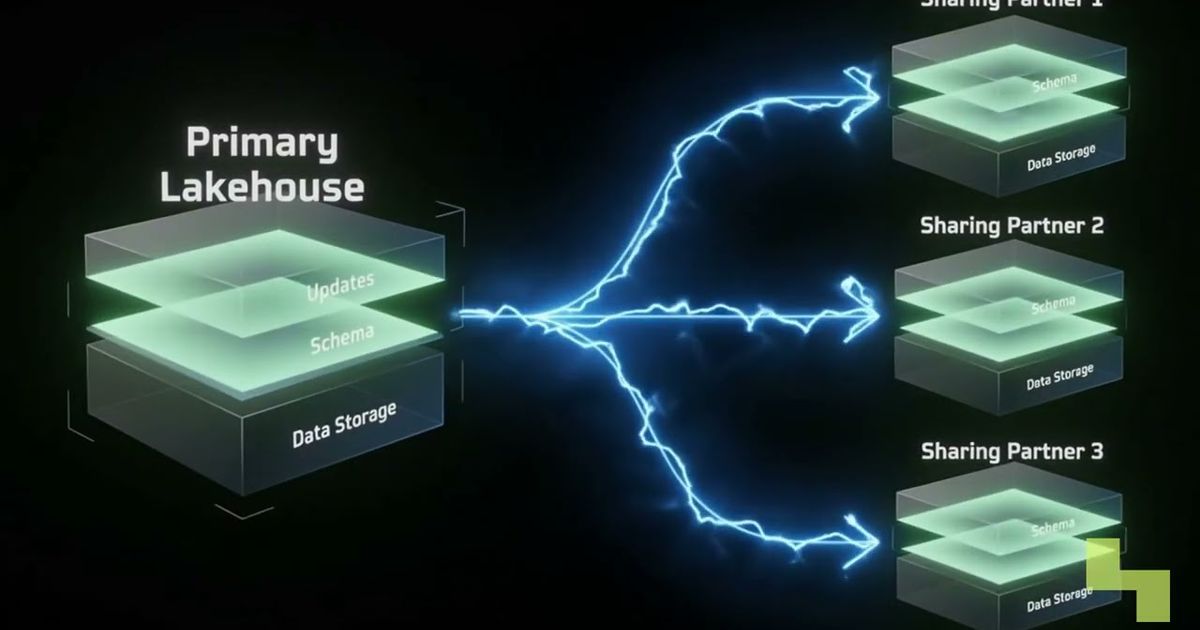
Data federation is an architecture for querying multiple independent data sources through one logical interface without first copying their contents into a central repository. A federation layer splits each query into source-specific operations, sends them to the relevant systems, retrieves their results, and combines those results into one response.
This matters when teams need current data across operational systems, organizational boundaries, or regulated locations but cannot justify another synchronized copy. Federation can simplify access, although its performance and governance depend on the participating sources and query design. The video above walks through the core ideas.
What is data federation and how does it work?
Data federation presents separate data sources as a unified system at query time. The original records remain in their source systems rather than being loaded into a shared warehouse or lake before users can query them.
A typical federated query follows four stages:
- Receive one query. A user, application, or agent submits a request through the federation layer.
- Plan source operations. The layer determines which systems contain the required data and decomposes the query.
- Execute at the sources. Source-specific operations run against databases, catalogs, APIs, or other supported systems.
- Combine the results. The federation layer joins, filters, aggregates, or formats the returned data into one response.
Good federation engines push as much filtering and aggregation as possible to each source. This reduces unnecessary data transfer and avoids making the federation layer process every underlying record. The exact behavior depends on source capabilities, connectors, query planning, and the operations being requested. A deeper view of this execution model appears in how queries run across data systems.

How is data federation different from ETL and virtualization?
Federation coordinates distributed sources when a query runs, while ETL copies and prepares data before it is queried. Data virtualization and data federation often describe substantially the same query-time access pattern, but the terms commonly emphasize different contexts.
An ETL pipeline extracts records, transforms them, and loads them into a central repository. That approach creates a materialized copy that can be optimized for predictable analytics, but teams must schedule, monitor, and update the pipeline to keep the copy current.
Federation removes the requirement for that central copy. Queries reach the original systems in real time, so freshness reflects the state available from each source when the query runs. However, query speed and reliability now depend partly on source performance, network conditions, and cross-source planning.
“Data virtualization” is more common in product descriptions, while “data federation” is often used as an architectural term. Neither should be interpreted as eliminating all network transfer: results still travel from sources to the query layer, but the full datasets are not persistently replicated into a new central store.

When should you use data federation?
Use data federation when current, distributed access matters more than consistently low-latency processing over large data volumes. It is particularly useful when copying data is difficult, restricted, or operationally wasteful.
Strong use cases include:
- Data distributed across teams, companies, or customer environments.
- Sources subject to jurisdictional or data residency constraints.
- Operational systems whose latest state matters more than a scheduled snapshot.
- Occasional cross-source questions that do not justify permanent ingestion pipelines.
Federation is usually a poor fit for queries that repeatedly scan or join very large datasets under strict latency requirements. Prematerialized, colocated data optimized for the query pattern will often perform better because it avoids repeated network calls and distributed execution. Many architectures therefore combine both methods: federation for selective, current access and pipelines for high-volume or latency-sensitive workloads.
Residency alone does not guarantee control over processing, identity, or legal authority. Teams making architecture decisions across jurisdictions should also distinguish data residency from data sovereignty.
How does data federation support AI agents?
Data federation lets an AI agent retrieve current context from several governed systems during one reasoning workflow. It can avoid synchronizing every possible source into a shared lake before the agent can use the information.
For example, an agent could query a customer database, product catalog, and financial system to answer a request involving account status, item availability, and payment terms. The federation layer routes each part of the request to the appropriate source and returns a combined result.
This pattern does not remove the need for governance. Agents should use authenticated services, scoped identities, policy checks, and logged access rather than shared database credentials. Query planners must also limit unnecessary scans and account for unavailable or slow sources. Federation provides the access mechanism; identity, authorization, semantic consistency, and evidence handling determine whether the resulting AI workflow is trustworthy.
Key takeaways
- Data federation queries separate sources through one logical interface without maintaining a central copy of all source data.
- The federation layer decomposes queries, executes source-specific operations, and combines the returned results.
- Data virtualization and data federation usually describe similar query-time access patterns.
- Federation suits current, distributed, or residency-constrained data, but not every high-volume, low-latency workload.
- AI agents still require governed identities, policy enforcement, and observable access when using federated data.
How Hyperlake helps
Hyperlake lets teams assemble data, model, application, and governance capabilities in infrastructure they or their clients control. Depending on the workload and deployment, teams can use engines such as Trino with Iceberg and object storage alongside operational, vector, graph, search, and streaming services, with authenticated access and policy enforcement at integrated access points. To discuss an architecture for governed distributed data and AI, talk to our team.
Frequently asked questions
Does data federation move any data between systems?
Data federation transfers query requests and returned results across systems, but it does not require a persistent central copy of each complete source. Filters, projections, and aggregations may run at the source to reduce transfer. The amount of result data moved depends on the query plan, connector capabilities, and source systems.
Can data federation replace a data warehouse or lakehouse?
Not in every workload. Federation works well for selective access to current, distributed data, while a warehouse or lakehouse is often better for repeated scans, large joins, historical analysis, and predictable low-latency queries. A practical architecture can use federation for live access and materialized data for intensive analytics.
How fresh are results from a federated query?
Federated results generally reflect what each source exposes when its part of the query executes, avoiding the delay of a scheduled replication pipeline. However, sources may use different transaction boundaries, caches, or update schedules. A combined response therefore may not represent one perfectly synchronized snapshot unless the participating systems support coordinated consistency.
How should access control work for federated AI queries?
Each request should carry an authenticated user or workload identity, and policy enforcement should restrict which sources, rows, fields, and operations it can access. The federation layer must not become a route around source controls. Logging query activity and policy decisions also helps teams investigate agent behavior and demonstrate how sensitive data was accessed.