Sim-to-real robotics is the job of moving behavior built in robot simulation onto a physical robot. It only works when sensor conventions, coordinate frames, control timing, dynamics and hardware limits all line up, and small mismatches can destabilize the machine. Systematic validation is what makes the movement safe and repeatable.
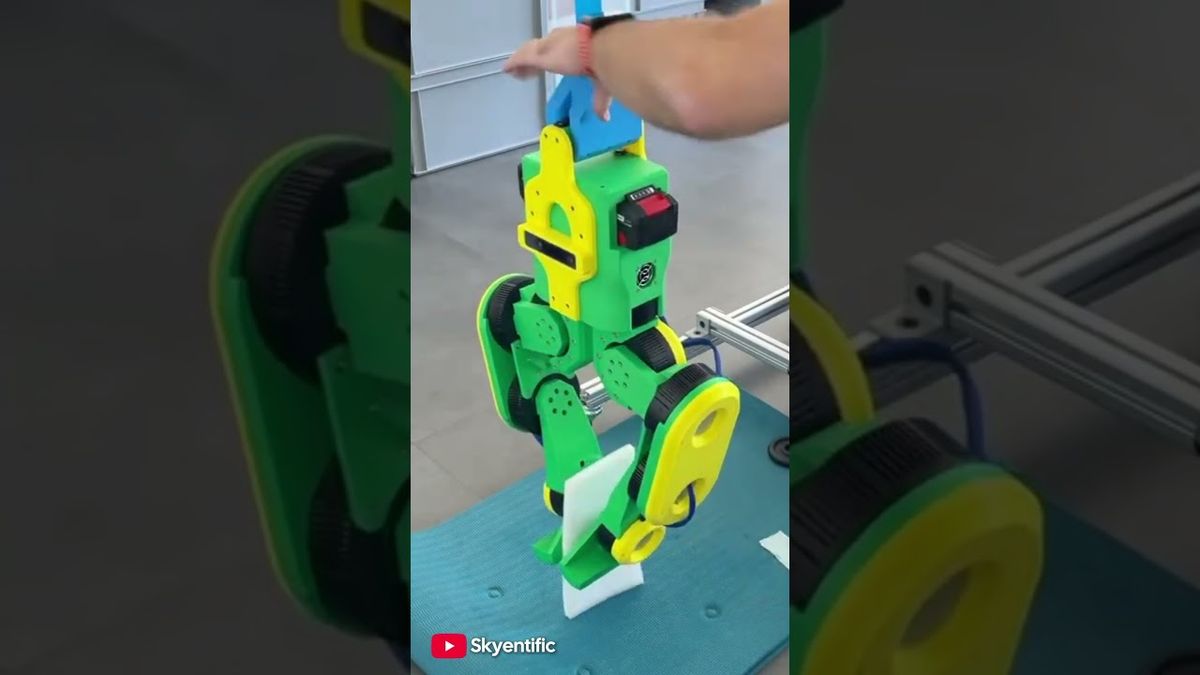
Under half a second. That's how long a controller that looked rock steady in simulation needed to wreck a pair of legs once bad real-world data reached it. The biped in this story took seven months of active work, and almost a year of development overall, before it walked forward and backward.
Why did the physical robot break its legs?
It thought it was upside down.
Its IMU data along the Z-axis was inverted, so the robot received incorrect orientation information and answered with extremely fast corrective movements. Both legs broke in under half a second. One visibly failed, the other was nearly broken, and a nearby wire may have been damaged too. Nobody could have reached in to stop it; the motion was too fast for manual intervention.
The camera was a second, quieter problem. The controller expected data in the camera's local frame, and the camera delivered it in the world frame. Finding and fixing that took almost two months, and the robot behaved a lot better afterward.
What we take from this: sensor semantics matter as much as sensor values. A number can look entirely plausible and still be wrong if its axis direction, origin, units, timestamp or reference frame isn't what downstream software expects.
What causes the sim-to-real gap in robotics?
How can a correct controller fail anyway? Because the model behind it doesn't describe the machine. The sim-to-real gap opens when assumptions baked into the simulator don't match the physical robot, and the real one brings sensor errors, mechanical variation, latency, flexible parts, wiring constraints and environmental forces of its own.
Inside the simulator, a biped can have ideal joints, exact dimensions, predictable friction and noise-free orientation data. On the bench you get manufacturing tolerances, backlash, calibration errors, communication delays and structural weak points.
Five places to look first. Axes that point different ways, or use different handedness. A sensor reporting in a world frame while the software expects its local frame. Latency and jitter from sensors, networks and actuators. Dynamics: mass, friction, motor strength and joint limits that differ from the simulated values. And sensor noise, drift, bias or saturation that distort the estimated state.
So sim-to-real is a system-validation problem, and a model-transfer step is only part of it. As with other compound AI systems, behavior comes from interactions among models, data, software, infrastructure and physical components.

How should teams debug a robot moving from simulation to reality?
One layer at a time, starting while the robot stands still. Move from static measurements to constrained motion, and test each assumption before the controller gets the authority to command full speed or full range.
A sequence that works:
- Check sensors at rest: orientation, gravity direction, signs, units, timestamps and expected ranges in known poses.
- Verify the transforms between world, base, camera, IMU, joint and tool frames.
- Test actuators one at a time, sending limited commands to a single joint and checking direction and magnitude.
- Constrain early trials with conservative speed, torque, gain and range limits, and physical support where it makes sense.
- Record synchronized evidence (commands, measurements, transforms, controller state, camera data), and add movement complexity only once the simpler cases behave consistently.
Please don't make safety depend on someone reacting fast. Half a second is nowhere near enough time. Depending on the machine, you can use software limits, hardware stops, remote power isolation, tethers or automatic shutdown conditions. Observability should tie decisions to evidence as well, as this overview of AI observability explains.

What makes Physical AI development repeatable?
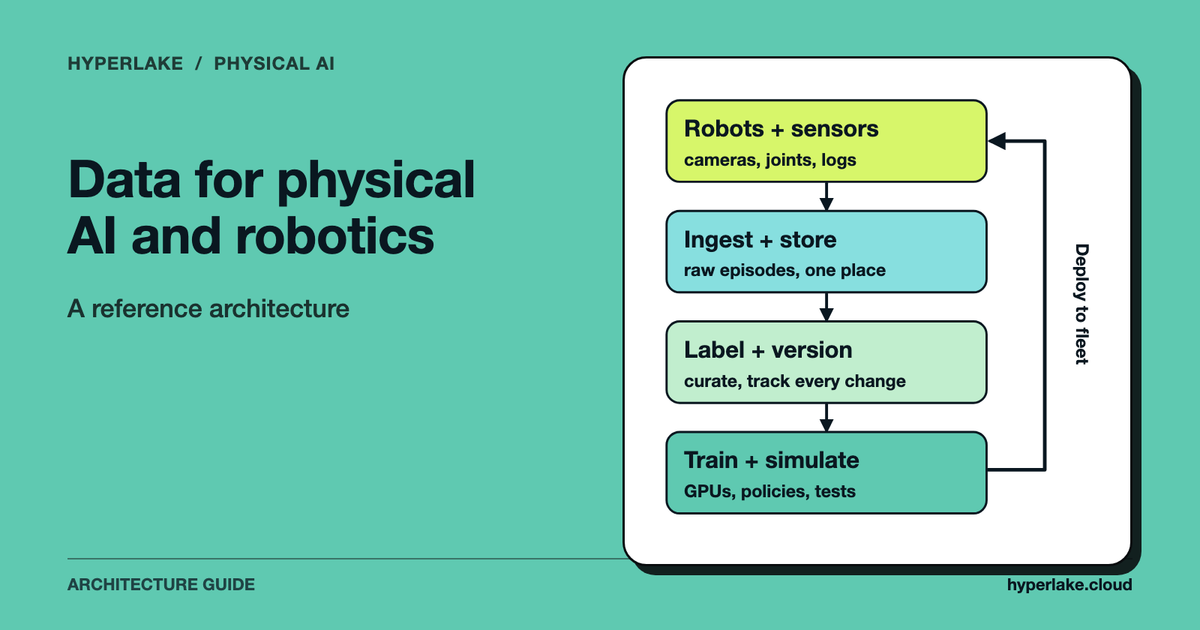
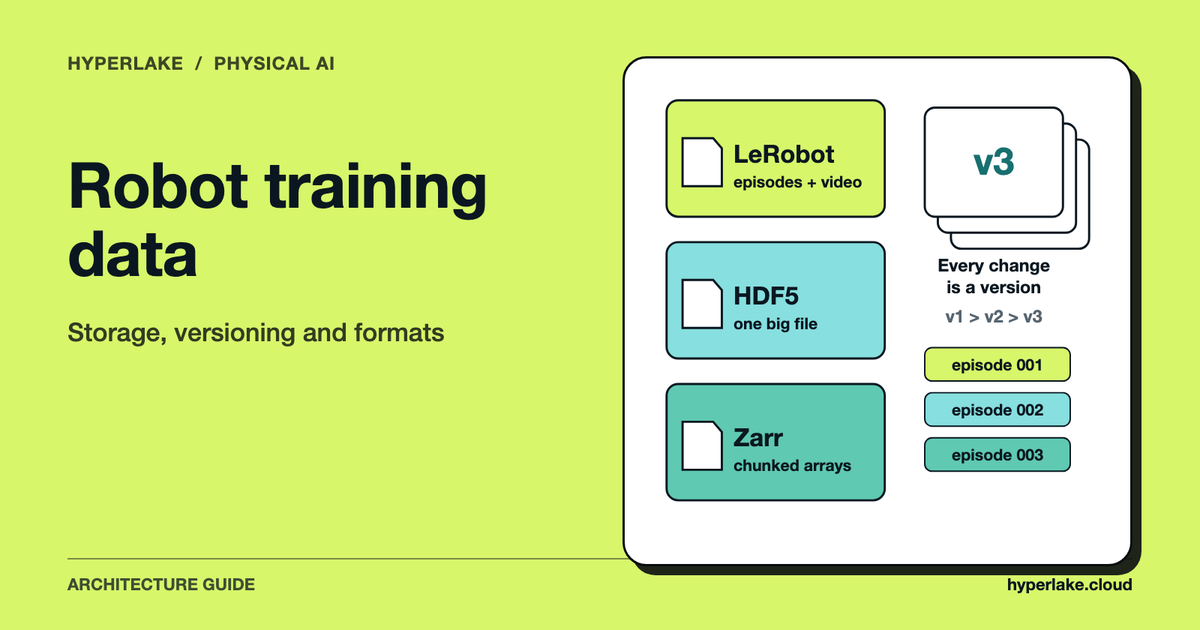
A working controller is only the start. Repeatable Physical AI development needs versioned simulation environments, traceable datasets, reproducible model deployments, evaluation procedures, and records that link software changes to physical outcomes.
For every test, keep the robot description, controller version, model weights, sensor calibration, frame definitions, runtime parameters and relevant infrastructure configuration. Skip that context and a successful trial can be hard to reproduce after a hardware repair or a software update.
Stage the testing too. Robotics simulation supports broad exploration without risking hardware. Hardware-in-the-loop testing exposes timing and interface problems. Constrained physical trials validate sensing and mechanics.
For this robot, fixing the inverted IMU axis and the misunderstood camera frame is what finally made controlled forward and backward walking possible.
How Hyperlake helps
Hyperlake provides a sovereign operating platform for assembling and governing the data, models, applications and tools behind Physical AI, in infrastructure the deploying team or its client controls. It can support repeatable environments that combine simulation, orchestration, training, data and model services, including tools such as NVIDIA OSMO, Omniverse, Isaac Sim and Isaac Lab, subject to licensing and validated integration. To talk through a Physical AI deployment, talk to our team.
Frequently asked questions
Why can a robot work in simulation but fail immediately in reality?
Because the simulator encodes assumptions about sensors, joints, timing, friction, mass and the environment, and physical hardware can break every one of them: calibration errors, latency, mechanical variation, different coordinate conventions. The controller stays stable in simulation and sends unsafe commands to the real robot.
How do you verify coordinate frames before testing a walking robot?
Put the robot and its sensors in known orientations, then compare the reported axes and transforms with what you expect. Check direction, handedness, origin, units, and whether each measurement uses a local or world frame. Repeat the checks with small, constrained movements before you turn on whole-body control.
Can domain randomization solve every sim-to-real problem?
No. Domain randomization can make controllers less sensitive to variation in dynamics, sensor noise or environmental conditions, but it doesn't replace interface validation. An inverted axis or a misread reference frame is a semantic error, so teams have to find and fix it directly.