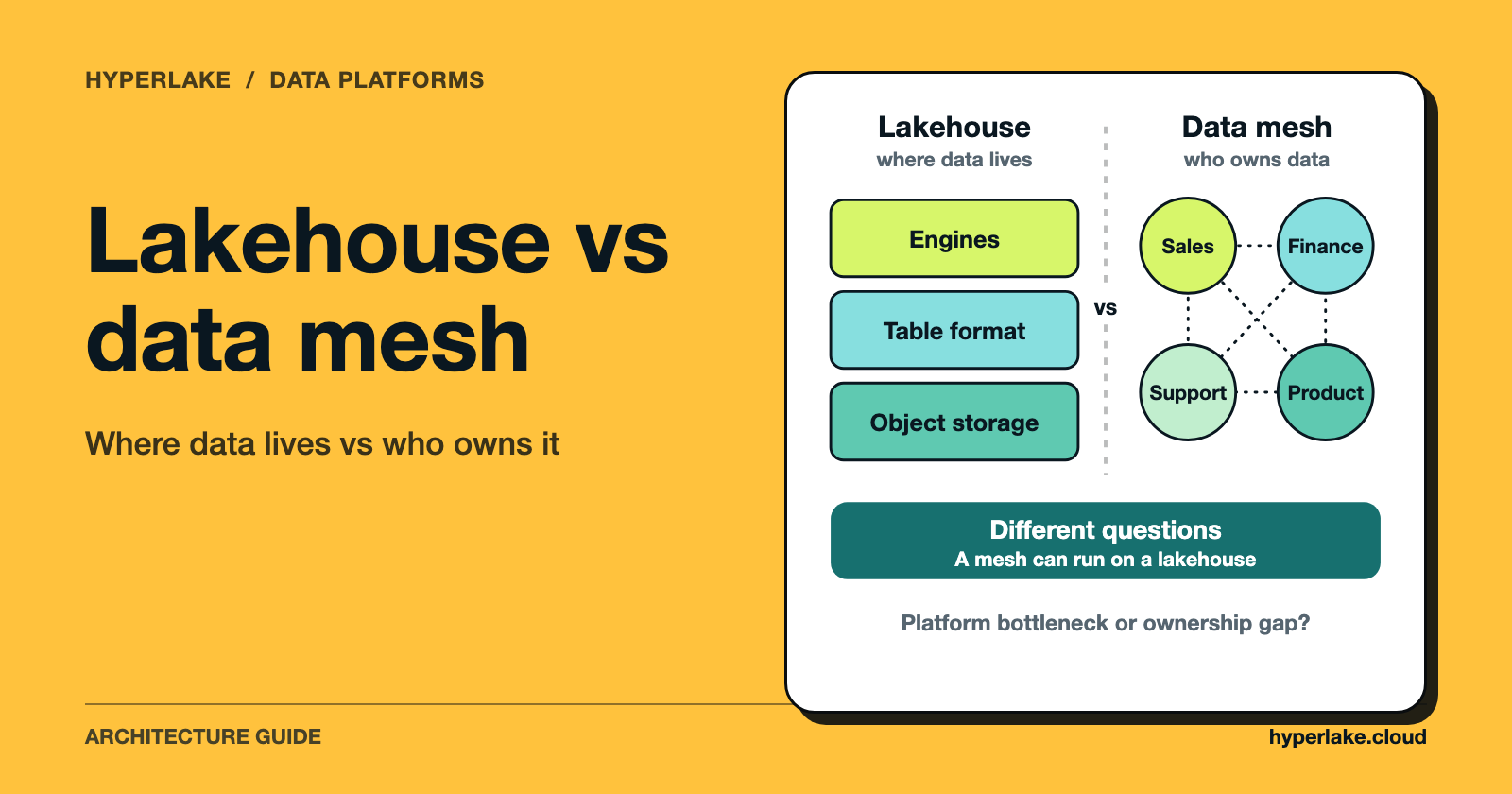
"Data lakehouse vs data mesh" is a misleading question. A data lakehouse is a storage-and-compute architecture: open files on cheap storage, plus a table layer that manages them like a warehouse. A data mesh is an organisational and governance approach in which domain teams own and publish their data as products. A mesh can even run on lakehouse technology. Decide by asking whether your bottleneck is the platform or the ownership model.
We make HyperLake, a sovereign AI operating platform. It isn't a lakehouse or a mesh on its own, and the last section explains exactly where it fits.

What is the difference between a data lakehouse and a data mesh?
| Data lakehouse | Data mesh | |
|---|---|---|
| What it is | An architecture for storing and querying data | An approach to who owns and serves data |
| Main question | Where does the data live and how is it queried? | Who is accountable for the data? |
| Unit of design | Tables on shared storage | Domain-owned data products |
| Typical structure | Central or shared platform | Decentralised domains on a shared platform |
| Governance | Usually set by a platform or data team | Federated: shared rules, local decisions |
| Main risk | Central team becomes a bottleneck | Inconsistent quality and duplicated effort |
| Technology | Specific: object storage, table format, engines | Technology-agnostic |
You're not comparing like with like. The original lakehouse paper (Armbrust, Ghodsi, Xin and Zaharia, CIDR 2021) describes the lakehouse as a pattern characterised by open direct-access data formats such as Apache Parquet, first-class support for machine learning and data science workloads, and state-of-the-art performance (the authors' claim) (CIDR 2021 paper). Zhamak Dehghani, who introduced data mesh, talks about "the data mesh approach" and offers what she describes as a technology-agnostic model (martinfowler.com). So one is about how data is stored. The other is about who answers for it.
What is a data lakehouse?
A lakehouse keeps data in a data lake, meaning low-cost storage holding open file formats such as Parquet, and layers a warehouse's management features on top. Databricks describes it as combining the flexibility, low cost and scale of lakes with the data management and ACID transactions of warehouses, so BI and machine learning can work on the same data (Databricks glossary). That page lists three building blocks: metadata layers on top of open files that track which files make up each table version, query engines that bring fast SQL to lake storage, and direct access for data science and ML tools.
In practice you pick three layers: object storage, an open table format, and one or more query engines. Apache Iceberg is one such table format, and its documentation lists integrations with engines including Spark, Flink, Trino, DuckDB and ClickHouse (Iceberg docs). For the layer-by-layer view, read Data Lakehouse Architecture: The Four Layers. For choosing a table format, there's Open Table Formats Explained.
What is a data mesh?
Dehghani's article names four principles (martinfowler.com):
- Domain-oriented ownership, where the teams closest to a business area own and serve its analytical data.
- Data as a product, offered to consumers with quality and usability standards, as if they were customers.
- Self-serve data infrastructure as a platform, with shared abstractions that let domain teams build and run data products without deep infrastructure expertise.
- Federated computational governance, where domains decide locally within shared global standards and the platform enforces those standards automatically.
Look at the third one. A mesh needs a platform, and the article doesn't say which. For a longer walkthrough, see Data Mesh: Architecture, Principles, and Ownership and Data Mesh Architecture: Four Layers Explained.
How do a lakehouse and a mesh differ architecturally?
Start with centralisation. A lakehouse is commonly run as a shared platform, with one team looking after storage, tables and engines. A mesh hands responsibility for data to the domains. Physical storage in a mesh can still be shared. What changes is who builds, documents and supports each dataset.
The unit of delivery differs too. In a lakehouse it's usually a table. In a mesh it's a data product: the data plus the documentation, quality expectations and access terms that make it usable. See Data Product: What It Is and Why It Matters.
Then governance. Lakehouse governance typically sits at the platform: catalog, access policy, lineage. Mesh governance is federated, with standards agreed across domains and enforced by the platform. The mechanics overlap heavily. Federated Computational Governance Explained goes into it.
Technology coupling is the big one. A lakehouse names its parts. A mesh doesn't. That's why teams so often ask "lakehouse or mesh?" when the real question is "what do we build the mesh on?"
And each one breaks in its own way. A centralised lakehouse can turn one team into the queue for every new dataset. A mesh without a capable platform and clear standards can leave every domain solving the same problems differently. That's our summary of the trade-offs, not a measured result.
Are lakehouse and data mesh mutually exclusive?
No. A common pattern is a mesh whose shared platform is a lakehouse. The lakehouse supplies storage, table format, query engines and catalog. Domains publish data products as tables on it and own their quality. The platform team runs the self-serve layer and automates the governance checks.
Here's a hypothetical illustration of what a domain-owned data product definition might hold. It's a generic sketch, not any tool's syntax.
# Illustration only: a generic data product descriptor
name: orders_daily
domain: sales
owner: sales-data-team
storage: lakehouse.sales.orders_daily   # an Iceberg-style table on shared storage
quality:
  freshness: "updated by 06:00 UTC"
  checks: [not_null_order_id, unique_order_id]
access:
  policy: "analysts in sales and finance; email column masked"
The table lives on the lakehouse. The ownership, the quality promise and the access terms are the mesh part.
When should you choose a lakehouse, a mesh, or both?
| Situation | Leans toward |
|---|---|
| Few data teams, one main business, data scattered across silos | Lakehouse first |
| Many domains, a central team that is a bottleneck | Mesh practices on a shared platform |
| Need to unify BI and ML on the same files | Lakehouse |
| Domains already own systems and know their data best | Mesh ownership model |
| Small organisation | Often a lakehouse alone; a mesh adds coordination cost |
Our rule of thumb, and it's ours, not a standard: start with the platform, then add mesh practices when the central team stops scaling or when domain knowledge is what's missing. Data mesh is mostly about people and ownership. You can't buy it as a product. Here's a quick test. If you can't name an accountable owner for your ten most important datasets, a new storage architecture won't fix that.
What does this mean for AI workloads?
AI asks for two things. Agents and models need data they're allowed to see, and data they can trust. Data products with owners, documented quality and explicit access terms help on both counts, and a lakehouse gives them a common home. Data Products for AI Agents covers that angle.
Where does HyperLake fit?
HyperLake isn't a lakehouse engine, and it doesn't prescribe a mesh. According to its product description, it's a platform for assembling, deploying and governing the data, models and applications behind AI in a customer's own environment or a client's, and its engines follow the workload, including Iceberg and Trino for lakehouse analytics. Its stated data-and-intelligence pattern is a governed foundation of Iceberg and object storage with a fitting query engine, plus a reviewed semantic layer so agents see only approved data. People and agents reach data through authenticated, governed services with OPA policy decisions.
So HyperLake is relevant once you've chosen a lakehouse, with or without mesh ownership, and need to decide where it runs and who can query it. If all you need is a managed warehouse, or you're still sorting out domain ownership, no platform will settle that for you. For the open-source stack, see What Does an Open-Source Data Lakehouse Stack Look Like?.
Frequently asked questions
Is a data lakehouse the same as a data mesh?
No. A lakehouse is an architecture for storing and querying data on open formats, while a data mesh is an approach to ownership and governance. They work at different levels, and you can combine them.
Can you build a data mesh on a lakehouse?
Yes, and plenty of teams do. The mesh's self-serve platform can be a lakehouse with shared storage, an open table format and query engines, and domains publish data products as tables. Dehghani's description is technology-agnostic, so it neither requires nor forbids one.
Which is better, data lakehouse or data mesh?
Neither, in the abstract. A lakehouse addresses platform design and a mesh addresses ownership. Smaller teams usually need the platform first, while larger organisations with many domains and a central bottleneck often get more from mesh practices.
Does data mesh replace the data warehouse or data lake?
Not on its own. The mesh approach says nothing about storage technology, so a domain's data product might sit in a warehouse, a lake or a lakehouse.
Is data fabric the same as data mesh?
No. Both try to make distributed data usable, but they put the emphasis in different places. Data Fabric vs Data Mesh: Differences and Roles compares them.
What are the four principles of data mesh?
They're domain-oriented ownership, data as a product, self-serve data infrastructure as a platform, and federated computational governance.