On-premises AI runs model weights, inference compute, and application data inside infrastructure an organization controls, such as a data center, private cloud, or dedicated GPU cluster. It creates a defined, auditable boundary instead of sending every request to a third-party API, but makes the organization responsible for operating the system.
This model matters when health records, financial data, legal documents, intellectual property, or classified information cannot cross an external administrative boundary. It provides greater control, but also introduces capacity, lifecycle, security, and reliability obligations. The video above walks through the core ideas.
What is on-premises AI?
On-premises AI means running models and their supporting services within infrastructure controlled by the organization. Despite the name, it can include physical servers, a private cloud, an isolated cloud environment, or a dedicated GPU cluster.
The defining feature is the control boundary. Model weights, prompts, retrieved context, outputs, inference compute, and keys remain within an environment the organization defines and audits.
That boundary must cover more than the model endpoint. Production systems may also include databases, vector stores, agent runtimes, identity services, queues, observability tools, and application APIs. A component that sends sensitive context elsewhere can break the intended containment model.
Why do regulated organizations use self-hosted AI?
Regulated organizations use self-hosted AI to control where data is processed, who can access it, how long it is retained, and what audit evidence is recorded. Prompts and enterprise context do not have to enter infrastructure administered by an external AI provider.
External APIs can offer encryption, retention controls, and contractual protections, but requests still cross a network and administrative boundary. For health, financial, legal, or classified information, that boundary may conflict with regulatory, contractual, or internal policy requirements.
GDPR, HIPAA, and high-risk obligations under the EU AI Act do not universally require on-premises deployment. Self-hosting also does not create compliance automatically. It can make data localization, access control, auditability, and evidence collection structurally easier to address. These distinctions also matter when comparing data residency and data sovereignty.
Can open-weight models handle enterprise workloads?
Open-weight models can now meet the quality bar for many bounded enterprise workloads, reducing the capability trade-off historically associated with on-premises AI. Depending on the model and evaluation, they can match or exceed hosted APIs for structured output, domain-specific reasoning, and high-volume routine operations.
Common candidates include extraction, classification, summarization, document processing, and constrained tool use. Retrieval, fine-tuning, and domain-specific evaluation can improve performance for a defined task.
This does not mean every open model equals every frontier service. Results depend on the task, language, context length, hardware, latency target, and evaluation method. Teams should test representative inputs and failure cases instead of relying only on general benchmarks.
What does operating on-premises AI require?
Operating on-premises AI requires ownership of capacity planning, GPU procurement, model lifecycle management, security, observability, and uptime. Self-hosting exchanges the abstraction of a managed API for infrastructure control and substantial operational responsibility.
Teams must size CPU, GPU, storage, and networking for expected demand, concurrency, latency, failures, and maintenance. They must also version models, patch services, monitor health, manage backups, and prepare for incidents.
Cloud APIs absorb much of this work in exchange for per-token or per-request pricing and provider dependency. Owned capacity may be attractive for sustained, well-utilized workloads, but the economics depend on hardware, staffing, power, maintenance, and utilization.
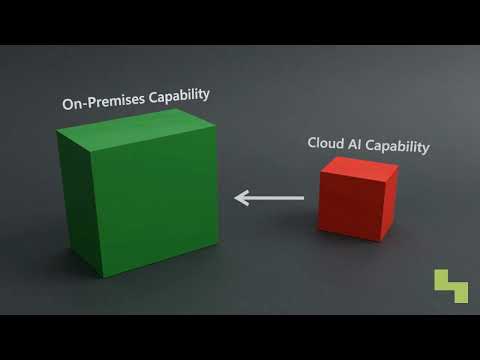
Model refreshes can also take longer. A self-hosted team must evaluate quality, compatibility, resource needs, and security before upgrading, so its environment may lag behind the newest cloud model improvements.

How does hybrid AI routing work?
Hybrid AI routing sends each request to an approved self-hosted or cloud model according to its sensitivity, complexity, frequency, cost, and capability requirements. It preserves local control for appropriate work while retaining selective access to external models.
Routine, high-volume, and sensitive workloads are strong candidates for self-hosted inference. Complex frontier-level requests or infrequent tasks that do not justify dedicated capacity may use cloud models when policy permits the associated data to leave the controlled environment.
A gateway layer makes this arrangement manageable. It can evaluate identity, data classification, model eligibility, availability, and cost before selecting an endpoint. It should record which model handled the request, what policy authorized the route, and whether a fallback occurred.
Without central routing, applications may connect directly to multiple providers, creating inconsistent credentials, policies, logs, and failure behavior. A governed gateway can support LLM failover and load balancing, but every possible destination must be approved for the data it could receive.

Key takeaways
- On-premises AI keeps model execution and application data inside infrastructure the organization controls.
- Self-hosting can support sovereignty and compliance objectives, but it does not guarantee compliance.
- Open-weight models are credible for many structured, domain-specific, and routine enterprise tasks.
- Operating the environment requires capacity, lifecycle, security, monitoring, and reliability engineering.
- Hybrid routing combines controlled local inference with policy-approved access to cloud models.
How Hyperlake helps
Hyperlake lets teams assemble, deploy, and govern data services, models, applications, and tools in their own infrastructure or their clients’ environments. Its Kubernetes-based foundation supports public cloud, private cloud, and on-premises deployments, with shared controls for identity, network isolation, scoped secrets, policy, audit, observability, and lifecycle operations. To discuss a self-hosted or hybrid environment, talk to our team.
Frequently asked questions
Does on-premises AI have to run on physical servers?
No. It can run in a data center, private cloud, isolated cloud environment, or dedicated GPU cluster. The important distinction is whether the organization controls the infrastructure, model execution, keys, administrative access, and movement of prompts, context, and outputs.
Is a self-hosted LLM automatically compliant?
No. Self-hosting can simplify data location and control, but compliance also depends on identity, authorization, encryption, logging, retention, risk management, and operating procedures. Organizations must map the complete system and its controls to applicable legal, regulatory, contractual, and internal requirements.
Which AI workloads should remain in the cloud?
Cloud models may suit low-frequency tasks, rapidly changing capabilities, or complex requests that need models unavailable internally. A cloud route is appropriate only when policy permits the prompt, retrieved context, attachments, and tool outputs to leave the controlled environment.
Is self-hosted AI cheaper than using an API?
Neither option is always cheaper. Managed APIs reduce infrastructure work but charge with usage, while self-hosting adds hardware, staffing, maintenance, and capacity risk. Owned compute can make sense for sustained, well-utilized demand, so teams should calculate the economics for each workload.