Data sovereignty is the principle that data is governed by the laws and governance frameworks of the jurisdiction where it originates or resides. For enterprise AI, it covers more than storage: prompts, retrieved documents, model context, agent memory, and API calls may become cross-border transfers subject to legal and organizational controls.
This matters because AI systems continually process and move information, making sovereignty a runtime architecture concern rather than a one-time compliance check. The video above walks through the core ideas.
What is data sovereignty?
Data sovereignty determines which jurisdiction has legal authority over data and under what conditions that data may be accessed, processed, or transferred. It connects the physical and technical handling of data to applicable laws, regulatory duties, and organizational governance.
During much of the cloud era, teams treated sovereignty mainly as a storage question: choose a region, document where the database lives, and identify the relevant regulations. AI makes that framing incomplete because processing can involve several systems and jurisdictions even when the original records remain in one region.
A sovereignty assessment therefore needs to examine the complete data path, including:
- Where source data originates and resides.
- Which services receive prompts, documents, embeddings, or metadata.
- Where models perform inference or training.
- Which organizations can legally or technically access the infrastructure.
- Whether data crosses jurisdictional boundaries during processing.
Sovereignty does not automatically prohibit international processing. It requires organizations to understand who governs the data, what transfers occur, and whether those transfers satisfy their legal and policy obligations.
How is data sovereignty different from data residency?
Data residency describes where data is physically stored, while data sovereignty concerns the legal authority governing it. The concepts overlap, but meeting a residency requirement does not necessarily resolve every sovereignty question.
For example, an organization may store records in a local cloud region. Depending on the provider’s corporate structure and applicable law, another jurisdiction may still have some legal authority affecting the provider or access to the infrastructure. Contracts, encryption, key ownership, operational access, and transfer mechanisms may therefore matter alongside the region selected.
The distinction can be summarized as follows:
- Residency asks where: Which country, region, facility, or infrastructure contains the data?
- Sovereignty asks who governs: Which authorities and legal frameworks can regulate access, processing, and transfer?
A sound enterprise assessment considers both rather than using the terms interchangeably. See this deeper explanation of data residency versus data sovereignty for additional architectural context.

Why does AI create new data sovereignty risks?
AI expands the number and frequency of data movements. When an organization sends information to a model hosted in another jurisdiction, each request can represent a data transfer rather than merely a remote computation.
The transferred content may include more than the visible user prompt. A production request can carry system instructions, customer records, retrieved documents, conversation history, tool results, metadata, or internal communications. Retrieval pipelines can also place regulated source material into the model context even when the underlying database remains inside an approved region.
Agents compound this issue because they can operate across sessions and accumulate context. Their memory may contain financial documents, customer details, prior decisions, and tool outputs. If the agent, model endpoint, memory service, or observability system runs outside the required boundary, accumulated context may traverse infrastructure that does not satisfy the organization’s residency or sovereignty requirements.
Teams must consequently map the entire compound AI system, not just the primary database. That includes model APIs, vector stores, agent state, logs, caches, evaluation systems, and external tools. This broader system view is also central to understanding compound AI system architecture.
How should enterprises architect AI for data sovereignty?
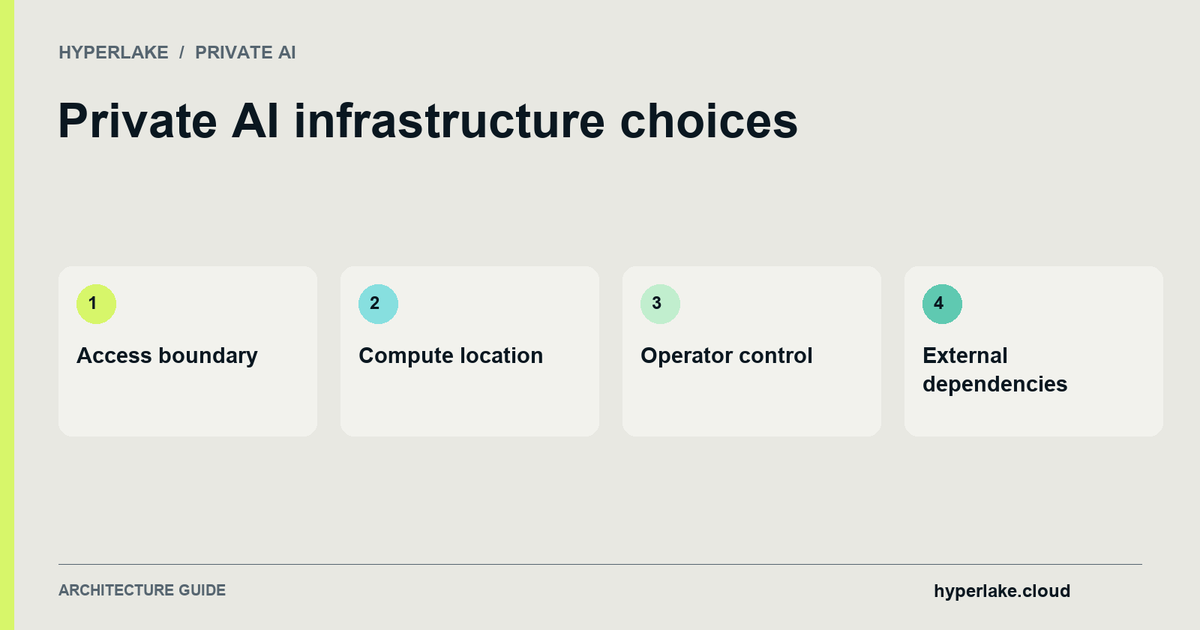
Enterprises should define the permitted data boundary first, then place inference, data services, agent state, access controls, and operational telemetry accordingly. Sensitive workloads may require on-premises infrastructure, private cloud, or a suitable sovereign cloud deployment where processing remains within the required jurisdiction and control model.
A practical design process includes four steps:
- Map the data flows. Trace prompts, retrieved context, documents, memory, model responses, logs, and tool calls across every service.
- Classify the information. Identify personal, regulated, confidential, or otherwise restricted data and the rules applying to it.
- Choose the execution boundary. Decide which workloads can use external services and which must run on infrastructure controlled by the organization or its client.
- Enforce and verify controls. Apply identity, policy, network isolation, scoped secrets, audit logging, and lifecycle procedures at the services handling data.
Keeping model inference within a jurisdiction can reduce cross-border transfer exposure, but location alone is insufficient. Teams must also evaluate provider control, key ownership, administrative access, subprocessors, backups, monitoring data, and failure procedures. An on-premises AI architecture can provide stronger infrastructure control when the workload and policy requirements justify it, but it still needs effective governance and operations.

Key takeaways
- Data sovereignty concerns legal authority over data, while data residency concerns its physical storage location.
- AI requests can transfer prompts, retrieved documents, context, metadata, and agent memory across jurisdictional boundaries.
- Agents increase sovereignty complexity because they accumulate information and interact with multiple services over time.
- Enterprises should treat sovereignty as an architectural requirement covering inference, data, identity, networking, logs, keys, and operational access.
- On-premises and suitable sovereign cloud deployments can reduce transfer exposure when their legal, technical, and operational controls match the workload.
How Hyperlake helps
Hyperlake lets teams assemble, deploy, and govern data, models, applications, and tools in infrastructure they or their clients control, while keeping their data, models, applications, and keys there. It supports deployments across public cloud, private cloud, and on premises, with shared controls for identity, network isolation, access policy, scoped secrets, audit, and lineage. To discuss the jurisdiction, data, policies, and deployment boundary for a specific workload, talk to our team.
Frequently asked questions
Does selecting a local cloud region guarantee data sovereignty?
No. A local region addresses physical residency, but sovereignty also depends on which legal entities operate the service, which laws apply to them, and who can access or transfer the data. Organizations should evaluate corporate jurisdiction, contracts, administrative access, key control, subprocessors, backups, and cross-border service dependencies.
Can an enterprise use hosted model APIs with regulated data?
Potentially, but the enterprise must assess each API request as a possible data transfer. The review should cover prompts, retrieved context, uploaded documents, logs, retention, provider access, processing locations, and downstream services. If those conditions conflict with legal or policy requirements, the workload may need private inference inside an approved environment.
Which parts of an AI system belong in a sovereignty review?
The review should cover the complete data path, including source systems, retrieval services, vector stores, model endpoints, agent memory, tool calls, caches, logs, evaluation systems, backups, and administrative interfaces. A database can remain local while prompts or context cross a border through another component, so reviewing storage alone is insufficient.
Is on-premises deployment always necessary for sovereign AI?
No. The appropriate environment depends on the workload, applicable jurisdiction, provider structure, data classification, and organizational policies. On-premises infrastructure offers direct control, while private cloud or a suitable sovereign cloud may also meet requirements when its legal, technical, and operational controls have been validated for the intended use.